数据与计算发展前沿 ›› 2025, Vol. 7 ›› Issue (6): 170-178.

CSTR: 32002.14.jfdc.CN10-1649/TP.2025.06.016

doi: 10.11871/jfdc.issn.2096-742X.2025.06.016

• 技术与应用 • 上一篇    下一篇

中小学人工智能教育综述

张森1(),褚铮2,黄松睿3,孟哲令1,*()   

  1. 1.中国科学院自动化研究所,北京 100190
    2.北京一零一中学,北京 100091
    3.天津市新华中学,天津 300203
  • 收稿日期:2025-09-08 出版日期:2025-12-20 发布日期:2025-12-17
  • 通讯作者: 孟哲令
  • 作者简介:张森,中国科学院自动化研究所,工程师,副研究馆员,主要从事科普相关工作等。
    本文承担工作为:提出中小学人工智能教育的核心科学问题,设计整体研究框架与调研方案;主导论文初稿的撰写与修改,并对最终版本内容负责。
    ZHANG Sen, an engineer and associate research fellow at the Institute of Automation, Chinese Academy of Sciences, mainly engages in science popularization work.
    In this paper, he is responsible for proposing the core scientific questions for AI education in primary and secondary schools, designing the overall research framework and survey plan; leading the drafting and revision of the manuscript, and being responsible for the content of the final version.
    E-mail: sen.zhang@ia.ac.cn|孟哲令,中国科学院自动化研究所,博士研究生,主要研究方向为多模态内容理解与生成。
    本文承担工作为:参与研究设计,完成数据的统计分析与结果解读。
    MENG Zheling is a Ph.D. student at the Institute of Automation, Chinese Academy of Sciences, with a main research focus on multimodal content understanding and generation.
    In this paper, he is responsible for participating in research design, completing statistical analysis of the data, and interpreting the results.
    E-mail: mengzheling2023@ia.ac.cn
  • 基金资助:
    国家自然科学基金(U23B2054)

A Review of Artificial Intelligence Education in Primary and Secondary Schools

ZHANG Sen1(),CHU Zheng2,HUANG Songrui3,MENG Zheling1,*()   

  1. 1. Institute of Automation, Chinese Academy of Sciences, Beijing 100190, China
    2. Beijing 101 High School, Beijing 100091, China
    3. Tianjin Xinhua High School, Tianjin 300203, China
  • Received:2025-09-08 Online:2025-12-20 Published:2025-12-17
  • Contact: MENG Zheling

摘要:

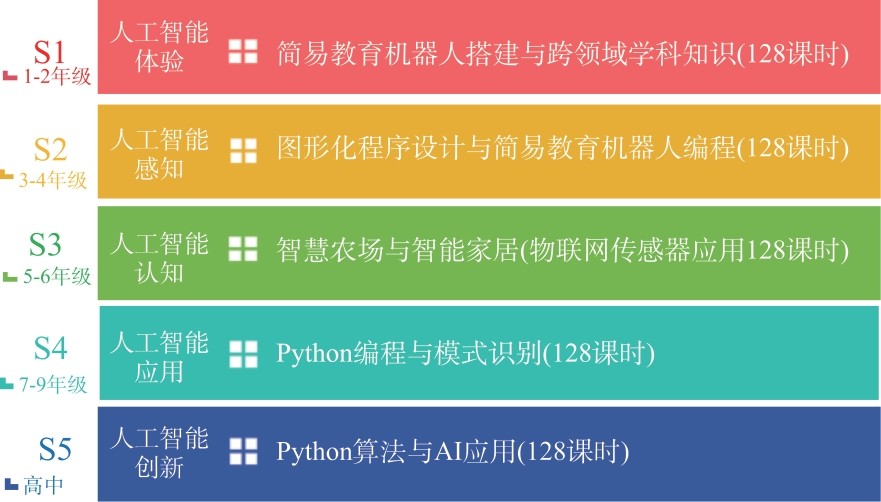
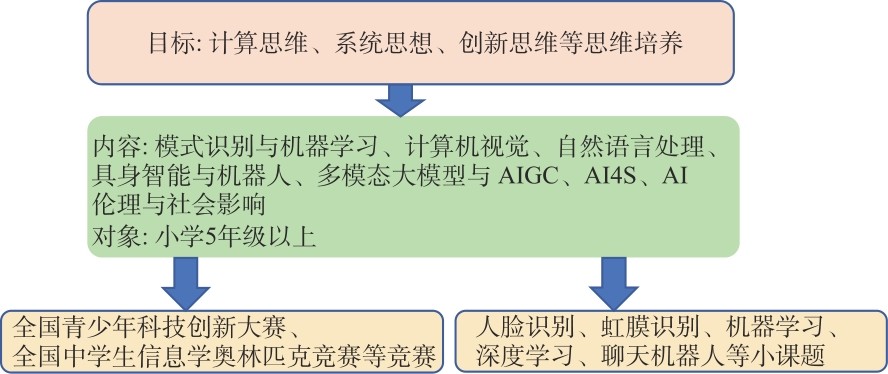
【目的】综述中小学人工智能教育以推动其高质量发展。【文献范围】梳理全球及国内外人工智能教育政策。【方法】以中国科学院自动化研究所开发的中小学人工智能教育课程作为案例分析,结合该课程体系在新疆多地的课程实践,反思现存问题并提出对策。【结果】说明中小学人工智能教育在政策制定、项目落地和理论构建上取得积极进展,形成了差异化课程体系。【局限】但仍存在区域发展不平衡、师资不足、评价机制不健全等局限性。【结论】中小学人工智能教育成效显著但挑战犹存,未来需聚焦实践案例挖掘、学科融合及教育公平研究,通过加强统筹规划、师资建设和评价机制完善,推动其向更高质量发展。

关键词: 中小学人工智能教育, 教育政策, 案例分析, 课程实践, 区域发展不平衡, 师资不足, 评价机制不健全

Abstract:

[Objective] This paper reviews Artificial Intelligence (AI) education in primary and secondary schools to promote its high-quality development. [Literature Scope] It examines AI education policies both globally and domestically. [Methods] Using the AI education curriculum for primary and secondary schools developed by the Institute of Automation, Chinese Academy of Sciences as a case study, combined with the curriculum practices in multiple regions of Xinjiang, existing problems are analyzed and countermeasures are proposed. [Results] It is shown that AI education in primary and secondary schools has made positive progress in policy formulation, project implementation, and theoretical construction, forming a differentiated curriculum system. [Limitations] However, there are still limitations, such as regional development imbalance, insufficient teaching staff, and incomplete evaluation mechanisms. [Conclusions] AI education in primary and secondary schools has achieved significant results, but still faces challenges. Future efforts should focus on exploring practical cases, interdisciplinary integration, and educational equity, and promote higher-quality development through strengthened overall planning, teacher training, and improved evaluation mechanisms.

Key words: primary and secondary school artificial intelligence education, education policy, case analysis, curriculum practice, regional development imbalance, insufficient teaching staff, incomplete evaluation mechanisms