Frontiers of Data and Computing ›› 2026, Vol. 8 ›› Issue (1): 103-118.
CSTR: 32002.14.jfdc.CN10-1649/TP.2026.01.009
doi: 10.11871/jfdc.issn.2096-742X.2026.01.009
• Technology and Application • Previous Articles Next Articles
PAN Yuquan1( ),YUAN Deyu1,2,*(),JIA Yuan1,WANG Anran1
Received:2025-02-22
Online:2026-02-20
Published:2026-02-02
Contact:
YUAN Deyu
E-mail:1870722711@qq.com;yuandeyu@ppsuc.edu.cn
PAN Yuquan,YUAN Deyu,JIA Yuan,WANG Anran. VGAT-VGAN Across Social Networks User Identity Linkage Algorithm Based on Fusion Features[J]. Frontiers of Data and Computing, 2026, 8(1): 103-118, https://cstr.cn/32002.14.jfdc.CN10-1649/TP.2026.01.009.
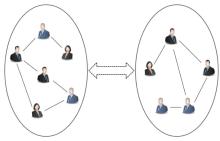
Fig.1
Friendship in social networks"
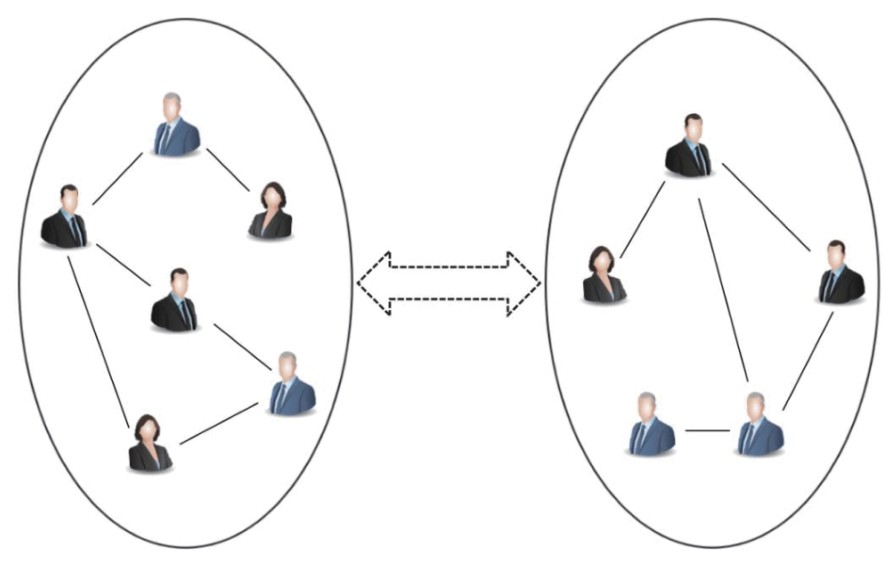
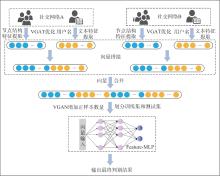
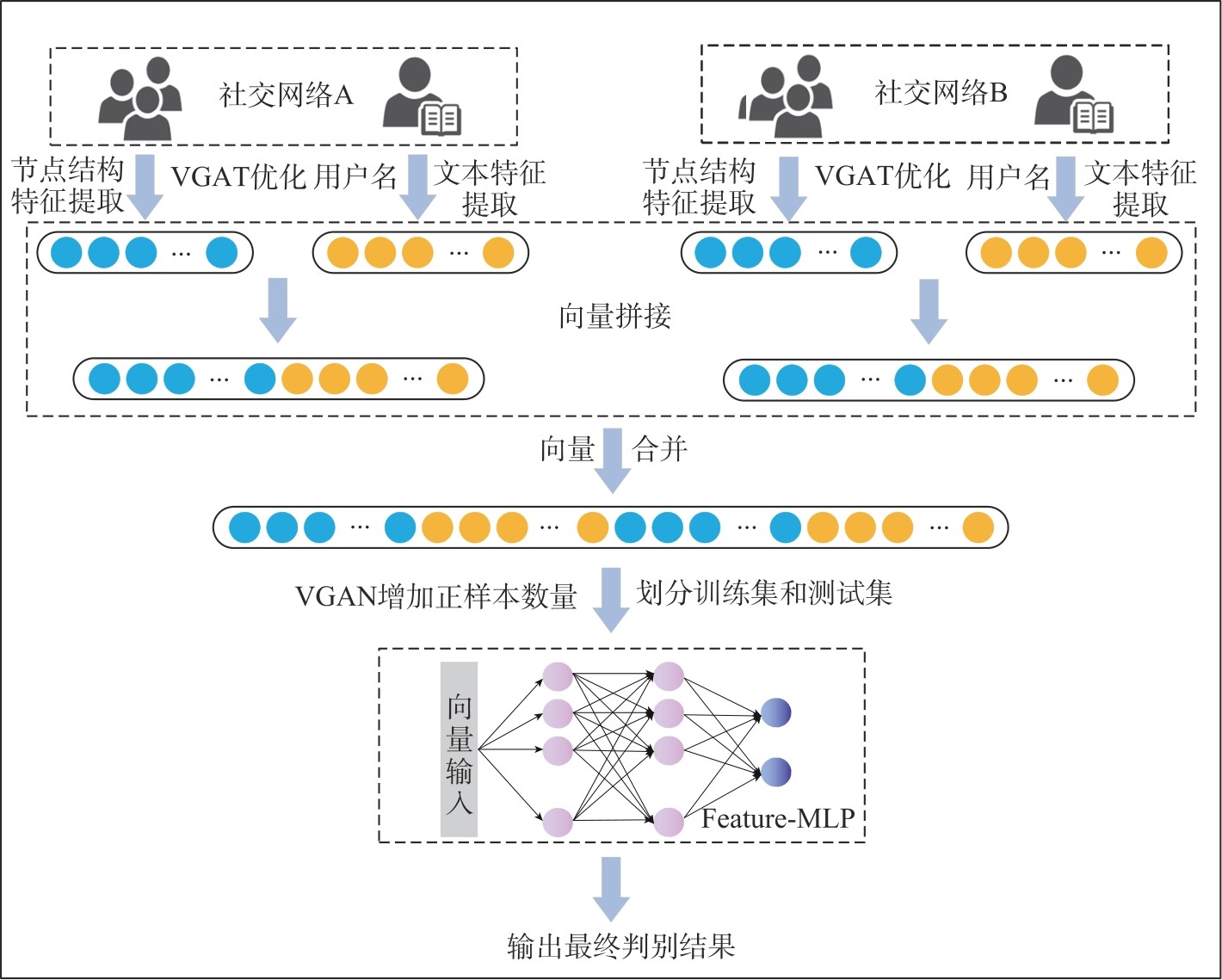
Fig.2
Flowchart of user identification algorithm"
Algorithm 1
FD-Struc2vec algorithm"
| 算法1: FD-Struc2vec算法 |
|---|
| Input: 社交网络关系图G. Output: 各用户的节点特征向量. Begin 将root添加到队列中,并标记为已访问 0 ← level while (quene>0) and (level ≦ max_layers) do count ← len(quene) if reduce_len then initialize deg_list 为字典 else initialize deg_list 为列表 end if whlie (count>0) do for 每一个节点 do 从队列中取出节点,并获取度数 end for if reduce_len then update deg_list else 将度数添加到deg_list end if for 邻居节点 do if 邻居未访问 then 标记为已访问并加入队列 end if end for count ← count - 1 if reduce_len then order_deg_list ← 将deg_list转换为有序列表 else order_deg_list ← 将deg_list排序 end if degree_seq ← order_deg_list level ← level + 1 end while end while return degree_seq for 每对结点( 获取 for neighbors中的每个节点 获取 计算有效层数max_layers for layer from 0 to max_layers do dtw_dist ← list_1[layer]和list_2[layer]的DTW距离 end for end for end for return dtw_dist //生成特征向量 execute biased_walk、random_work return embedding End |
Algorithm 2
DW-Word2vec algorithm"
| 算法2: DW-Word2vec算法 |
|---|
| Input: 用户名文本内容. Output: 每个用户名对应的文本特征向量. Begin execute preprocess_text、read_corpus //定义方法Deep_walks Input: 处理后的文本列表corpus、每个游走的长度walk_length. Output: 所有游走序列的列表walks. initialize for text in corpus do for walk from 0 to walk_length do start ← 随机起始索引 生成游走序列walk,从start开始,长度为walk_length walks ← append (walk) end for end for return walks //生成特征向量 train Word2vec (walks) return embedding End |
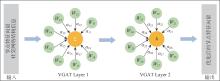
Fig.3
VGAT optimizes node feature vectors"
Fig.4
VGAN Increases the number of samples"
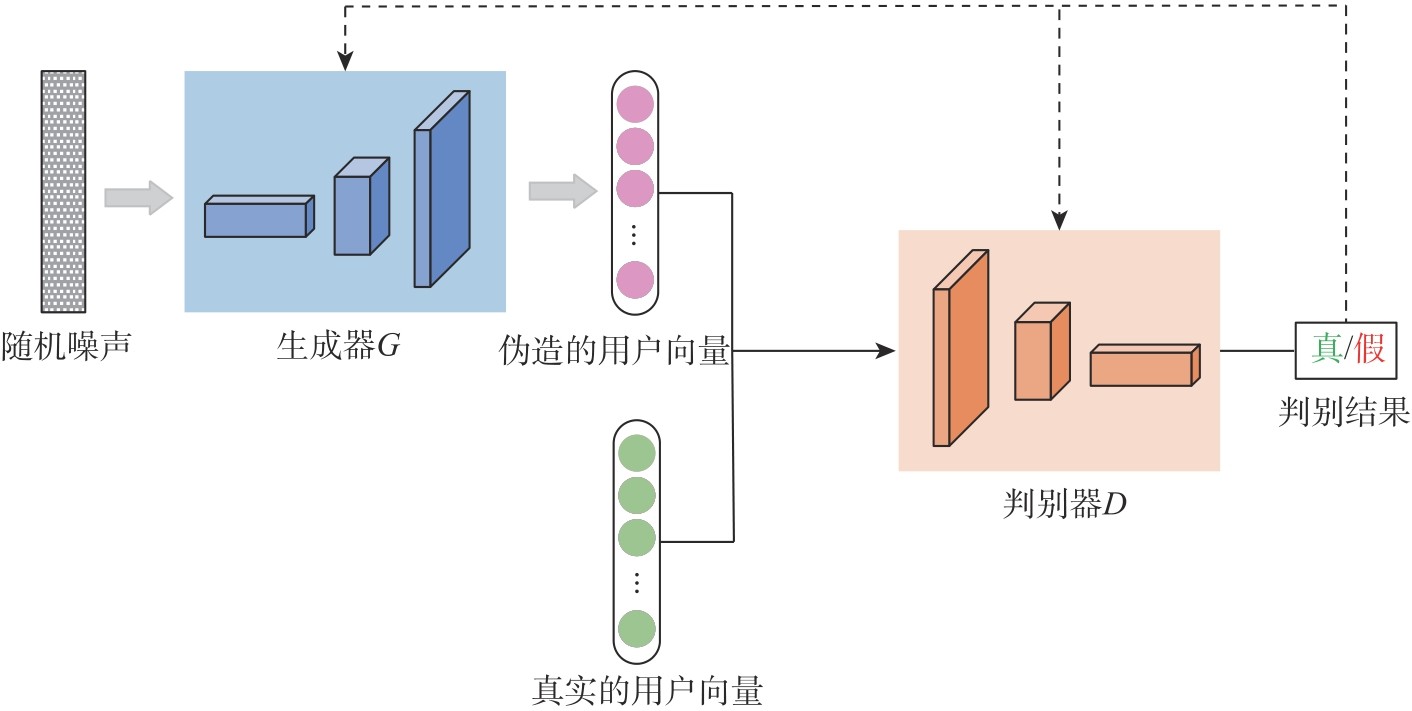
Table 1
Flickr-Lastfm information table"
| 状态 | 社交网络类型 | 节点数 | 边数 | 关联节点数 | 无关节点数 | 比值 |
|---|---|---|---|---|---|---|
| 处理前 | Flickr | 215,495 | 9,114,557 | 641 | 214,854 | 335.1856 |
| Lastfm | 136,420 | 1,685,524 | 641 | 135,957 | 212.1014 | |
| 处理后 | Flickr | 171,028 | 1,497,165 | 452 | 170,576 | 377.3805 |
| Lastfm | 136,409 | 1,685,469 | 452 | 135,779 | 300.3960 |
Table 2
Categories of similar user names"
| 序号 | Flickr用户名 | Lastfm用户名 | 相似类别 |
|---|---|---|---|
| 1 | karles | smkn | 完全不相同 |
| 2 | type_girl | type_girl | 完全相同 |
| 3 | lcfik | LCFik | 改变大小写 |
| 4 | griffey/jhench1638 | jgriffey/jhench | 添加字符串前缀/后缀 |
| 5 | apple | ^apple^ | 加入特殊符号 |
| 6 | clintonjeff | cj | 缩写 |
| 7 | -_-_-_- | =_=_=_= | 无法识别,需要替换 |
Table 3
Results of user identification model comparison"
| 身份关联算法 | P | R | |
|---|---|---|---|
| 本文算法 | 0.8514 | 0.8326 | 0.8419 |
| WLAlign | 0.7952 | 0.7471 | 0.7381 |
| PALE | 0.6897 | 0.6382 | 0.6630 |
| DeepLink | 0.7736 | 0.7324 | 0.7547 |
| CrossMNA | 0.7598 | 0.6783 | 0.7167 |
| B-GCN | 0.8037 | 0.7859 | 0.7947 |
| MNF-UI | 0.7712 | 0.7852 | 0.7781 |
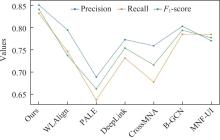
Fig.5
Results of user identification model comparison"
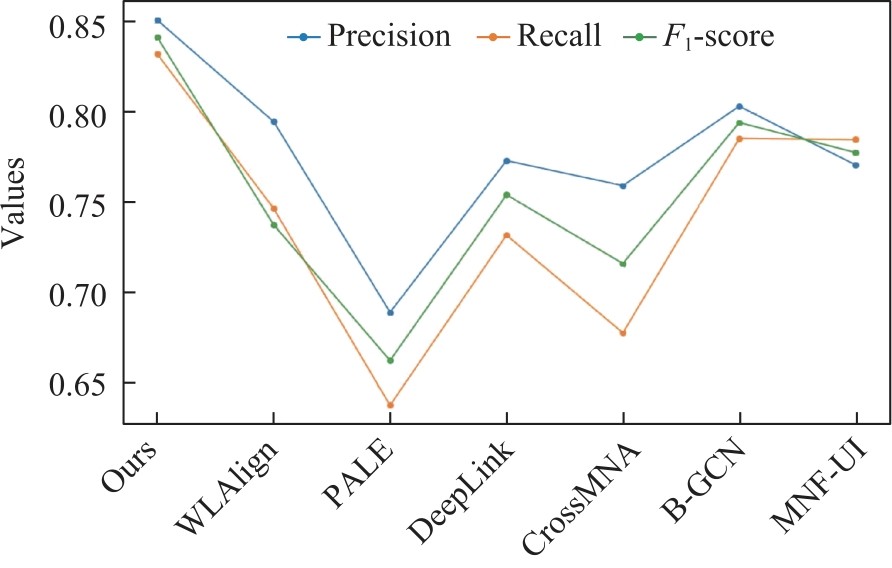
Table 4
Results of node embedding algorithm comparison"
| 节点嵌入算法 | P | R | |
|---|---|---|---|
| FD-Struc2vec | 0.7223 | 0.6854 | 0.7034 |
| Struc2vec | 0.6982 | 0.6521 | 0.6744 |
| Node2vec | 0.6728 | 0.6301 | 0.6508 |
| LINE | 0.6402 | 0.6007 | 0.6198 |
| Deepwalk | 0.6551 | 0.6298 | 0.6422 |
Table5
Results of word embedding algorithm comparison"
| 用户名来源(同一自然人) | 嵌入算法结果的相似度 | ||||
|---|---|---|---|---|---|
| Flickr | Lastfm | DW-Word2vec | Word2vec | GloVe | BERT |
| ine_ber | ineber | 0.8798 | 0.7812 | 0.6945 | 0.7461 |
| marcogomes | MARcoGomes | 0.8481 | 0.7680 | 0.7235 | 0.7656 |
| IPDpl | IpD*pk | 0.7471 | 0.6308 | 0.6412 | 0.6190 |
| Pvw2180 | pvw | 0.6249 | 0.5756 | 0.6188 | 0.5873 |
| editor | editor | 0.9306 | 0.8745 | 0.8529 | 0.8223 |
Table 6
Experimental results of weight factor"
| 序号 | a | b | P | R | |
|---|---|---|---|---|---|
| 1 | 0.55 | 0.45 | 0.7754 | 0.7458 | 0.7603 |
| 2 | 0.60 | 0.40 | 0.8121 | 0.7689 | 0.7899 |
| 3 | 0.65 | 0.35 | 0.8323 | 0.7854 | 0.8082 |
| 4 | 0.70 | 0.30 | 0.7556 | 0.7110 | 0.7326 |
Table 7
Results of ablation experiment"
| 实验序号 | VGAN | VGAT | Feature-MLP | P | R | |
|---|---|---|---|---|---|---|
| 1 | - | - | - | 0.6981 | 0.6521 | 0.6744 |
| 2 | + | - | - | 0.7224 | 0.6854 | 0.7034 |
| 3 | - | + | - | 0.7153 | 0.6758 | 0.6950 |
| 4 | - | - | + | 0.7301 | 0.7249 | 0.7275 |
| 5 | + | - | + | 0.8235 | 0.7762 | 0.7992 |
| 6 | - | + | + | 0.8027 | 0.7589 | 0.7802 |
| 7 | + | + | - | 0.7845 | 0.7271 | 0.7547 |
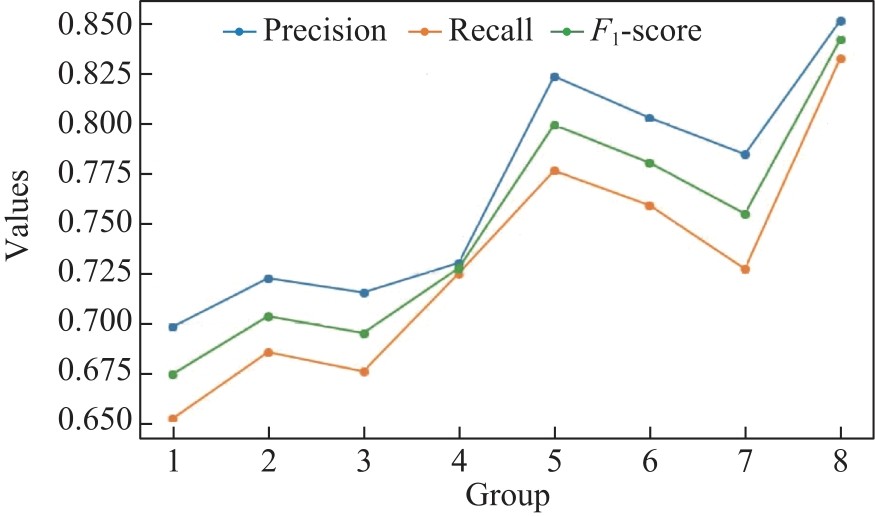
| 8 | + | + | + | 0.8514 | 0.8326 | 0.8419 |
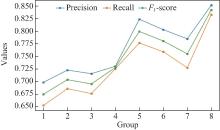
Fig.6
Results of ablation experiment"
| [1] | 张津, 郭艳光. 基于偏好逻辑的社交网络用户身份识别方法[J]. 计算机仿真, 2022, 39(4): 450-453. |
| [2] | KEIKHA M M, MASEUD R, MASOUD A. DeepLink: A novel link prediction framework based on deep learning[J]. Journal Of Information Science,2021: 642-657. |
| [3] |
王庚润. 网络空间用户身份对齐技术研究及应用综述[J]. 计算机科学, 2024, 51(5): 12-20.
doi: 10.11896/jsjkx.230300172 |
| [4] |
戴军, 马强. 基于用户签到的跨社交网络用户匹配[J]. 计算机工程与应用, 2023, 59(2): 76-84.
doi: 10.3778/j.issn.1002-8331.2203-0581 |
| [5] |
LI Y, PENG W, JI W, et al. User identification based on display names across online social networks[J]. IEEE Access, 2017, 5: 17342-17353.
doi: 10.1109/ACCESS.2017.2744646 |
| [6] |
QU Y, XING L, MA H, et al. Exploiting User Friendship Networks for User Identification Across Social Networks[J]. Symmetry, 2022, 14(1): 110.
doi: 10.3390/sym14010110 |
| [7] | 陈鸿昶, 徐乾, 黄瑞阳, 等. 一种基于用户轨迹的跨社交网络用户身份识别算法[J]. 电子与信息学报, 2018, 40(11): 2758-2764. |
| [8] | GAO X, JI W, LI Y, et al. User Identification with Spatiotemporal Awareness Across Social Networks[C]// Proceedings of the 27th ACM International Conference on Information and Knowledge Management, 2018. |
| [9] |
CHEN W, WANG W, YIN H, et al. HFUL: A Hybrid Framework for User Account Linkage Across Location Aware Social Networks[J]. The VLDB Journal, 2023, 32(1): 1-22.
doi: 10.1007/s00778-022-00730-8 |
| [10] | RIEDERER C, KIM Y, CHAINTREAU A, et al. Linking Users Across Domains With Location Data: Theory And Validation[C]// Proceedings of the 25th international conference on world wide web, 2016. |
| [11] | HALIMI A, AYDAY E. Profile Matching Across Online Social Networks[C]// Information and Communications Security:22nd International Conference, ICICS 2020, Copenhagen, Denmark,Springer International Publishing, 2020. |
| [12] | ZHOU F, WEN Z, ZHONG T, et al. Unsupervised User Identity Linkage via Graph Neural Networks[C]// 2020 IEEE Global Communications Conference: GLOBECOM2020, Taipei, Taiwan, China, 2020:2975-2980. |
| [13] |
ABBAS, ASH MOHAMMAD. Social Network Analysis Using Deep Learning: ApplicationsAnd Schemes[J]. Social Network Analysis and Mining, 2021, 11(1): 106.
doi: 10.1007/s13278-021-00799-z |
| [14] | LIU L, CHEN P, LI X, et al. Wlalign: Weisfeiler-lehman relabeling for aligning users across networks via regularized representation learning[J]. IEEE Transactions on Knowledge andData Engineering, 2023, 36(1): 445-458. |
| [15] | CHEN H, YIN H, SUN X, et al. Multi-levelgraph convolutional networks for cross-platform anchor link prediction[C]// Proceedings of the 26th ACM SIGKDD international conference on knowledge discovery & data mining. 2020. |
| [16] |
SHEN Y, JIANG X, LI Z, et al. UniSKGRep: A unified representation learning framework of social network and knowledge graph[J]. Neural Networks, 2023, 158: 142-153.
doi: 10.1016/j.neunet.2022.11.010 |
| [17] | ZHOU F, LIU L, ZHANG K, et al. Deeplink: A deep learning approach for user identity linkage[C]// IEEE INFOCOM 2018-IEEE Conference on computer communications. IEEE, 2018. |
| [18] | TRUNG H T, VAN VINH T, TAM N T, et al. Adaptive network alignment with unsupervised and multiorder convolutional networks[C]// 2020 IEEE 36th International Conference onData Engineering (ICDE). IEEE, 2020. |
| [19] |
LI X, CAO Y, LI Q, et al. RLINK: Deep Reinforcement Learning For User Identity Linkage[J]. World Wide Web, 2021, 24: 85-103.
doi: 10.1007/s11280-020-00833-8 |
| [20] | MAN T, SHEN H, LIU S, et al. Predict anchor links across social networks via an embedding approach[C]// Ijcai. 2016, 16: 1823-1829. |
| [21] | CHU X, FAN X, YAO D, et al. Cross-network embedding for multi-network alignment[C]// In The worldwide web conference, 2019: 273-284. |
| [22] |
ZHOU X, LIANG X, DU X, et al. Structure based user identification across social networks[J]. IEEE Transactions on Knowledge and Data Engineering, 2017, 30(6): 1178-1191.
doi: 10.1109/TKDE.69 |
| [23] | HUANG S, XIANG H, LENG C, et al. Cross-Social-Network User Identification Based on Bidirectional GCN and MNF-UI Models[J]. Electronics 2024, 13, 2351. |
| [24] |
CHEN W, WANG W, YIN H, et al. User Account Linkage Across Multiple Platforms With Location Data[J]. Journal of Computer Science and Technology, 2020, 35: 751-768.
doi: 10.1007/s11390-020-0250-7 |
| [25] | 袁烽. 跨社交网络用户身份识别关键技术研究[D]. 南京: 东南大学, 2022. |
| [26] |
QI M, WANG Z, HE Z, et al. User Identification Across Asynchronous Mobility Trajectories[J]. Sensors, 2019, 19(9): 2102.
doi: 10.3390/s19092102 |
| [27] | LI X, SHANG Y, CAO Y, et al. Type-Aware Anchor Link Prediction Across Heterogeneous Networks Based On Graph Attention Network[C]// Proceedings of the AAAI Conference on Artificial Intelligence, 2020. |
| [28] |
DING X, ZHANG H, MA C, et al. User Identification Across Multiple Social Networks Based On Naive Bayes Model[J]. IEEE Transactions on Neural Networks and Learning Systems, 2022, 35(3): 4274-4285.
doi: 10.1109/TNNLS.2022.3202709 |
| [29] | 吴劲, 陈树沛, 杨庆, 等. 基于图神经网络的用户轨迹分类[J]. 电子科技大学学报, 2021, 50(5): 734-740. |
| [30] | YANG J, ZHOU W, QIAN H, et al. Topic Sequence Embedding for User Identity Linkage from Heterogeneous Behavior Data[C].// ICASSP 2021-2021 IEEE International Conference on Acoustics, Speech and Signal Processing. IEEE, 2021: 2590-2594. |
| [31] | ZHANG Y, TANG J, YANG Z, et al. COSNET: Connecting Heterogeneous Social Networks with Local and Global Consistency[C]// Proceedings of the 21th ACM SIGKDD International Conference on Knowledge Discovery and Data Mining. 2015: 1485-1494. |
| [1] | CAI Yi,WANG Xiaobin,CHEN Ruili,HAN Xun. Review of Research on Gender and Age Detection of Writers Based on Handwriting [J]. Frontiers of Data and Computing, 2026, 8(1): 129-147. |
| [2] | WAN Meng, HE Honglin, REN Xiaoli, NIE Ningming, CAO Rongqiang, WANG Zongguo, LI Kai, WANG Xiaoguang, WANG Yangang, WANG Jue, GAO Chao. The Real-Time Assimilation and Prediction System for Terrestrial Ecosystem Carbon Cycling Based on Workflow [J]. Frontiers of Data and Computing, 2026, 8(1): 168-182. |
| [3] | DENG Yiru,HE Hongbo,WANG Ying,WANG Runqiang. Network Public Opinion Tendency Detection Method Based on Sentiment Analysis [J]. Frontiers of Data and Computing, 2026, 8(1): 91-102. |
| [4] | YANG Qinmeng,NIE Ningming,ZHOU Chunbao,WANG Yangang. Algorithm for Taylor Bar Collision Data Simulation Based on Deep Learning [J]. Frontiers of Data and Computing, 2025, 7(6): 101-110. |
| [5] | ZHOU Faguo,LIU Fang,WANG Yangang,WANG Jue,YU Miao,LI Shunde,ZHOU Chunbao,WANG Jing,YANG Qinmeng. Porting and Adapting Deep Learning Framework Operators on Domestic Supercomputers [J]. Frontiers of Data and Computing, 2025, 7(6): 136-148. |
| [6] | LINGHU Rongwei,ZHANG Yu,SHI Yuanquan,YANG Yujun. Multi-Feature Fusion-Based Detection and Classification of Portable Executable Malware [J]. Frontiers of Data and Computing, 2025, 7(6): 77-91. |
| [7] | XIN Yuhang,WANG Qiyi,SUN Jing,ZHAO Chunyan,LIU Yujia,LIANG Xue,CHEN Jie. Application of Radar Echo Extrapolation Based Model TrajCast on Domestic Accelerators for Short-Term and Imminent Precipitation Forecasting [J]. Frontiers of Data and Computing, 2025, 7(5): 113-122. |
| [8] | WANG Peng,YANG Xiaofeng,HE Zhongchen,DU Jun. Multispectral Remote Sensing Image Pansharpening Method Based on Shallow-Deep Convolutional Recurrent Neural Network [J]. Frontiers of Data and Computing, 2025, 7(5): 138-152. |
| [9] | ZENG Yan,WU Baofu,YI Guangzheng,HUANG Chengchuang,QIU Yang,CHEN Yue,WAN Jian,HU Fan,JIN Sicong,LIANG Jiajun,LI Xin. FlowAware: A Feature-Aware Automated Model Parallelization Method for AI-for-Science Tasks [J]. Frontiers of Data and Computing, 2025, 7(5): 65-87. |
| [10] | JIA Ziang. Teeth Structure Segmentation Based on Multi-Source Semi-Supervised Learning [J]. Frontiers of Data and Computing, 2025, 7(2): 175-185. |
| [11] | LI Yong,REN Yongmao,YIN Zhuoran,ZHOU Xu. A Lightweight Traffic Identification Model Based on Deep Learning [J]. Frontiers of Data and Computing, 2025, 7(2): 3-11. |
| [12] | MA Qiuping, ZHANG Qi, ZHAO Xiaofan. Review of Research on Chart Question Answering [J]. Frontiers of Data and Computing, 2025, 7(1): 19-37. |
| [13] | SHUI Yingyi, ZHANG Qi, LI Gen, ZHANG Shihao, WU Shang. A Review of Research on Social Network Influence Prediction Based on Multi-Class Features [J]. Frontiers of Data and Computing, 2025, 7(1): 2-18. |
| [14] | JIN Jiali, GAO Siyuan, GAO Manda, WANG Wenbin, LIU Shaozhen, SUN Zhenan. A Survey of Face Age Editing Based on Generative Adversarial Networks and Diffusion Models [J]. Frontiers of Data and Computing, 2025, 7(1): 38-55. |
| [15] | LU Chenghao,CHEN Xiuhong. IPDFF: Reconstructed Surface Network Based on Implicit Partition Learning Deep Feature Fusion [J]. Frontiers of Data and Computing, 2024, 6(6): 19-31. |
| Viewed | ||||||
|
Full text |
|
|||||
|
Abstract |
|
|||||

