Frontiers of Data and Computing ›› 2026, Vol. 8 ›› Issue (5): 61-71.
CSTR: 32002.14.jfdc.CN10-1649/TP.2026.05.005
doi: 10.11871/jfdc.issn.2096-742X.2026.05.005
• Special Issue: ORISE Supercomputing Application • Previous Articles Next Articles
YANG Yufan1,2( ),LI Dongxiang1,*(),ZHOU Peng2,*()
Received:2026-03-19
Online:2026-10-20
Published:2026-10-20
YANG Yufan, LI Dongxiang, ZHOU Peng. Advances and Prospect of Computer-Aided Technology in Predicting the Properties of Glass Materials[J]. Frontiers of Data and Computing, 2026, 8(5): 61-71, https://cstr.cn/32002.14.jfdc.CN10-1649/TP.2026.05.005.
Table 1
Classification of descriptors"
| 类别 | 主要信息 | 示例 |
|---|---|---|
| 1D 描述符[ | 元素组成及统计特征 | 原子序数、原子质量、原子半径、化学计量比、偶极极化率 |
| 2D 描述符[ | 原子连接关系和局域网络结构 | 配位数、键角分布、环 统计 |
| 3D 描述符[ | 原子的空间和能量信息 | 密度、自由体积、径向分布函数、内聚能 |
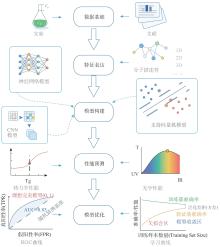
Fig.1
Machine learning methods predict the properties of glass materials"
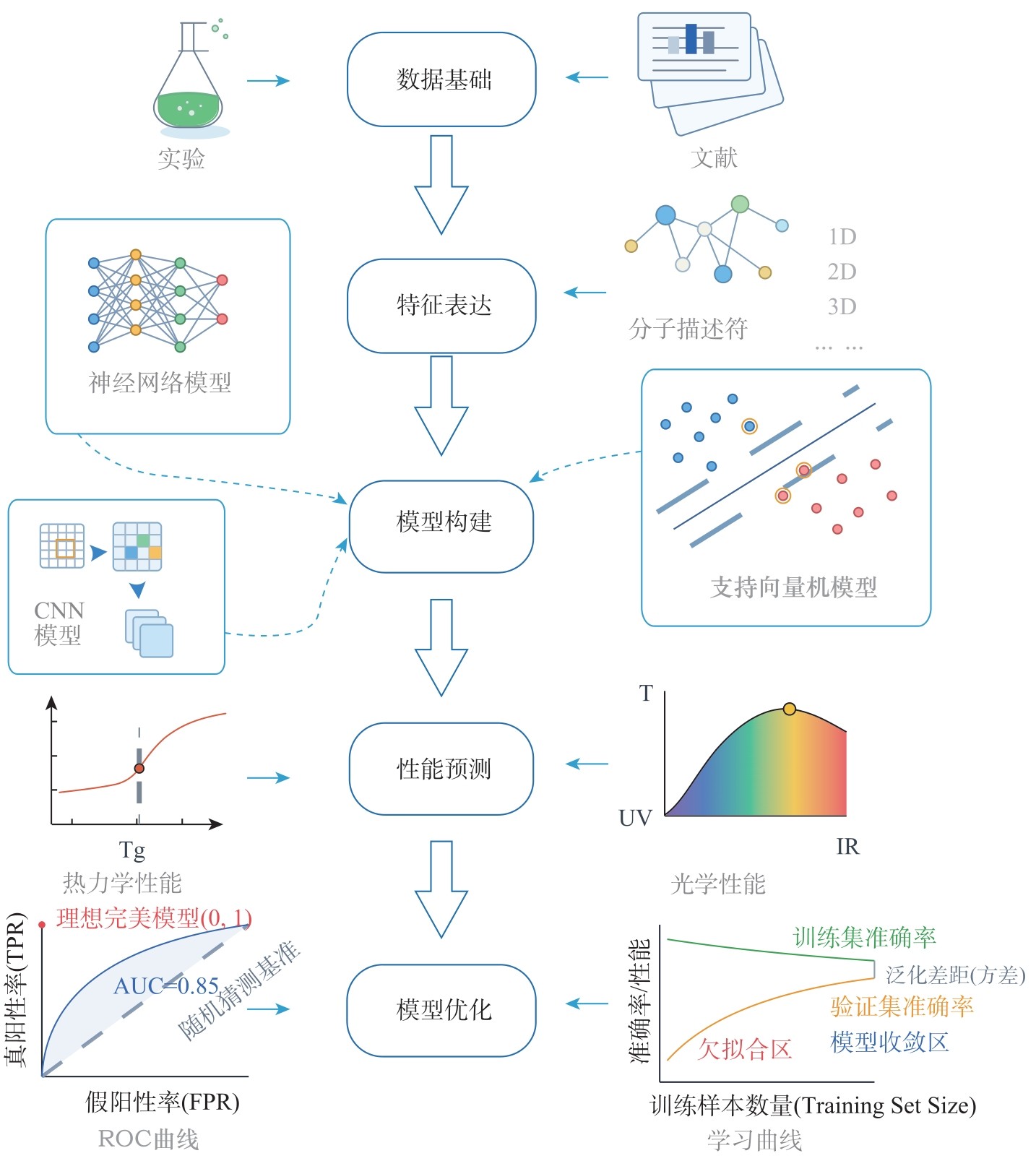
Table 2
Performance comparison of different ML algorithms in Tg prediction"
| 算法 | RMSE | R2 | 性能比较 |
|---|---|---|---|
| RF | 30 K | 0.96 | 表现最佳,稳健性高 |
| k-NN | 33 K | 0.95 | 在极端Tg区间表现最优 |
| CatBoost | 36 K | 0.94 | 精度较高,可解释性高 |
| CART | 43 K | 0.92 | 模型直观,但精度有限 |
| MLP | 35 K | 0.95 | 非线性拟合能力强,可解释性不足 |
| SVM | 44 K | 0.92 | 弱于RF和k-NN |
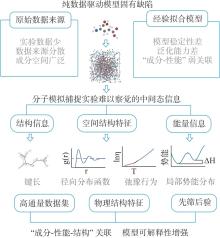
Fig.2
Molecular dynamics simulation aiding machine learning"
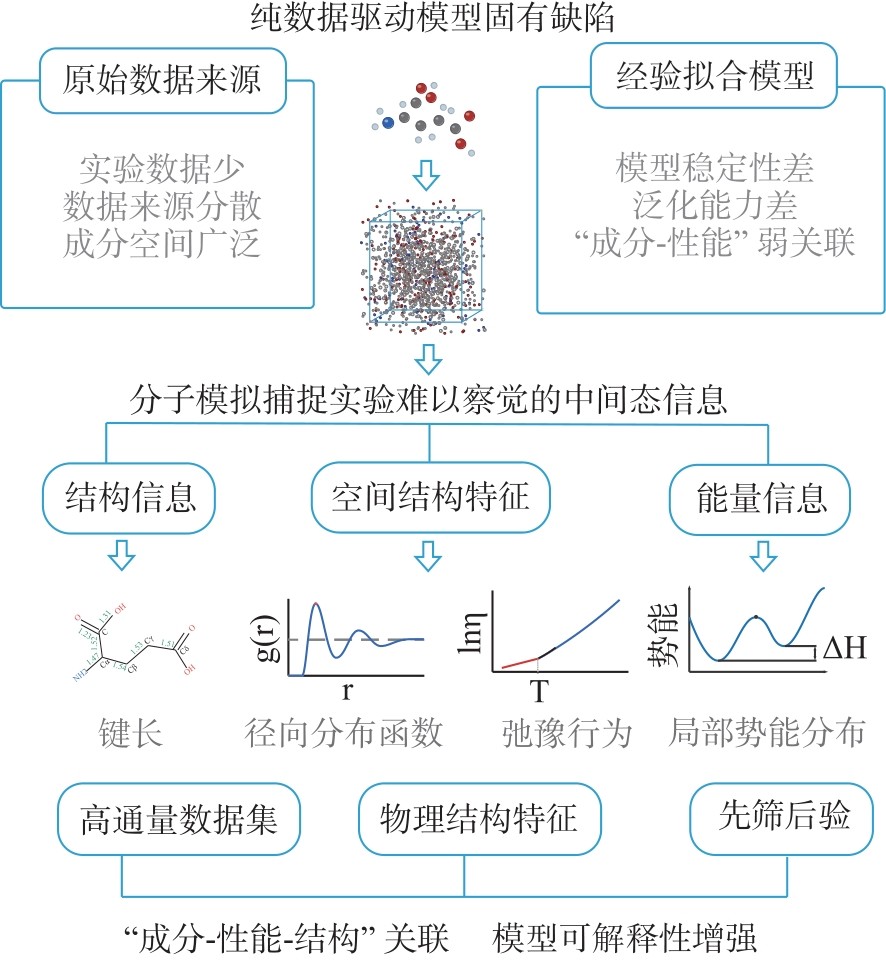
Fig.3
Technological evolution and future pathways of glass material design"
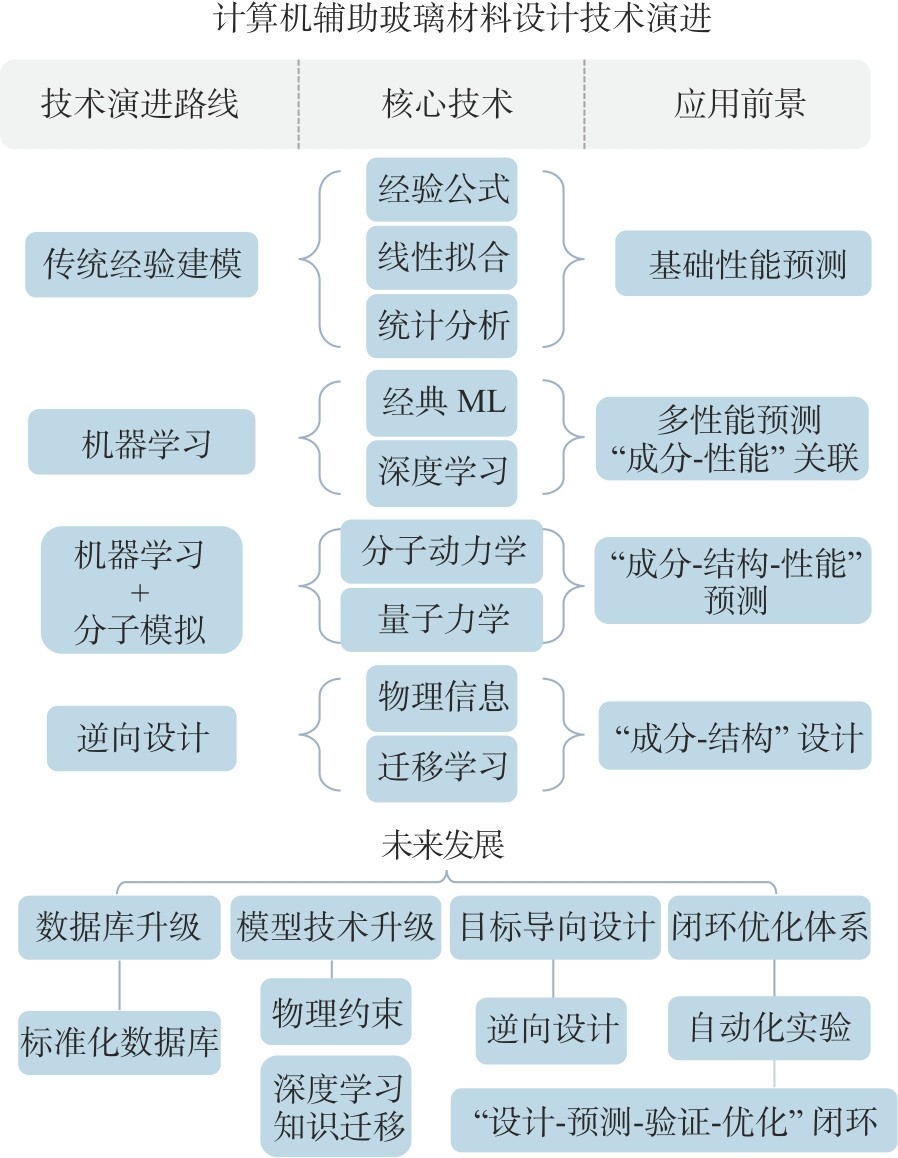
Table 3
Comparison of computer-aided methods for glass research"
| 方法分类 | 典型用途 | 核心优势 | 局限与瓶颈 |
|---|---|---|---|
| 传统ML | Tg/密度/硬度预测 | 训练快;小样本友好 | 泛化能力弱;依赖人工特征工程 |
| DL与生成式模型 | 多性质预测;数据增强 | 自动提取高维特征;支持逆向设计 | 可解释性不足;易过拟合或模式崩塌 |
| ML与分子模拟耦合 | 特征提取/联合筛选 | 物理机制明确;泛化能力强 | 计算耗时长;耦合难度大 |
| [1] | SINGH J, SINGH S. A review on Machine learning aspect in physics and mechanics of glasses[J]. Materials Science and Engineering: B, 2022, 284: 115858. |
| [2] | MAURO J C. Decoding the glass genome[J]. Current Opinion in Solid State and Materials Science, 2018, 22(2): 58-64. |
| [3] | ZHANG L, ZHANG H, JI B, et al. Application of machine learning in amorphous alloys[J]. Materials, 2025, 18(8): 1771. |
| [4] | LIU H, FU Z, YANG K, et al. Machine learning for glass science and engineering: a review[J]. Journal of Non-Crystalline Solids, 2021, 557: 119419. |
| [5] | CASSAR D R, MASTELINI S M, BOTARI T, et al. Predicting and interpreting oxide glass properties by machine learning using large datasets[J]. Ceramics International, 2021, 47(17): 23958-23972. |
| [6] | CASSAR D R. GlassNet: a multitask deep neural network for predicting many glass properties[J]. Ceramics International, 2023, 49(22, Part B): 36013-36024. |
| [7] | RAVINDER R, SRIDHARA K H, BISHNOI S, et al. Deep learning aided rational design of oxide glasses[J]. Materials Horizons, 2020, 7(7): 1819-1827. |
| [8] | ZANOTTO E D, MAURO J C. The glassy state of matter: Its definition and ultimate fate[J]. Journal of Non-Crystalline Solids, 2017, 471: 490-495. |
| [9] | DANEWALIA S S, SINGH K. An improved machine learning strategy using structural features to predict the glass transition temperature of oxide glasses[J]. Digital Discovery, 2025, 4(12): 3764-3773. |
| [10] | VENUGOPAL V, SAHOO S, ZAKI M, et al. Looking through glass: knowledge discovery from materials science literature using natural language processing[J]. Patterns, 2021, 2(7): 100290. |
| [11] | CASSAR D R, DE CARVALHO A C P L F, ZANOTTO E D. Predicting glass transition temperatures using neural networks[J]. Acta Materialia, 2018, 159: 249-256. |
| [12] | ALCOBAÇA E, MASTELINI S M, BOTARI T, et al. Explainable Machine Learning Algorithms For Predicting Glass Transition Temperatures[J]. Acta Materialia, 2020, 188: 92-100. |
| [13] | SHIH Y T, SHI Y, HUANG L. Predicting glass properties by using physics- and chemistry-informed machine learning models[J]. Journal of Non-Crystalline Solids, 2022, 584: 121511. |
| [14] | BAUCHY M. Deciphering the atomic genome of glasses by topological constraint theory and molecular dynamics: a review[J]. Computational Materials Science, 2019, 159: 95-102. |
| [15] | PEI H W, ZHU Y L, LU Z Y, et al. Automatic multiscale method of building up a cross-linked polymer reaction system: bridging SMILES to the multiscale molecular dynamics simulation[J]. Journal of Physical Chemistry B, 2023, 127(21): 4905-4914. |
| [16] | ZHANG Y, BERTANI M, PEDONE A, et al. Decoding crystallization behavior of aluminoborosilicate glasses: From structural descriptors to Quantitative Structure-Property Relationship (QSPR) based predictive models[J]. Acta Materialia, 2024, 268: 119784. |
| [17] | ARENDT F, LIMBACH R, WONDRACZEK L, et al. Enhancing glass property predictions through ab initio-derived descriptors[J]. Journal of the American Ceramic Society, 2024, 107(9): 5841-5853. |
| [18] | LIU J, LIU H, CHEN H, et al. Progress and challenges toward the rational design of oxygen electrocatalysts based on a descriptor approach[J]. Advanced Science, 2020, 7(1): 1901614. |
| [19] | CUI T, LIU H, LIU X, et al. Interpreting Molecular Descriptors for Glass Transition Temperature Prediction and Design of Polyimides[J]. Materials, 2025, 18(24): 5541. |
| [20] | GAURAV A, BAKHT P, SAINI M, et al. Role of bacterial efflux pumps in antibiotic resistance, virulence, and strategies to discover novel efflux pump inhibitors[J]. Microbiology, 2023, 169(5): 001333. |
| [21] | JIAO S, FU X, HUANG H. Descriptors for the Evaluation of Electrocatalytic Reactions: d-Band Theory and Beyond[J]. Advanced Functional Materials, 2022, 32(4): 2107651. |
| [22] | MA Y, XU P, LI M, et al. The mastery of details in the workflow of materials machine learning[J]. npj Computational Materials, 2024, 10(1): 141. |
| [23] | LI M, DAI L, HU Y. Machine Learning for Harnessing Thermal Energy: From Materials Discovery to System Optimization[J]. ACS Energy Letters, 2022, 7(10): 3204-3226. |
| [24] | DENG B. Machine learning on density and elastic property of oxide glasses driven by large dataset[J]. Journal of Non-Crystalline Solids, 2020, 529: 119768. |
| [25] | MANNAN S, ZAKI M, BISHNOI S, et al. Glass hardness: Predicting composition and load effects via symbolic reasoning-informed machine learning[J]. Acta Materialia, 2023, 255: 119046. |
| [26] | GARG P, BRODERICK S, MAZUMDER B. Machine learning-based accelerated design of fluorphlogopite glass ceramic chemistries with targeted hardness[J]. Journal of the American Ceramic Society, 2023, 106(8): 4654-4663. |
| [27] | HU Y J, ZHAO G, ZHANG M, et al. Predicting densities and elastic moduli of SiO2-based glasses by machine learning[J]. npj Computational Materials, 2020, 6(1): 25. |
| [28] | MASTELINI S M, CASSAR D R, ALCOBAÇA E, et al. Machine learning unveils composition-property relationships in chalcogenide glasses[J]. Acta Materialia, 2022, 240: 118302. |
| [29] | BISHNOI S, SINGH S, RAVINDER R, et al. Predicting young’s modulus of oxide glasses with sparse datasets using machine learning[J]. Journal of Non-Crystalline Solids, 2019, 524: 119643. |
| [30] | JAFARI A, MOLLAALI M, MA L, et al. Brittle fracture strength prediction via XML with reliability considerations[J]. Engineering Fracture Mechanics, 2025, 328: 111555. |
| [31] | LI J, SHEN J, DONG Z, et al. Prediction of glass refractive index based on a multi-algorithm stacked integration model[J]. Journal of Non-Crystalline Solids, 2025, 666: 123681. |
| [32] | LIU C, SU H. Prediction of optical properties of oxide glass combined with autoencoder and machine learning[J]. Journal of Non-Crystalline Solids, 2024, 642: 123166. |
| [33] | TIAN J, LI Y, GUAN M, et al. Data-augmented machine learning models for oxynitride glasses via wasserstein generative adversarial network with gradient penalty and content constraint[J]. Journal of Materiomics, 2026, 12(1): 101111. |
| [34] | PARK N, MOHAMMADI M, GORDE K, et al. Data synthesis based on generative adversarial networks[J]. Proc. VLDB Endow., 2018, 11(10): 1071-1083. |
| [35] | WANG L, YOU J, WANG B, et al. Interpretable machine learning for predicting properties of multi-component oxide glasses and experimental validation[J]. Ceramics International, 2025, 51(20, Part A): 30604-30617. |
| [36] | LU X, DU J. Quantitative structure-property relationship (QSPR) analysis of calcium aluminosilicate glasses based on molecular dynamics simulations[J]. Journal of Non-Crystalline Solids, 2020, 530: 119772. |
| [37] | YANG K, XU X, YANG B, et al. Predicting the young’s modulus of silicate glasses using high-throughput molecular dynamics simulations and machine learning[J]. Scientific Reports, 2019, 9(1): 8739. |
| [38] | ALENCAR V F S, OLIVEIRA J C A, PEREIRA A S, et al. Molecular simulation and machine learning tools to predict bioglass modulus of elasticity[J]. Journal of Non-Crystalline Solids, 2023, 618: 122507. |
| [39] | XING J, QIAO A, WU F, et al. Compositional design of oxide glass with multi-target performances[J]. Journal of Non-Crystalline Solids, 2025, 664: 123613. |
| [40] | ZHU L, YANG T, LI S, et al. Experimental investigation and prediction of chemical etching kinetics on mask glass using random forest machine learning[J]. Chemical Engineering Research and Design, 2025, 213: 309-318. |
| [41] | WANG Q, ZHANG L. Inverse design of glass structure with deep graph neural networks[J]. Nature Communications, 2021, 12(1): 5359. |
| [42] | LUNDBERG S M, LEE S I. A unified approach to interpreting model predictions[C]//Proceedings of the 31st International Conference on Neural Information Processing Systems. Red Hook, NY, USA: Curran Associates Inc., 2017: 4768-4777. |
| [43] | ZHANG T, LONG Z, PENG L, et al. Prediction of glass forming ability of bulk metallic glasses based on convolutional neural network[J]. Journal of Non-Crystalline Solids, 2022, 595: 121846. |
| [44] | TIAN J, ZHAO Y, HUANG Y, et al. Theoretical Prediction of Vickers Hardness for Oxide Glasses: Machine Learning Model, Interpretability Analysis, and Experimental Validation[J]. Materialia, 2024, 33: 102006. |
| [45] | NOH J, KIM J, STEIN H S, et al. Inverse design of solid-state materials via a continuous representation[J]. Matter, 2019, 1(5): 1370-1384. |
| [46] | DUVAL A, ROBIN E, HOUIZOT P, et al. Inverse design of high-performance glasses through an encoder-decoder machine learning approach toward materials discovery: application to oxynitride glasses[J]. Acta Materialia, 2026, 306: 121882. |
| [47] | LIU H, ZHANG T, ANOOP KRISHNAN N M, et al. Predicting the dissolution kinetics of silicate glasses by topology-informed machine learning[J]. npj Materials Degradation, 2019, 3(1): 32. |
| [1] | MA Le, ZHANG Ran, HAN Yikun, YU Shirui, WANG Zaitian, NING Zhiyuan, ZHANG Jinghan, XU Ping, LI Pengjiang, QIAO Ziyue, JU Wei, CHEN Chong, WANG Dongjie, LIU Kunpeng, WANG Pengyang, WANG Pengfei, FU Yanjie, LIU Chunjiang, LYU Changtian. A Comprehensive Survey on Vector Database: Storage and Retrieval Techniques [J]. Frontiers of Data and Computing, 2026, 8(4): 42-71. |
| [2] | CAI Yi,WANG Xiaobin,CHEN Ruili,HAN Xun. Review of Research on Gender and Age Detection of Writers Based on Handwriting [J]. Frontiers of Data and Computing, 2026, 8(1): 129-147. |
| [3] | FENG Wenjun,ZHANG Zhengjun,WANG Yiming. Jump Information, Machine Learning Models, and Realized Volatility Forecasting [J]. Frontiers of Data and Computing, 2026, 8(1): 45-63. |
| [4] | JI Peng,NIU Tie,WEI Ting,PENG Liang. Research on Supercomputer Job Running State Prediction Based on XGBoost Model [J]. Frontiers of Data and Computing, 2024, 6(6): 123-129. |
| [5] | ZHANG Bin,LI Chen,LU Zhonghua. A Survey of Research on Risk Factors in the Chinese Stock Market [J]. Frontiers of Data and Computing, 2024, 6(6): 146-159. |
| [6] | LONG Chun, LI Lisha, LI Jing, YANG Fan, WEI Jinxia, Fu Yuhao. Review of Research on Secure Inference in Machine Learning [J]. Frontiers of Data and Computing, 2024, 6(5): 1-12. |
| [7] | GUO Xuebing, ZHU Xiaojie, TANG Xinzhai, YANG Gang, HOU Yanfei, HE Honglin. Study on Integration Method of Algorithm Model Based on Big Data Pipeline— Taking Tree Biomass Inversion Based on Machine Learning Method and LiDAR Data as an Example [J]. Frontiers of Data and Computing, 2024, 6(4): 96-105. |
| [8] | HE Ruilin, YANG Xinyi, SUN Hongzan, LI Chen. The Latest Development and Prospects of Histopathological Image Analysis Methods Based on Graph Features [J]. Frontiers of Data and Computing, 2024, 6(2): 101-116. |
| [9] | YE Xu, DU Yi, CUI Wenjuan, SHEN Junjie, XIE Jing, WANG Ludi. Application of Machine Learning Technology in the Field of Eye Health [J]. Frontiers of Data and Computing, 2024, 6(2): 117-133. |
| [10] | SHEN Zhihao, LI Na, YIN Shihao, DU Yi, HU Lianglin. Airfare Price Prediction Based on TPA-Transformer [J]. Frontiers of Data and Computing, 2023, 5(6): 115-125. |
| [11] | WEI Ting, PENG Liang, NIU Tie, ZHANG Honghai. Detection and Root Cause Analysis of HPC Failure Jobs Based on Feature Analysis [J]. Frontiers of Data and Computing, 2023, 5(6): 94-103. |
| [12] | SUN Yifan, ZHANG Rui, TAO Yang, GAO Birou, QIN Shihan, AN Chao. A Survey on Local Differential Privacy [J]. Frontiers of Data and Computing, 2023, 5(5): 74-97. |
| [13] | TIAN Yiqing, CHENG Xi, FENG Bojing. A Review of Computational Models for Corporate Credit Rating [J]. Frontiers of Data and Computing, 2023, 5(4): 139-153. |
| [14] | CHEN Meilin, LIU Duanyang, XU Liming, WANG Yang. A Review of Force Field Models Based on Machine Learning [J]. Frontiers of Data and Computing, 2023, 5(4): 27-37. |
| [15] | LIU Duanyang, WEI Zhongming. Application of Supervised Learning Algorithms in Materials Science [J]. Frontiers of Data and Computing, 2023, 5(4): 38-47. |
| Viewed | ||||||
|
Full text |
|
|||||
|
Abstract |
|
|||||

