Frontiers of Data and Computing ›› 2026, Vol. 8 ›› Issue (2): 184-203.
CSTR: 32002.14.jfdc.CN10-1649/TP.2026.02.014
doi: 10.11871/jfdc.issn.2096-742X.2026.02.014
• Technology and Application • Previous Articles Next Articles
XU Huangchao1,2( ),ZHANG Baohua1,*(),LIU Qian1,JIN Zhong1,*()
Received:2025-08-08
Online:2026-04-20
Published:2026-04-23
XU Huangchao, ZHANG Baohua, LIU Qian, JIN Zhong. A Review on AI-Driven Methods and Data Resources for Molecule Generation[J]. Frontiers of Data and Computing, 2026, 8(2): 184-203, https://cstr.cn/32002.14.jfdc.CN10-1649/TP.2026.02.014.
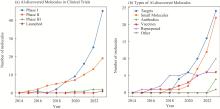
Fig.1
Statistics on the number and types of AI-discovered molecules entering clinical trials"
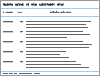
Table 1
Statistical details of molecule generation-related datasets"
| 分类 | 数据集 | 数据规模 | 原始数据格式 | 访问途径 |
|---|---|---|---|---|
| 小分子数据 | ZINC | 37 B | SMILES、SDF | |
| ChEMBL | 22.7 M | SMILES、InChI | | |
| PubChem | 750 M | SMILES、SDF | | |
| Enamine REAL | 10 B | SMILES、SDF | | |
| DrugBank | 1.5 M | SMILES、MOL、SDF | | |
| ChemDiv | 1.6 M | SMILES、SDF | | |
| 蛋白质和复合物数据 | RCSB PDB | 238 K | Experimental PDB | |
| AlphaFoldDB | 200 M | Predicted PDB | | |
| UniProt | 250 M | Sequence Entry | | |
| PDBBind | 35 K | PDB、SDF | | |
| Crossdocked | 22.5 M | PDB、SDF | | |
| KLIFS | 6 K | PDB、SDF | | |
| BindingDB | 1.2 M | SMILES、Sequence | | |
| 基准评估 数据 | MoleculeNet | 700 K | SMILES | |
| MOSES | 1.9 M | SMILES | | |
| GuacaMol | / | SMILES、MD5 | | |
| TDC | / | SMILES、PDB | | |
| ADMET Lab | 400 K | SMILES | |
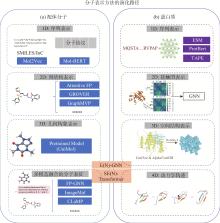
Fig.2
Evolutionary path of molecular and protein representation methods"
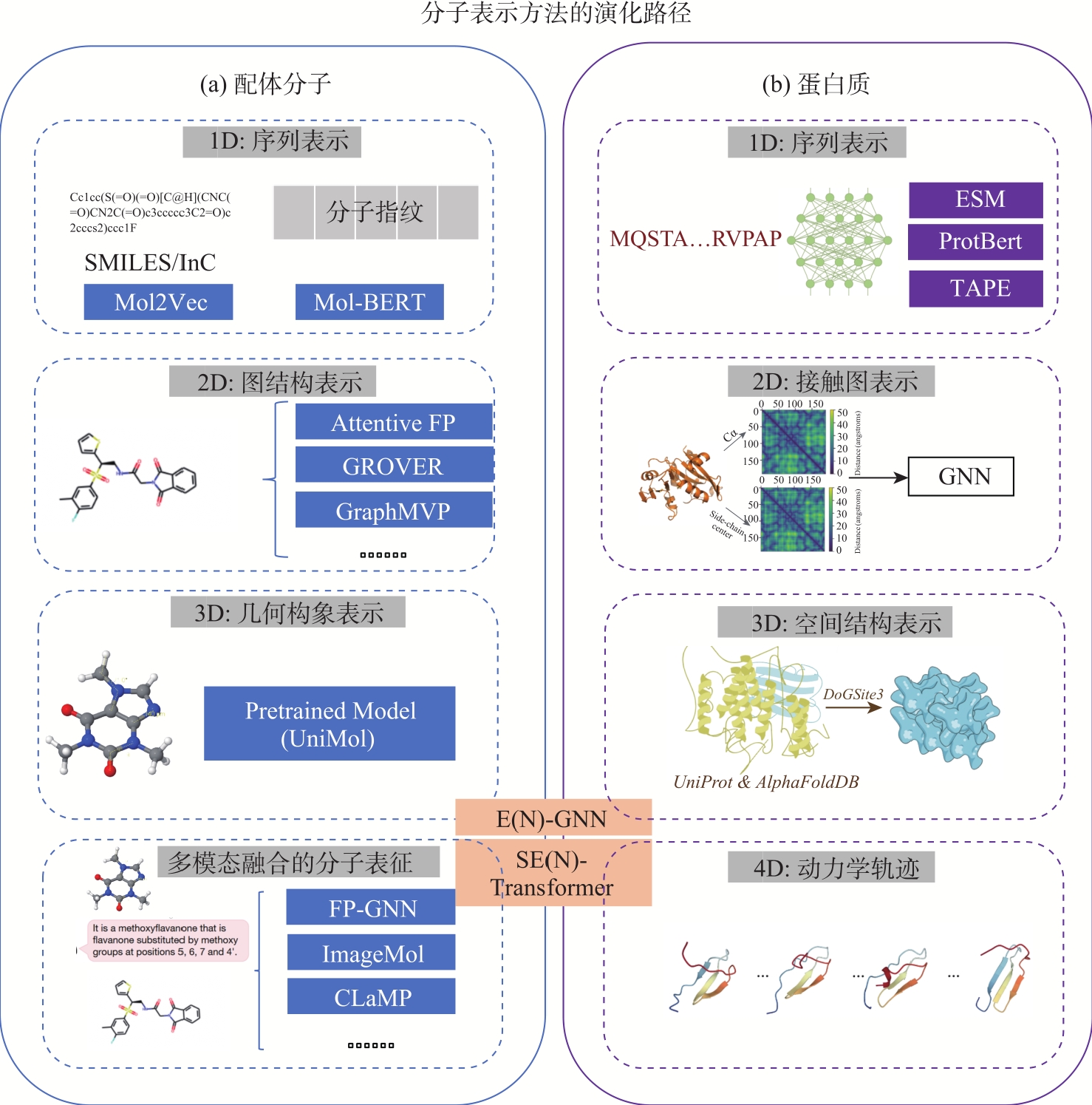
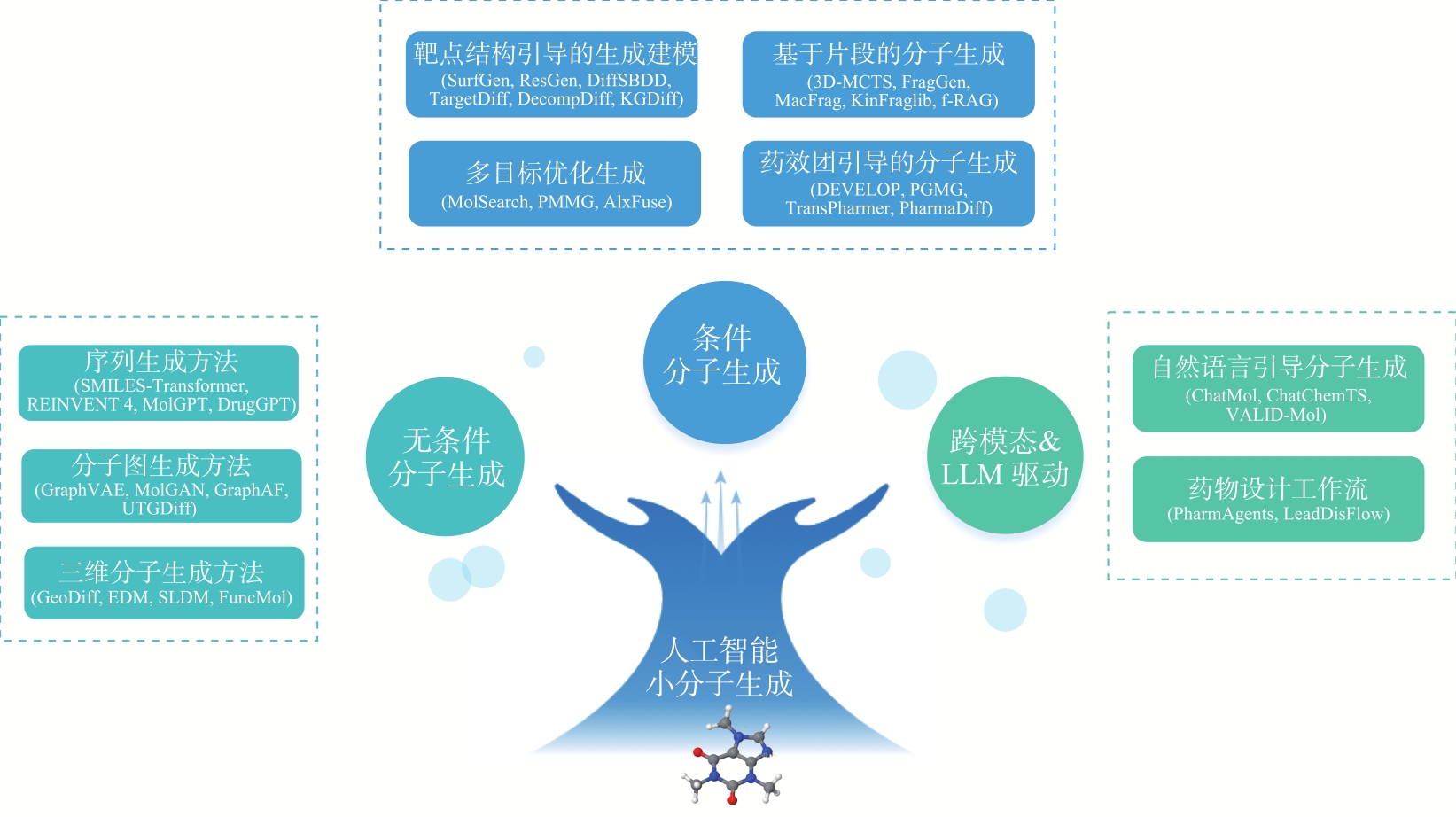
Fig.3
Classification of generative models discussed in this review for drug discovery applications"
| [1] |
JAYATUNGA M, AYERS M, BRUENS L, et al. How successful are AI-discovered drugs in clinical trials? A first analysis and emerging lessons[J]. Drug Discovery Today, 2024, 29: 104009.
doi: 10.1016/j.drudis.2024.104009 |
| [2] |
IRWIN J J, TANG K G, YOUNG J, et al. ZINC20—A Free Ultralarge-Scale Chemical Database for Ligand Discovery[J]. Journal of Chemical Information and Modeling, 2020, 60(12): 6065-6073.
doi: 10.1021/acs.jcim.0c00675 |
| [3] |
TINGLE B I, TANG K G, CASTANON M, et al. ZINC-22─A Free Multi-Billion-Scale Database of Tangible Compounds for Ligand Discovery[J]. Journal of Chemical Information and Modeling, 2023, 63(4): 1166-1176.
doi: 10.1021/acs.jcim.2c01253 pmid: 36790087 |
| [4] |
GAULTON A, BELLIS L J, BENTO A P, et al. ChEMBL: a large-scale bioactivity database for drug discovery[J]. Nucleic Acids Research, 2012, 40(Database issue): D1100-D1107.
doi: 10.1093/nar/gkr777 |
| [5] |
ZDRAZIL B, FELIX E, HUNTER F, et al. The ChEMBL Database in 2023: a drug discovery platform spanning multiple bioactivity data types and time periods[J]. Nucleic Acids Research, 2024, 52(D1): D1180-D1192.
doi: 10.1093/nar/gkad1004 |
| [6] |
KIM S, THIESSEN P A, BOLTON E E, et al. PubChem Substance and Compound databases[J]. Nucleic Acids Research, 2016, 44(Database issue): D1202-D1213.
doi: 10.1093/nar/gkv951 |
| [7] |
KIM S, CHEN J, CHENG T, et al. PubChem 2023 update[J]. Nucleic Acids Research, 2023, 51(D1): D1373-D1380.
doi: 10.1093/nar/gkac956 |
| [8] |
GRYGORENKO O O, RADCHENKO D S, DZIUBA I, et al. Generating Multibillion Chemical Space of Readily Accessible Screening Compounds[J]. iScience, 2020, 23(11): 101681.
doi: 10.1016/j.isci.2020.101681 |
| [9] |
WISHART D S, FEUNANG Y D, GUO A C, et al. DrugBank 5.0: a major update to the DrugBank database for 2018[J]. Nucleic Acids Research, 2018, 46(D1): D1074-D1082.
doi: 10.1093/nar/gkx1037 |
| [10] |
KNOX C, WILSON M, KLINGER C M, et al. DrugBank 6.0: the DrugBank Knowledgebase for 2024[J]. Nucleic Acids Research, 2024, 52(D1): D1265-D1275.
doi: 10.1093/nar/gkad976 |
| [11] |
SHANG J, SUN H, LIU H, et al. Comparative analyses of structural features and scaffold diversity for purchasable compound libraries[J]. Journal of Cheminformatics, 2017, 9(1): 25.
doi: 10.1186/s13321-017-0212-4 pmid: 29086044 |
| [12] |
BURLEY S K, BERMAN H M, BHIKADIYA C, et al. RCSB Protein Data Bank: biological macromolecular structures enabling research and education in fundamental biology, biomedicine, biotechnology and energy[J]. Nucleic Acids Research, 2019, 47(D1): D464-D474.
doi: 10.1093/nar/gky1004 |
| [13] |
UNIPROT CONSORTIUM T, BATEMAN A, MARTIN M J, et al. UniProt: the universal protein knowledgebase[J]. Nucleic Acids Research, 2017, 45(D1): D158-D169.
doi: 10.1093/nar/gkw1099 |
| [14] |
CONSORTIUM T U, BATEMAN A, MARTIN M J, et al. UniProt: the Universal Protein Knowledgebase in 2023[J]. Nucleic Acids Research, 2023, 51(D1): D523-D531.
doi: 10.1093/nar/gkac1052 |
| [15] |
JUMPER J, EVANS R, PRITZEL A, et al. Highly accurate protein structure prediction with AlphaFold[J]. Nature, 2021, 596(7873): 583-589.
doi: 10.1038/s41586-021-03819-2 |
| [16] |
ABRAMSON J, ADLER J, DUNGER J, et al. Accurate structure prediction of biomolecular interactions with AlphaFold 3[J]. Nature, 2024, 630(8016): 493-500.
doi: 10.1038/s41586-024-07487-w |
| [17] |
WANG R, FANG X, LU Y, et al. The PDBbind database: methodologies and updates[J]. Journal of Medicinal Chemistry, 2005, 48(12): 4111-4119.
pmid: 15943484 |
| [18] |
LIU Z, LI Y, HAN L, et al. PDB-wide collection of binding data: current status of the PDBbind database[J]. Bioinformatics, 2015, 31(3): 405-412.
doi: 10.1093/bioinformatics/btu626 pmid: 25301850 |
| [19] |
FRANCOEUR P G, MASUDA T, SUNSERI J, et al. Three-Dimensional Convolutional Neural Networks and a Cross-Docked Data Set for Structure-Based Drug Design[J]. Journal of Chemical Information and Modeling, 2020, 60(9): 4200-4215.
doi: 10.1021/acs.jcim.0c00411 pmid: 32865404 |
| [20] |
VAN LINDEN O P J, KOOISTRA A J, LEURS R, et al. KLIFS: A Knowledge-Based Structural Database To Navigate Kinase-Ligand Interaction Space[J]. Journal of Medicinal Chemistry, 2014, 57(2): 249-277.
doi: 10.1021/jm400378w pmid: 23941661 |
| [21] |
KANEV G K, DE GRAAF C, WESTERMAN B A, et al. KLIFS: an overhaul after the first 5 years of supporting kinase research[J]. Nucleic Acids Research, 2020, 49(D1): D562-D569.
doi: 10.1093/nar/gkaa895 |
| [22] |
GILSON M K, LIU T, BAITALUK M, et al. BindingDB in 2015: A public database for medicinal chemistry, computational chemistry and systems pharmacology[J]. Nucleic Acids Research, 2016, 44(Database issue): D1045-D1053.
doi: 10.1093/nar/gkv1072 |
| [23] |
LIU T, HWANG L, BURLEY S K, et al. BindingDB in 2024: a FAIR knowledgebase of protein-small molecule binding data[J]. Nucleic Acids Research, 2025, 53(D1): D1633-D1644.
doi: 10.1093/nar/gkae1075 pmid: 39574417 |
| [24] | WU Z, RAMSUNDAR B, FEINBERG E N, et al. MoleculeNet: A Benchmark for Molecular Machine Learning[Z]. arXiv, 2018[2025-07-21]. http://arxiv.org/abs/1703.00564. |
| [25] | POLYKOVSKIY D, ZHEBRAK A, SANCHEZ-LENGELING B, et al. Molecular Sets (MOSES): A Benchmarking Platform for Molecular Generation Models[Z]. arXiv, 2020[2025-07-10]. http://arxiv.org/abs/1811.12823. |
| [26] |
BROWN N, FISCATO M, SEGLER M H S, et al. GuacaMol: Benchmarking Models for de Novo Molecular Design[J]. Journal of Chemical Information and Modeling, 2019, 59(3): 1096-1108.
doi: 10.1021/acs.jcim.8b00839 pmid: 30887799 |
| [27] | HUANG K, FU T, GAO W, et al. Therapeutics Data Commons: Machine Learning Datasets and Tasks for Drug Discovery and Development[Z]. arXiv, 2021[2025-07-10]. http://arxiv.org/abs/2102.09548. |
| [28] |
DONG J, WANG N N, YAO Z J, et al. ADMETlab: a platform for systematic ADMET evaluation based on a comprehensively collected ADMET database[J]. Journal of Cheminformatics, 2018, 10(1): 29.
doi: 10.1186/s13321-018-0283-x pmid: 29943074 |
| [29] |
XIONG G, WU Z, YI J, et al. ADMETlab 2.0: an integrated online platform for accurate and comprehensive predictions of ADMET properties[J]. Nucleic Acids Research, 2021, 49(W1): W5-W14.
doi: 10.1093/nar/gkab255 pmid: 33893803 |
| [30] |
FU L, SHI S, YI J, et al. ADMETlab 3.0: an updated comprehensive online ADMET prediction platform enhanced with broader coverage, improved performance, API functionality and decision support[J]. Nucleic Acids Research, 2024, 52(W1): W422-W431.
doi: 10.1093/nar/gkae236 |
| [31] |
ROGERS D, HAHN M. Extended-Connectivity Fingerprints[J]. Journal of Chemical Information and Modeling, 2010, 50(5): 742-754.
doi: 10.1021/ci100050t pmid: 20426451 |
| [32] |
KUWAHARA H, GAO X. Analysis of the effects of related fingerprints on molecular similarity using an eigenvalue entropy approach[J]. Journal of Cheminformatics, 2021, 13(1): 27.
doi: 10.1186/s13321-021-00506-2 pmid: 33757582 |
| [33] |
JAEGER S, FULLE S, TURK S. Mol2vec: unsupervised machine learning approach with chemical intuition[J]. Journal of chemical information and modeling, 2018, 58(1): 27-35.
doi: 10.1021/acs.jcim.7b00616 pmid: 29268609 |
| [34] | FABIAN B, EDLICH T, GASPAR H, et al. Molecular representation learning with language models and domain-relevant auxiliary tasks[Z]. arXiv, 2020[2025-07-21]. http://arxiv.org/abs/2011.13230. |
| [35] |
XIONG Z, WANG D, LIU X, et al. Pushing the Boundaries of Molecular Representation for Drug Discovery with the Graph Attention Mechanism[J]. Journal of Medicinal Chemistry, 2020, 63(16): 8749-8760.
doi: 10.1021/acs.jmedchem.9b00959 pmid: 31408336 |
| [36] | RONG Y, BIAN Y, XU T, et al. Self-Supervised Graph Transformer on Large-Scale Molecular Data[Z]. arXiv, 2020[2025-07-21]. http://arxiv.org/abs/2007.02835. |
| [37] | LIU S, WANG H, LIU W, et al. Pre-training Molecular Graph Representation with 3D Geometry[Z]. arXiv, 2022[2025-07-21]. http://arxiv.org/abs/2110.07728. |
| [38] | BATZNER S, MUSAELIAN A, SUN L, et al. E(3)-Equivariant Graph Neural Networks for Data-Efficient and Accurate Interatomic Potentials[J/OL]. Nature Communications, 2022, 13(1)[2025-07-10]. http://arxiv.org/abs/2101.03164. |
| [39] | FUCHS F B, WORRALL D E, FISCHER V, et al. SE(3)-Transformers: 3D Roto-Translation Equivariant Attention Networks[Z]. arXiv, 2020[2025-07-10]. http://arxiv.org/abs/2006.10503. |
| [40] |
LU S, GAO Z, HE D, et al. Data-driven quantum chemical property prediction leveraging 3D conformations with Uni-Mol+[J]. Nature Communications, 2024, 15(1): 7104.
doi: 10.1038/s41467-024-51321-w pmid: 39160169 |
| [41] | CAI H, ZHANG H, ZHAO D, et al. FP-GNN: a versatile deep learning architecture for enhanced molecular property prediction[J]. Briefings in Bioinformatics, 2022, 23(6): bbac408. |
| [42] | WU S, YU D, TAN X, et al. CLaMP: Contrastive Language-Music Pre-training for Cross-Modal Symbolic Music Information Retrieval[Z]. arXiv, 2023[2025-07-21]. http://arxiv.org/abs/2304.11029. |
| [43] | KAUFMAN B, WILLIAMS E, UNDERKOFFLER C, et al. COATI: multi-modal contrastive pre-training for representing and traversing chemical space[Z]. ChemRxiv, 2023[2025-07-21]. https://chemrxiv.org/engage/chemrxiv/article-details/64e8137fdd1a73847f73f7aa. |
| [44] | LIN Z, AKIN H, RAO R, et al. Evolutionary-scale prediction of atomic level protein structure with a language model[Z]. bioRxiv, 2022: 2022.07.20.500902[2025-07-10]. https://www.biorxiv.org/content/10.1101/2022.07.20.500902v3. |
| [45] | HAYES T, RAO R, AKIN H, et al. Simulating 500 million years of evolution with a language model[Z]. bioRxiv, 2024: 2024.07.01.600583[2025-07-10]. https://www.biorxiv.org/content/10.1101/2024.07.01.600583v1. |
| [46] |
BRANDES N, OFER D, PELEG Y, et al. ProteinBERT: a universal deep-learning model of protein sequence and function[J]. Bioinformatics, 2022, 38(8): 2102-2110.
doi: 10.1093/bioinformatics/btac020 pmid: 35020807 |
| [47] | RAO R, BHATTACHARYA N, THOMAS N, et al. Evaluating Protein Transfer Learning with TAPE[Z]. arXiv, 2019[2025-07-10]. http://arxiv.org/abs/1906.08230. |
| [48] |
JIANG M, LI Z, ZHANG S, et al. Dru-target affinity prediction using graph neural network and contact maps[J]. RSC Advances, 2020, 10(35): 20701-20712.
doi: 10.1039/D0RA02297G |
| [49] |
KLOCZKOWSKI A, JERNIGAN R L, WU Z, et al. Distance Matrix-Based Approach to Protein Structure Prediction[J]. Journal of structural and functional genomics, 2009, 10(1): 67-81.
doi: 10.1007/s10969-009-9062-2 pmid: 19224393 |
| [50] | ZHAO L, WANG H, SHI S. PocketDTA: an advanced multimodal architecture for enhanced prediction of drug-target affinity from 3D structural data of target binding pockets[J]. Bioinformatics, 2024, 40(10): btae594. |
| [51] | JING B, EISMANN S, SURIANA P, et al. Learning from Protein Structure with Geometric Vector Perceptrons[Z]. arXiv, 2021[2025-07-10]. http://arxiv.org/abs/2009.01411. |
| [52] | LIU C, WANG J, CAI Z, et al. Dynamic PDB: A New Dataset and a SE(3) Model Extension by Integrating Dynamic Behaviors and Physical Properties in Protein Structures[Z]. arXiv, 2024[2025-07-21]. http://arxiv.org/abs/2408.12413. |
| [53] | JIN W, BARZILAY R, JAAKKOLA T. Junction Tree Variational Autoencoder for Molecular Graph Generation[Z]. arXiv, 2019[2025-07-10]. http://arxiv.org/abs/1802.04364. |
| [54] | KUSNER M J, PAIGE B, HERNÁNDEZ-LOBATO J M. Grammar Variational Autoencoder[C]// Proceedings of the 34th International Conference on Machine Learning. PMLR, 2017: 1945-1954. |
| [55] | CAO N D, KIPF T. MolGAN: An implicit generative model for small molecular graphs[Z]. arXiv, 2022[2025-07-21]. http://arxiv.org/abs/1805.11973. |
| [56] | GUIMARAES G L, SANCHEZ-LENGELING B, OUTEIRAL C, et al. Objective-Reinforced Generative Adversarial Networks (ORGAN) for Sequence Generation Models[Z]. arXiv, 2018[2025-07-10]. http://arxiv.org/abs/1705.10843. |
| [57] | ZANG C, WANG F. MoFlow: An Invertible Flow Model for Generating Molecular Graphs[Z]. arXiv, 2020[2025-07-10]. http://arxiv.org/abs/2006.10137. |
| [58] | SONG Y, GONG J, XU M, et al. Equivariant Flow Matching with Hybrid Probability Transport[Z]. arXiv, 2023[2025-08-15]. http://arxiv.org/abs/2312.07168. |
| [59] | XU M, YU L, SONG Y, et al. GeoDiff: a Geometric Diffusion Model for Molecular Conformation Generation[Z]. arXiv, 2022[2025-07-10]. http://arxiv.org/abs/2203.02923. |
| [60] | HOOGEBOOM E, SATORRAS V G, VIGNAC C, et al. Equivariant Diffusion for Molecule Generation in 3D[Z]. arXiv, 2022[2025-07-10]. http://arxiv.org/abs/2203.17003. |
| [61] |
SHERSTINSKY A. Fundamentals of Recurrent Neural Network (RNN) and Long Short-Term Memory (LSTM) Network[J]. Physica D: Nonlinear Phenomena, 2020, 404: 132306.
doi: 10.1016/j.physd.2019.132306 |
| [62] | CHUNG J, GULCEHRE C, CHO K, et al. Empirical Evaluation of Gated Recurrent Neural Networks on Sequence Modeling[Z]. arXiv, 2014[2025-07-10]. http://arxiv.org/abs/1412.3555. |
| [63] |
BLASCHKE T, ARÚS-POUS J, CHEN H, et al. REINVENT 2.0: An AI Tool for De Novo Drug Design[J]. Journal of Chemical Information and Modeling, 2020, 60(12): 5918-5922.
doi: 10.1021/acs.jcim.0c00915 pmid: 33118816 |
| [64] |
LOEFFLER H H, HE J, TIBO A, et al. Reinvent 4: Modern AI-driven generative molecule design[J]. Journal of Cheminformatics, 2024, 16(1): 20.
doi: 10.1186/s13321-024-00812-5 pmid: 38383444 |
| [65] |
IRWIN R, DIMITRIADIS S, HE J, et al. Chemformer: a pre-trained transformer for computational chemistry[J]. Machine Learning: Science and Technology, 2022, 3(1): 015022.
doi: 10.1088/2632-2153/ac3ffb |
| [66] | OPENAI, ACHIAM J, ADLER S, et al. GPT-4 Technical Report[Z]. arXiv, 2024[2025-07-13]. http://arxiv.org/abs/2303.08774. |
| [67] | KEVIAN D, SYED U, GUO X, et al. Capabilities of Large Language Models in Control Engineering: A Benchmark Study on GPT-4, Claude 3 Opus, and Gemini 1.0 Ultra[Z]. arXiv, 2024[2025-07-13]. http://arxiv.org/abs/2404.03647. |
| [68] | TEAM G, ANIL R, BORGEAUD S, et al. Gemini: A Family of Highly Capable Multimodal Models[Z]. arXiv, 2025[2025-07-13]. http://arxiv.org/abs/2312.11805. |
| [69] |
FREY N C, SOKLASKI R, AXELROD S, et al. Neural scaling of deep chemical models[J]. Nature Machine Intelligence, 2023, 5(11): 1297-1305.
doi: 10.1038/s42256-023-00740-3 |
| [70] |
BAGAL V, AGGARWAL R, VINOD P K, et al. MolGPT: Molecular Generation Using a Transformer-Decoder Model[J]. Journal of Chemical Information and Modeling, 2022, 62(9): 2064-2076.
doi: 10.1021/acs.jcim.1c00600 |
| [71] | LI Y, GAO C, SONG X, et al. DrugGPT: A GPT-based Strategy for Designing Potential Ligands Targeting Specific Proteins[J]. bioRxiv, 2023: 2023.06.29.543848. |
| [72] | FANG Y, LIANG X, ZHANG N, et al. Mol-Instructions: A Large-Scale Biomolecular Instruction Dataset for Large Language Models[Z]. arXiv, 2024[2025-07-13]. http://arxiv.org/abs/2306.08018. |
| [73] | LUO Y, YANG K, HONG M, et al. MolFM: A Multimodal Molecular Foundation Model[Z]. arXiv, 2023[2025-07-13]. http://arxiv.org/abs/2307.09484. |
| [74] |
SEGLER M H S, KOGEJ T, TYRCHAN C, et al. Generating Focused Molecule Libraries for Drug Discovery with Recurrent Neural Networks[J]. ACS Central Science, 2018, 4(1): 120-131.
doi: 10.1021/acscentsci.7b00512 pmid: 29392184 |
| [75] | HONDA S, SHI S, UEDA H R. SMILES Transformer: Pre-trained Molecular Fingerprint for Low Data Drug Discovery[Z]. arXiv, 2019[2025-07-13]. http://arxiv.org/abs/1911.04738. |
| [76] | SIMONOVSKY M, KOMODAKIS N. GraphVAE: Towards Generation of Small Graphs Using Variational Autoencoders[Z]. arXiv, 2018[2025-07-13]. http://arxiv.org/abs/1802.03480. |
| [77] | SHI C, XU M, ZHU Z, et al. GraphAF: a Flow-based Autoregressive Model for Molecular Graph Generation[Z]. arXiv, 2020[2025-07-13]. http://arxiv.org/abs/2001.09382. |
| [78] | XIANG Y, ZHAO H, MA C, et al. Instruction-Based Molecular Graph Generation with Unified Text-Graph Diffusion Model[Z]. arXiv, 2024[2025-07-21]. http://arxiv.org/abs/2408.09896. |
| [79] | NI Y, FENG S, CHI H, et al. Straight-Line Diffusion Model for Efficient 3D Molecular Generation[Z]. arXiv, 2025[2025-07-21]. http://arxiv.org/abs/2503.02918. |
| [80] | KIRCHMEYER M, PINHEIRO P O, SAREMI S. Score-based 3D molecule generation with neural fields[Z]. arXiv, 2025[2025-07-21]. http://arxiv.org/abs/2501.08508. |
| [81] |
ZHANG O, WANG T, WENG G, et al. Learning on topological surface and geometric structure for 3D molecular generation[J]. Nature Computational Science, 2023, 3(10): 849-859.
doi: 10.1038/s43588-023-00530-2 pmid: 38177756 |
| [82] |
ZHANG O, ZHANG J, JIN J, et al. ResGen is a pocket-aware 3D molecular generation model based on parallel multiscale modelling[J]. Nature Machine Intelligence, 2023, 5(9):1020-1030.
doi: 10.1038/s42256-023-00712-7 |
| [83] | SCHNEUING A, HARRIS C, DU Y, et al. Structure-based Drug Design with Equivariant Diffusion Models[Z]. arXiv, 2024[2025-07-13]. http://arxiv.org/abs/2210.13695. |
| [84] | GUAN J, QIAN W W, PENG X, et al. 3D Equivariant Diffusion for Target-Aware Molecule Generation and Affinity Prediction[Z]. arXiv, 2023[2025-07-13]. http://arxiv.org/abs/2303.03543. |
| [85] | GUAN J, ZHOU X, YANG Y, et al. DecompDiff: Diffusion Models with Decomposed Priors for Structure-Based Drug Design[Z]. arXiv, 2024[2025-07-13]. http://arxiv.org/abs/2403.07902. |
| [86] | QIAN H, HUANG W, TU S, et al. KGDiff: towards explainable target-aware molecule generation with knowledge guidance[J]. Briefings in Bioinformatics, 2023, 25(1): bbad435. |
| [87] |
DU H, JIANG D, ZHANG O, et al. A flexible data-free framework for structure-based de novo drug design with reinforcement learning[J]. Chemical Science, 2023, 14(43): 12166-12181.
doi: 10.1039/D3SC04091G |
| [88] |
ZHANG O, HUANG Y, CHENG S, et al. FragGen: towards 3D geometry reliable fragment-based molecular generation[J]. Chemical Science, 2024, 15(46): 19452-19465.
doi: 10.1039/d4sc04620j pmid: 39568888 |
| [89] | DIAO Y, HU F, SHEN Z, et al. MacFrag: segmenting large-scale molecules to obtain diverse fragments with high qualities[J]. Bioinformatics, 2023, 39(1): btad012. |
| [90] |
SYDOW D, SCHMIEL P, MORTIER J, et al. KinFragLib: Exploring the Kinase Inhibitor Space Using Subpocket-Focused Fragmentation and Recombination[J]. Journal of Chemical Information and Modeling, 2020, 60(12): 6081-6094.
doi: 10.1021/acs.jcim.0c00839 pmid: 33155465 |
| [91] | LEE S, KREIS K, VECCHAM S P, et al. Molecule Generation with Fragment Retrieval Augmentation[Z]. arXiv, 2024[2025-07-13]. http://arxiv.org/abs/2411.12078. |
| [92] |
IMRIE F, HADFIELD T E, BRADLEY A R, et al. Deep generative design with 3D pharmacophoric constraints[J]. Chemical Science, 2021, 12(43): 14577-14589.
doi: 10.1039/d1sc02436a pmid: 34881010 |
| [93] |
ZHU H, ZHOU R, CAO D, et al. A pharmacophore-guided deep learning approach for bioactive molecular generation[J]. Nature Communications, 2023, 14(1): 6234.
doi: 10.1038/s41467-023-41454-9 pmid: 37803000 |
| [94] | XIE W, ZHANG J, XIE Q, et al. Accelerating Discovery of Novel and Bioactive Ligands With Pharmacophore-Informed Generative Models[Z]. arXiv, 2024[2025-07-13]. http://arxiv.org/abs/2401.01059. |
| [95] | ALAKHDAR A, POCZOS B, WASHBURN N. Pharmacophore-Conditioned Diffusion Model for Ligand-Based De Novo Drug Design[Z]. arXiv, 2025[2025-07-21]. http://arxiv.org/abs/2505.10545. |
| [96] | SUN M, XING J, MENG H, et al. MolSearch: Search-based Multi-objective Molecular Generation and Property Optimization[C]// Proceedings of the 28th ACM SIGKDD Conference on Knowledge Discovery and Data Mining. Washington DC USA: ACM, 2022: 4724-4732. |
| [97] |
LIU Y, ZHU Y, WANG J, et al. A Multi-Objective Molecular Generation Method Based on Pareto Algorithm and Monte Carlo Tree Search[J]. Advanced Science, 2025, 12(20): 2410640.
doi: 10.1002/advs.v12.20 |
| [98] |
CHEN S. Structure-aware dual-target drug design through collaborative learning of pharmacophore combination and molecular simulation[J]. Chemical Science, 2024, 15(27): 10366-10380.
doi: 10.1039/d4sc00094c pmid: 38994407 |
| [99] |
BHATTACHARYA D, CASSADY H J, HICKNER M A, et al. Large Language Models as Molecular Design Engines[J]. Journal of Chemical Information and Modeling, 2024, 64(18): 7086-7096.
doi: 10.1021/acs.jcim.4c01396 pmid: 39231030 |
| [100] | ZENG Z, YIN B, WANG S, et al. Interactive Molecular Discovery with Natural Language[Z]. arXiv, 2023[2025-07-14]. http://arxiv.org/abs/2306.11976. |
| [101] |
ISHIDA S, SATO T, HONMA T, et al. Large language models open new way of AI-assisted molecule design for chemists[J]. Journal of Cheminformatics, 2025, 17(1): 36.
doi: 10.1186/s13321-025-00984-8 pmid: 40128788 |
| [102] | MALIKUSSAID, NUHA H H. VALID-Mol: a Systematic Framework for Validated LLM-Assisted Molecular Design[Z]. arXiv, 2025[2025-07-21]. http://arxiv.org/abs/2506.23339. |
| [103] |
MA P, CHENG Z, CHENG Z, et al. Discovery of EP4 antagonists with image-guided explainable deep learning workflow[J]. National Science Open, 2025, 4(4): 20240015.
doi: 10.1360/nso/20240015 |
| [104] | GAO B, HUANG Y, LIU Y, et al. PharmAgents: Building a Virtual Pharma with Large Language Model Agents[Z]. arXiv, 2025[2025-07-14]. http://arxiv.org/abs/2503.22164. |
| [105] |
BICKERTON G R, PAOLINI G V, BESNARD J, et al. Quantifying the chemical beauty of drugs[J]. Nature Chemistry, 2012, 4(2): 90-98.
doi: 10.1038/nchem.1243 pmid: 22270643 |
| [106] |
ERTL P, SCHUFFENHAUER A. Estimation of synthetic accessibility score of drug-like molecules based on molecular complexity and fragment contributions[J]. Journal of Cheminformatics, 2009, 1(1): 8.
doi: 10.1186/1758-2946-1-8 pmid: 20298526 |
| [107] |
TROTT O, OLSON A J. AutoDock Vina: improving the speed and accuracy of docking with a new scoring function, efficient optimization and multithreading[J]. Journal of computational chemistry, 2010, 31(2): 455-461.
doi: 10.1002/jcc.v31:2 |
| [108] |
FRIESNER R A, BANKS J L, MURPHY R B, et al. Glide: A New Approach for Rapid, Accurate Docking and Scoring. 1. Method and Assessment of Docking Accuracy[J]. Journal of Medicinal Chemistry, 2004, 47(7): 1739-1749.
doi: 10.1021/jm0306430 |
| [109] |
SHEN C, ZHANG X, DENG Y, et al. Boosting Protein-Ligand Binding Pose Prediction and Virtual Screening Based on Residue-Atom Distance Likelihood Potential and Graph Transformer[J]. Journal of Medicinal Chemistry, 2022, 65(15): 10691-10706.
doi: 10.1021/acs.jmedchem.2c00991 pmid: 35917397 |
| [110] | ÖZTÜRK H, ÖZGÜR A, OZKIRIMLI E. DeepDTA: deep drug-target binding affinity prediction[J]. Bioinformatics, 2018, 34(17): i821-i829. |
| [111] |
DAINA A, MICHIELIN O, ZOETE V. SwissADME: a free web tool to evaluate pharmacokinetics, drug-likeness and medicinal chemistry friendliness of small molecules[J]. Scientific Reports, 2017, 7(1): 42717.
doi: 10.1038/srep42717 |
| [112] | BUTTENSCHOEN M, MORRIS G M, DEANE C M. PoseBusters: AI-based docking methods fail to generate physically valid poses or generalise to novel sequences[Z]. arXiv, 2023[2024-12-09]. http://arxiv.org/abs/2308.05777. |
| [1] | REN Xudong, MENG Guanghao, ZHANG Letian, QI Baowei, WANG Yiming. Exploration of AI Intelligent Operation and Maintenancein Open Source Community [J]. Frontiers of Data and Computing, 2026, 8(2): 141-153. |
| [2] | ZHANG Sen, CHU Zheng, HUANG Songrui, MENG Zheling. A Review of Artificial Intelligence Education in Primary and Secondary Schools [J]. Frontiers of Data and Computing, 2025, 7(6): 170-178. |
| [3] | CHEN Changsong, WU Yueshun, MEI Guang. Research on the Hierarchical Model of Artificial Intelligence Security Protection Systems [J]. Frontiers of Data and Computing, 2025, 7(6): 68-76. |
| [4] | GUO Huijie,ZHOU Yongjie,XU Jianzhen. A Survey of Pharmacokinetics of Traditional Chinese Medicine Based on Multimodal Artificial Intelligence Data Fusion [J]. Frontiers of Data and Computing, 2025, 7(2): 149-160. |
| [5] | JIA Ziang. Teeth Structure Segmentation Based on Multi-Source Semi-Supervised Learning [J]. Frontiers of Data and Computing, 2025, 7(2): 175-185. |
| [6] | CAI Huaqian, LIU Yihao, GUAN Tianpeng, WU Kaidong, YANG Jingru, LUO Chaoran, ZHU Xiaojie, LIU Jia, HUANG Gang. DPML: A Markup Language for Scientific Data Pragmatics [J]. Frontiers of Data and Computing, 2024, 6(4): 46-58. |
| [7] | WANG Zhiyong, LIU Jingjing, WANG Xinming, CHEN Bowen, NIE Wei, ZHANG Hanlin, LIU Honghai. Advancements and Frontiers in Autism Diagnosis and Treatment Based on Artificial Intelligence [J]. Frontiers of Data and Computing, 2024, 6(3): 15-27. |
| [8] | KOU Dazhi. Automatic Teeth Segmentation on Dental Panoramic Radiographs with Deep Learning [J]. Frontiers of Data and Computing, 2024, 6(3): 162-172. |
| [9] | HE Ruilin, YANG Xinyi, SUN Hongzan, LI Chen. The Latest Development and Prospects of Histopathological Image Analysis Methods Based on Graph Features [J]. Frontiers of Data and Computing, 2024, 6(2): 101-116. |
| [10] | ZHU Mingming, CAO Wudi, WU Lin, WANG Zixi, LIAO Qi, ZHANG Si, TANG Xiao, LI Jie, WANG Jing, WANG Yangang, WANG Zifa. The Development and Prospects of Informatization Applications in Dual-Carbon Atmospheric Environment Based on Artificial Intelligence and Big Data [J]. Frontiers of Data and Computing, 2023, 5(3): 2-12. |
| [11] | HU Xiaoyan,XU Jiyao,ZOU Ziming. Preliminary Study on Paradigm Shift in Space Weather Research Driven by Big Data and Artificial Intelligence [J]. Frontiers of Data and Computing, 2023, 5(2): 24-36. |
| [12] | QI Fazhi,LI Gang,LI Chun,WANG Lu,ZHANG Yi,ZHANG Zhengde,CHEN Gang,LUO Wuming,ZHAO Lina,HU Yu,YUAN Ye. Big Data and AI for High Energy Physics [J]. Frontiers of Data and Computing, 2023, 5(2): 50-59. |
| [13] | WANG Fan,FENG Liqiang,CAO Rongqiang. Design and Application of Big Data-Driven Ocean Artificial Intelligence Service Platform [J]. Frontiers of Data and Computing, 2023, 5(2): 73-85. |
| [14] | WANG Zongguo,WAN Meng,CHEN Ziyi,LI Kai,WANG Xiaoguang,LIU Miao,MENG Sheng,WANG Yangang. Research and Application of a Data-Driven Intelligent Design Platform for Materials [J]. Frontiers of Data and Computing, 2023, 5(2): 86-96. |
| [15] | LIU Jiaqi,YANG Binyan. Research on the Hot Spots and Trends of the Coupling Development of Artificial Intelligence and Social Science in China——A Bibliometric Analysis Based on CiteSpace [J]. Frontiers of Data and Computing, 2022, 4(6): 77-91. |
| Viewed | ||||||
|
Full text |
|
|||||
|
Abstract |
|
|||||

