Frontiers of Data and Computing ›› 2025, Vol. 7 ›› Issue (6): 170-178.

CSTR: 32002.14.jfdc.CN10-1649/TP.2025.06.016

doi: 10.11871/jfdc.issn.2096-742X.2025.06.016

• Technology and Application • Previous Articles     Next Articles

A Review of Artificial Intelligence Education in Primary and Secondary Schools

ZHANG Sen1(),CHU Zheng2,HUANG Songrui3,MENG Zheling1,*()   

  1. 1. Institute of Automation, Chinese Academy of Sciences, Beijing 100190, China
    2. Beijing 101 High School, Beijing 100091, China
    3. Tianjin Xinhua High School, Tianjin 300203, China
  • Received:2025-09-08 Online:2025-12-20 Published:2025-12-17
  • Contact: MENG Zheling E-mail:sen.zhang@ia.ac.cn;mengzheling2023@ia.ac.cn

Abstract:

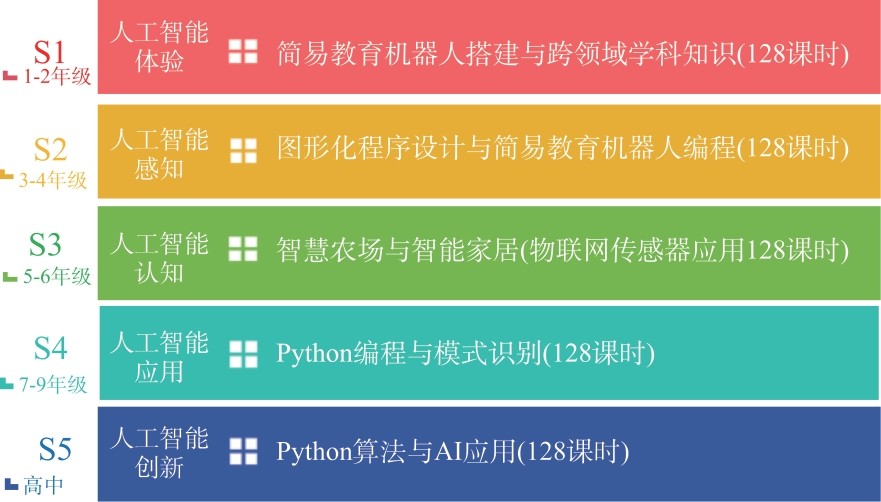
[Objective] This paper reviews Artificial Intelligence (AI) education in primary and secondary schools to promote its high-quality development. [Literature Scope] It examines AI education policies both globally and domestically. [Methods] Using the AI education curriculum for primary and secondary schools developed by the Institute of Automation, Chinese Academy of Sciences as a case study, combined with the curriculum practices in multiple regions of Xinjiang, existing problems are analyzed and countermeasures are proposed. [Results] It is shown that AI education in primary and secondary schools has made positive progress in policy formulation, project implementation, and theoretical construction, forming a differentiated curriculum system. [Limitations] However, there are still limitations, such as regional development imbalance, insufficient teaching staff, and incomplete evaluation mechanisms. [Conclusions] AI education in primary and secondary schools has achieved significant results, but still faces challenges. Future efforts should focus on exploring practical cases, interdisciplinary integration, and educational equity, and promote higher-quality development through strengthened overall planning, teacher training, and improved evaluation mechanisms.

Key words: primary and secondary school artificial intelligence education, education policy, case analysis, curriculum practice, regional development imbalance, insufficient teaching staff, incomplete evaluation mechanisms