Frontiers of Data and Computing ›› 2026, Vol. 8 ›› Issue (1): 129-147.
CSTR: 32002.14.jfdc.CN10-1649/TP.2026.01.011
doi: 10.11871/jfdc.issn.2096-742X.2026.01.011
• Technology and Application • Previous Articles Next Articles
CAI Yi1( ),WANG Xiaobin1,*(),CHEN Ruili1,HAN Xun2,3
Received:2025-03-07
Online:2026-02-20
Published:2026-02-02
Contact:
WANG Xiaobin
E-mail:2023211393@stu.ppsuc.edu.cn;xiaobin08d016@126.com
CAI Yi,WANG Xiaobin,CHEN Ruili,HAN Xun. Review of Research on Gender and Age Detection of Writers Based on Handwriting[J]. Frontiers of Data and Computing, 2026, 8(1): 129-147, https://cstr.cn/32002.14.jfdc.CN10-1649/TP.2026.01.011.
Table 1
Dataset related to handwriting, writer’s gender, and age classification"
| 数据集 | 参与者总数 | 样本总数 | 男女比例 | 语言 | 优点 | 缺点 |
|---|---|---|---|---|---|---|
| QUWI[ | 1,017 | 4,068 | ≈1/1 | 阿拉伯语和英语 | 支持文本依赖和非依赖任务; 书写工具多样;规模大、多样性高;公开可用 | 书写内容规范性高,限制了个体差异表达,影响模型泛化能力 |
| MSHD[ | 100 | 1,300 | 43/57 | 阿拉伯语和法语 | 多脚本内容;适用于多种手写分析任务;公开可用 | 规模小,深度学习适用性受限;预定义文本限制书写特征多样性 |
| KHATT[ | 1,000 | 4,000 | 677/323 | 阿拉伯语 | 作者来源广泛;包含多种分辨率图像;公开可用 | 仅限阿拉伯语,不适用于多语言或跨语言研究 |
| IAM[ | 650 | 650 | — | 英语 | 大规模语料库;数据多样性;包含预处理和分割程序;公开可用 | 仅限英语,缺乏多语种数据 |
| HHD[ | 702 | 702 | 351/351 | 希伯来语 | 多种书写风格;字符、单词、文本行层面完整标注;公开可用 | 手动验证缓慢;字符分类实验仍有改进空间 |
| FSHS[ | 2,200 | 2,700 | — | 阿拉伯语 | 规模大,手写风格丰富;适用性广 | 数据清理工作量大;语言单一;不公开 |
| RDF[ | 11,118 | 11,118 | — | 汉语 | 文本类型丰富;适合多特征研究 | 特征值复杂,数据处理难度大;数据隐私性高,不公开 |
| CEHS[ | 221 | 1,531 | — | 英语和汉语 | 覆盖中英文,年龄范围广;数据增强技术提升模型效果 | 样本量较小;老年组分类准确率低;中英文适用性差异;不公开 |
| HEBIU[ | 405 | 810 | — | 希伯来语和英语 | 语言多样,样本数量适中;支持多语言笔迹研究 | 数据标准化要求高;不公开 |
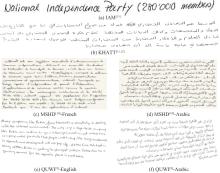
Fig.1
Samples from different datasets"
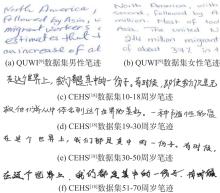
Fig.2
Handwriting samples of different genders and ages"
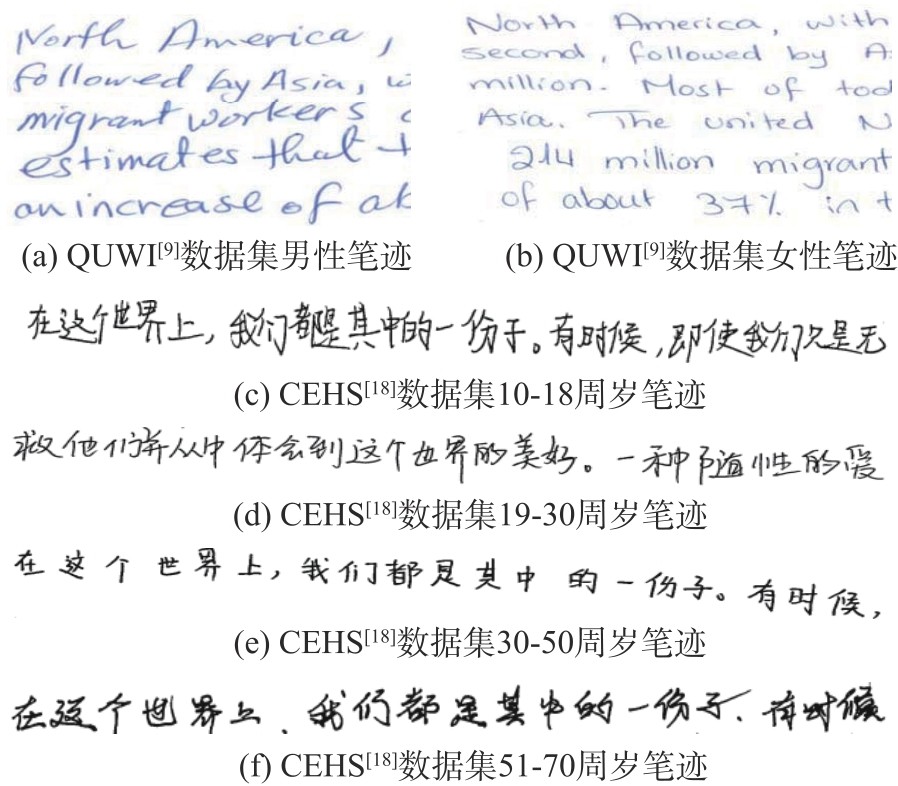
Table 2
Handwriting detection method using SVM"
| 检测内容 | 数据集 | 特征提取(方法) | 方法概述及优势 | 不足 |
|---|---|---|---|---|
| 性别、利手性和年龄 | IAM | 梯度局部二值模式(GLBP) | 提出多类预测方案,结合模糊隶属度模型改进年龄特征描述,多类预测准确率达61.51%[ | 年龄特征难以区分,预测准确率受限 |
| 性别 | IAM、QUWI、KHATT、MSHD | 基于模板直方图(HOTs)、旋转不变均匀局部二值模式(LBPriu)、GLBP | 基于模糊积分(FI)算子组合SVM预测器,HOTs特征描述笔画局部方向,与其他特征互补[ | 未分析不同特征在语言和书写者中的表现差异 |
| 性别、利手性和年龄 | IAM、KHATT | 拓扑特征和GLBP | 通过Sugeno模糊积分结合多种SVM分类器,显著提升性别、惯用手和年龄范围的预测准确性[ | 特征提取对参数敏感,模型需优化以适应不同语言和数据集 |
| 性别 | IAM | 方向梯度直方图(HOG)、局部二值模式(LBP) | 使用局部描述符(如HOG、LBP和像素密度)显著提高性别分类精度[ | 分类性能对特征选择和数据集大小敏感,计算复杂度较高 |
| 性别、利手性和年龄 | IAM、KHATT | 灰度共生矩阵(GLCM)、GLBP、HOG和像素分布 | 基于Sugeno模糊积分的组合方法,整合多特征SVM分类器,显著提升预测精度[ | 计算复杂度高,模型泛化能力需加强,特征选择和参数调整需经验 |
| 性别、利手性和年龄 | IAM,KHATT | GLBP、HOG | 提出基于梯度的特征(HOG和GLBP),在多语言数据集上表现出 语言无关性,显著提升分类精度[ | GLBP在复杂任务中不优于HOG,年龄预测表现较差 |
| 性别 | QUWI | 基于方向的基本图像特征(oBIFs) | 利用oBIFs特征实现多脚本手写图像的性别分类,对不同语言脚本具有鲁棒性[ | 计算复杂度高,特征提取繁琐,参数调整敏感 |
| 性别 | QUWI | LBP、HOG、GLCM和尺度不变特征变换(SFTA) | 集成分类器(如Bagging、Voting和Stacking)结合多种纹理特征,在多语言环境中表现优异[ | 对特征选择和分类器组合参数调优敏感,低质量数据集效果需改进 |
| 性别 | 自建数据集 | LBP、HOG | 融合多种特征(LBP、HOG、统计和纹理特征),使用多种机器学习分类器实现较高性别分类准确率[ | 计算复杂度高,对特征选择和数据集大小敏感,泛化性能受限 |
| 性别 | QUWI | CNN作为特征提取器 | 利用预训练CNN提取特征,在多脚本手写文本中实现较高性别分类准确率,验证了不同观察尺度的有效性[ | 分类结果对脚本依赖性较强,跨语言性能下降 |
| 性别 | 自建数据集 | Zoning、Diagonal、Transition和PeakExtent方法 | 结合PCA进行特征降维,显著提高性别分类准确性和处理效率[ | 对数据多样性和特征选择依赖高,泛化能力受限 |
| 性别 | ICDAR2013RDF | 方向、曲率、链码、梯度方向、纹理和字形特征 | 基于互信息(MI)选择最佳特征子集,结合核函数优化特征选择过程,提升分类精度[ | 计算复杂度高,核方法时间复杂度显著增加 |
| 性别 | ICDAR2013、RDF | 纹理特征、几何特征和滤波(Gabor)特征 | 基于核互信息(KMI)的特征选择方法,减少冗余特征,显著提高分类准确率[ | 计算复杂度高,对特征选择参数敏感,需额外优化资源 |
| 性别 | ICDAR2013 | 文本行不规则性(TLI)、笔压不规则性(PPI)、笔迹密度(SI)和白色和黑色像素的百分比(PWB) | 提取物理和视觉特征,结合多分类器(SVM、逻辑回归和KNN)及多数投票提高预测准确性[ | 对特征选择依赖高,少样本场景性能下降 |
| 性别 | QUWI、MSHD | 基于小波变换的全局纹理特征 | 使用小波变换和符号动态过滤提取性别相关纹理特征,在跨语言脚本和数据集上表现优异[ | 对文本内容依赖高,跨数据库性能下降 |
| 性别 | QUWI、MSHD | 局部和全局特征(倾斜度/方向、圆润度/曲率、整洁度/清晰度和书写纹理) | 结合支持向量机和神经网络,利用多种特征(如斜度、曲率、纹理等)实现较高分类精度[ | 对数据集脚本和内容依赖强,跨数据库性能下降 |
| 性别 | QUWI | 线路分布云,铰链功能 | 引入链码特征线路分布(COLD)和铰链特征,结合SVM分类器,在多语言数据集上取得较高准确率[ | 对参数设置敏感,跨领域适应性不稳定 |
| 性别 | QUWI、MSHD | GLCM、GLBP、HOG和基于分割的分形纹理分析 | 使用空间金字塔匹配方法结合局部和全局特征,在语言相关场景中表现优异[ | 跨语言分类效果不稳定,对数据集特征提取依赖高 |
| 性别 | IAM | 曲线变换提取特征 | 基于单类支持向量机(OC-SVM)方法,利用曲线变换进行特征提取,在数据稀少情况下表现良好[ | 对参数调优敏感,模型复杂度高 |
Fig.3
Gender classification workflow"
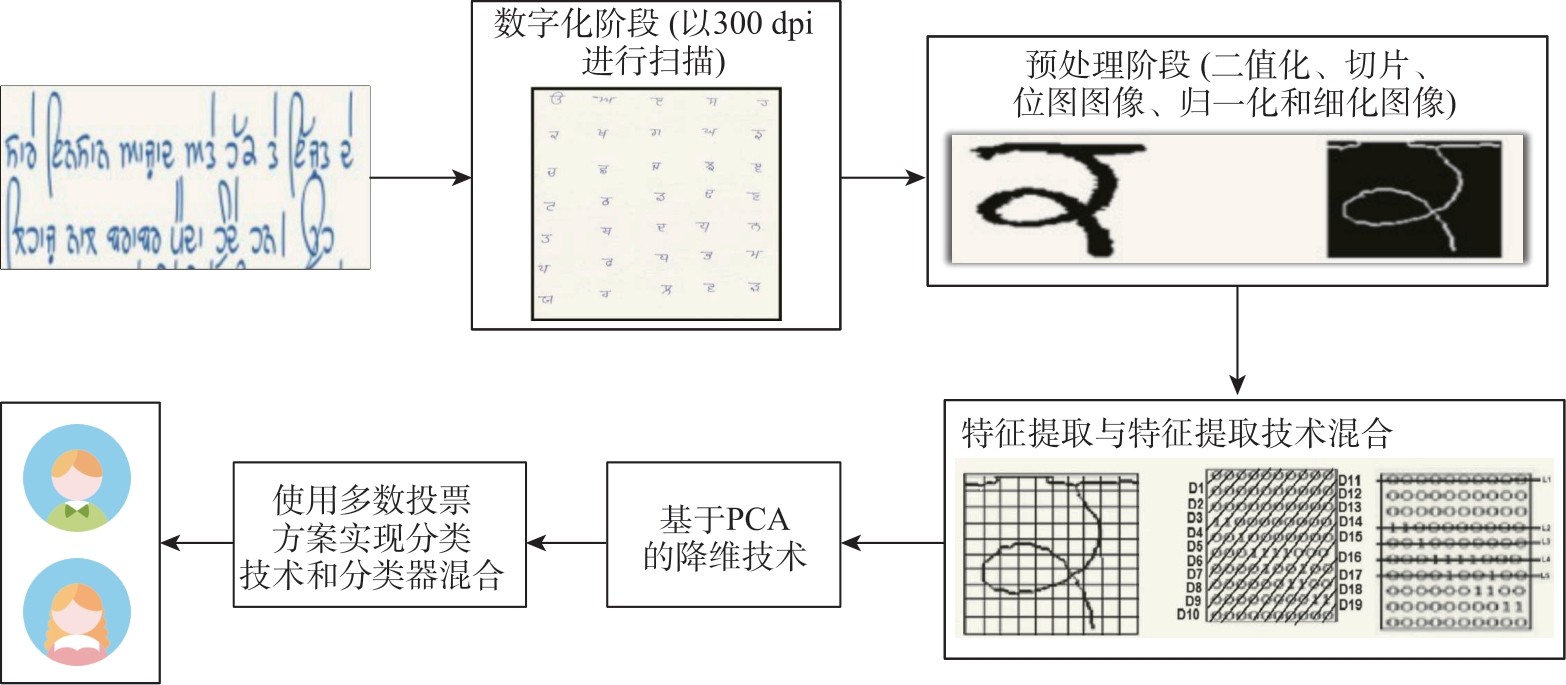
Fig.4
CA-ResNet[18] model architecture"
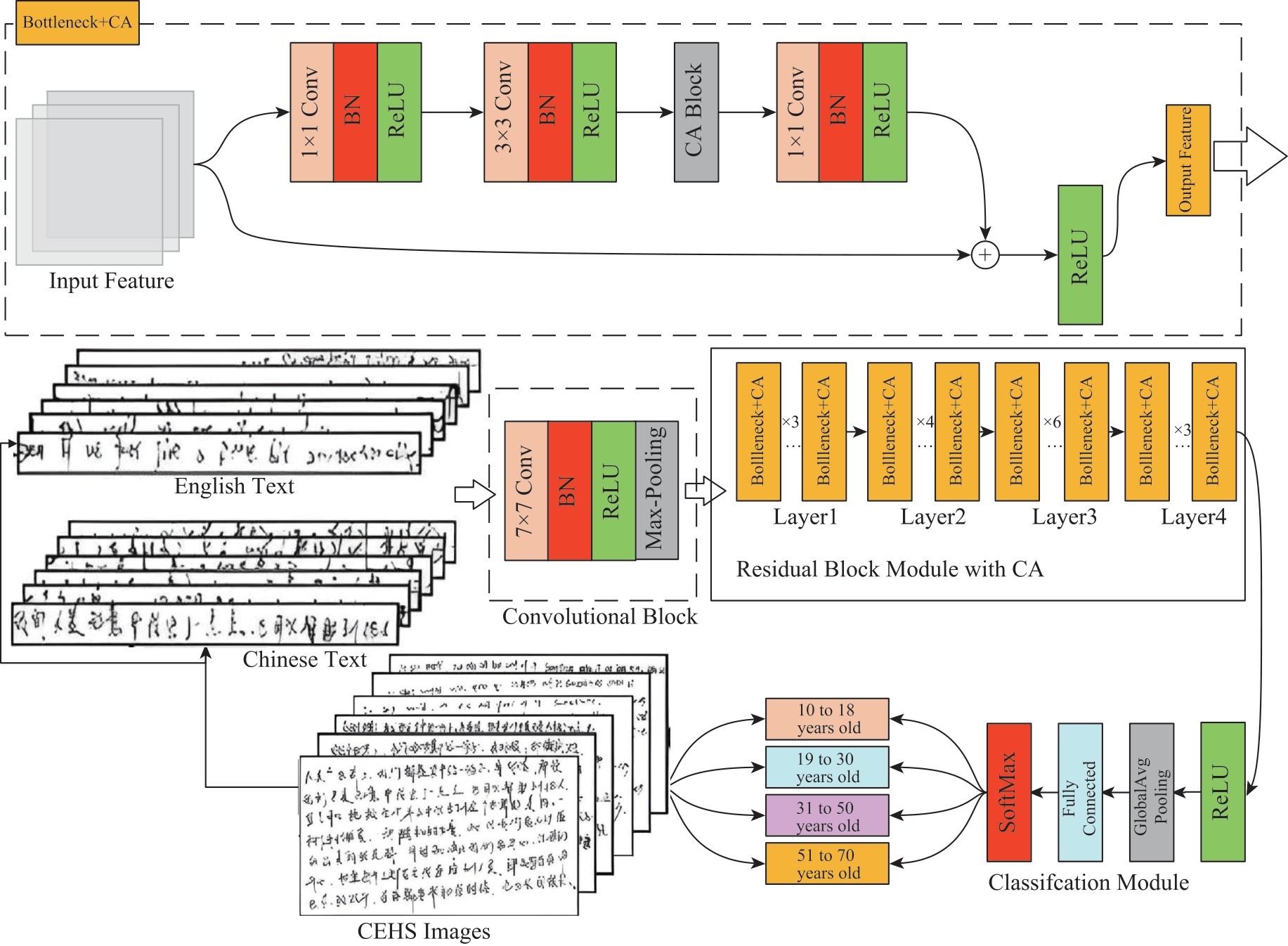
Table 3
End-to-End deep learning method for handwriting detection"
| 检测内容 | 作者 | 数据集 | 训练网络 | 方法概述及优势 | 不足 |
|---|---|---|---|---|---|
| 性别和利手性 | Morera2018[ | IAM、KHATT | CNN | 通过CNN自动提取特征,实现性别和惯用手性的高效预测,在多语言数据集上表现良好,简化了模型设计 | 对数据量和样本多样性依赖较高,处理连笔或低质量文本时性能下降 |
| 性别和利手性 | Rahmanian2021[ | KHATT、IAM | InceptionV3、 DenseNet201、Xception | 使用先进CNN(如DenseNet201、InceptionV3和Xception)实现高精度性别和惯用手性分类 | 对样本多样性和数量依赖较高,手写风格重叠时分类准确性下降 |
| 性别 | Rabaev2021[ | HHD、QUWI | VGGNet、ResNet、Inception、Xception、DenseNet、NASNet、EfficientNet | 结合迁移学习,对多语言笔迹数据集进行性别分类,分类精度高于以往研究 | 对数据量需求大,跨语言分类时表现波动,通用性受限 |
| 性别、年龄 | Balat2024[ | KHATT、AHAWP、MSHD | ResNet50、MobileNetV2、EfficientNetB7 | 通过深度学习和迁移学习,使用先进模型(如ResNet50、MobileNetV2和EfficientNetB7)进行阿拉伯笔迹识别,分类准确率高,引入数据增强技术提高泛化能力 | 对预处理和数据增强技术依赖高,需大规模高质量数据集,实际应用中可扩展性和适用性受限 |
| 性别 | Xue2020[ | ICDAR 2013、KHATT、IAM | ATP-DenseNet | 提出基于注意力机制的两路径DenseNet模型(ATP-DenseNet),结合页面级和单词级特征,提高性别分类精度,在多个数据集上表现良好 | 对手写图像切分质量敏感,高连笔性文本中切分不当可能导致分类精度下降 |
| 性别、年龄 | Rabaev2022[ | KHATT、QUWI、HHD | B-ResNet | 提出双线性ResNet网络,对多语言笔迹数据集进行性别和年龄分类,表现优于现有方法 | 对样本量需求高,高龄组(50岁以上)分类表现不理想,数据量较少导致模型难以有效学习 |
| 年龄 | Zhao2024[ | CEHS、IAM | CA-ResNet | 引入坐标注意力机制增强深度残差网络(CA-ResNet),显著提升年龄识别精度和效率,在多语言数据集上表现优异 | 对数据量需求高,部分年龄组(特别是老年组)分类准确率较低 |
Fig.5
ATP-DenseNet network[56] architecture"
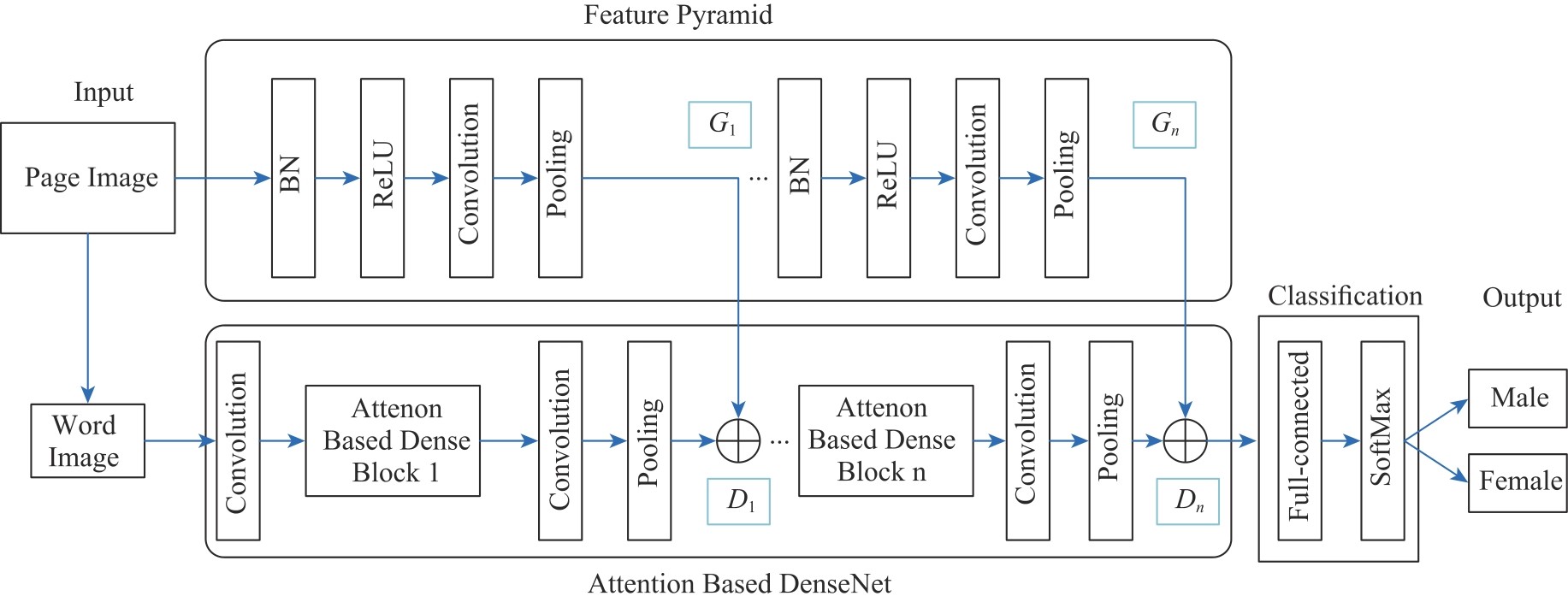
Table 4
Comparison of features in handwriting detection methods"
| 方法类别 | 代表方法 | 主要特点 | 适用数据集 | 优势 | 局限性 | 实际应用效果 |
|---|---|---|---|---|---|---|
| 传统机器学习 | SVM、 KNN、朴素 贝叶斯等 | 依赖于手动设计和提取特征;对小数据集的适应性强 | 数据量较小、特征单一的数据集 | 对数据量要求较低 | 无法自动学习复杂特征,其性能高度依赖于选取的特征是否能够充分代表数据的模式;对跨数据集泛化能力较弱 | 适用于特征稳定、数据无大量噪声的数据集 |
| 端到端的深度学习 | CNN | 自动提取复杂特征 | 数据量充足、复杂场景数据 | 适应复杂的书写风格 | 数据需求大,资源消耗高;容易出现过拟合问题 | 适合在复杂数据集和应用场景中使用 |
Table 5
Gender classification performance on the QUWI dataset"
| 准确率(%) | ||||||||
|---|---|---|---|---|---|---|---|---|
| 训练集(上)测试集(下) | ||||||||
| 文献 | 数据集设置 | 特征/特征提取方法 | 分类器 | Ar | En | Ar | En | Ar+En |
| Ar | En | En | Ar | Ar+En | ||||
| [ | TR=300,VL=100,TS=100 | LBP,HOG,GLCM | 集成 | — | — | — | — | 85.0 |
| [ | TR=2800,TS=1200 | AlexNet | LDA | 69.83 | 71.50 | 64.83 | 65.16 | 70.08 |
| [ | TR=282,TS=193 | 基于小波变换的全局纹理特征 | SVM | 77.70 | 75.50 | 69.40 | 68.60 | — |
| ANN | 71.90 | 69.00 | 67.80 | 68.70 | — | |||
| [ | TR=1200,TS=400 | 倾斜,曲率,整齐度,分形特征,纹理特征 | SVM | 68.50 | 68.50 | 62.50 | 67.00 | 68.75 |
| ANN | 66.50 | 65.00 | 65.00 | 65.00 | 67.50 | |||
| [ | TR=500,VL=250,TS=250 | COLD和Hinge特征 | SVM | 74.8 | 73.6 | 64.00 | 64.80 | — |
| [ | TR=300,VL=100,TS=100 | SIFT描述符 | SVM | 74.00 | 76.00 | 73.00 | 70.00 | — |
| 集成 | 82.00 | 81.00 | 68.00 | 64.00 | — | |||
| [ | S=4068,TR=70%,TS=30% | 几何特征 | RF | 71.1 | 71.6 | — | — | 69.8 |
| KDA | 68.4 | 69.7 | — | — | 72.3 | |||
| [ | TR=300,VL=100,TS=100 | Gabor滤波器、傅立叶变换 | NN | 70.0 | 67.0 | 63.0 | 69.0 | — |
Table 6
Gender classification performance in the ICDAR 2013, ICDAR 2015, and ICFHR 2016 competitions"
| 准确率(%) | ||||||||
|---|---|---|---|---|---|---|---|---|
| 训练集(上)测试集(下) | ||||||||
| 文献 | 特征/特征提取方法 | 分类器 | Ar | En | Ar | En | Ar+En | |
| Ar | En | En | Ar | Ar+En | ||||
| [ | ICDAR2013 | 基于小波变换的全局纹理特征 | SVM | 77.7 | 75.5 | — | — | 77.8 |
| ANN | 71.9 | 69 | — | — | 79.3 | |||
| [ | ICDAR2013 | 基于方向的基本图像特征(oBIF) | 集成分类器 | 76.17 | 77.98 | — | — | 75 |
| [ | ICDAR2013 | 方向、曲率、链码、梯度方向、纹理和字形特征 | SVM | — | — | — | — | 63.6 |
| [ | ICDAR2013 | 纹理特征、几何特征和Gabor特征 | SVM | — | — | — | — | 67.2 |
| [ | ICDAR2013 | 形态特征 | SVM、LR、KNN集成 | — | — | — | — | 65.71 |
| [ | ICDAR2013 | 像素特征 | Efficient-Net | 74 | 75 | — | — | 67 |
| [ | ICDAR2013 | 像素特征 | ATP-DenseNet-169 | — | — | — | — | 71.8 |
| [ | ICDAR2015 | 纹理特征和形态特征 | SVM | 68.5 | 68.5 | 62.5 | 67 | — |
| ANN | 65 | 66.5 | 63 | 65 | — | |||
| [ | ICDAR2015 | 纹理特征 | ANN | 70 | 67 | 69 | 63 | — |
| [ | ICDAR2015 | LBP,HOG,GLCM,SFTA | 集成分类器 | 79 | 85 | 80 | 81 | — |
| [ | ICDAR2015 | 像素特征 | CNN | 76 | 77 | 71 | 73 | — |
| [ | ICDAR2015 | 基于方向的基本图像特征(oBIF) | 集成分类器 | 64 | 75 | 66 | 55 | — |
| [ | ICDAR2015 | 纹理和局部特征 | SVM | 74 | 76 | 73 | 70 | — |
| AdaBoost | 82 | 81 | 68 | 64 | — | |||
| [ | ICFHR2016 | 基于方向的基本图像特征(oBIF) | SVM | 74.8 | 75.2 | 66 | 70 | — |
| [ | ICFHR2016 | HOTs、LBPriu、GLBP | SVM,FI | 73.86 | 70.39 | 67.96 | 64.37 | — |
| [ | ICFHR2016 | 纹理特征 | SVM | 86.5 | — | — | — | — |
Table 7
Gender classification performance on the MSHD dataset"
| 准确率(%) | ||||||||
|---|---|---|---|---|---|---|---|---|
| 训练集(上)测试集(下) | ||||||||
| 文献 | 数据集设置 | 特征/特征提取方法 | 分类器 | Ar | Fr | Ar | Fr | Ar+Fr |
| Ar | Fr | Fr | Ar | Ar+Fr | ||||
| [ | TR=252,TS=252 | HOTs、LBPriu、GLBP | SVM,FI | 88.09 | 88.09 | 80.95 | 80.95 | — |
| [ | TR=252,TS=252 | 基于小波变换的全局纹理特征 | SVM | 75.80 | 77.60 | 77.90 | 75.70 | 79.90 |
| ANN | 76.40 | 75.10 | 74.20 | 75.20 | 79.00 | |||
| [ | TR=252,TS=252 | 倾斜,曲率,整齐度,分形特征,纹理特征 | SVM | 76.98 | 70.63 | 57.94 | 70.63 | 73.02 |
| ANN | 73.41 | 69.44 | 61.90 | 69.84 | 69.44 | |||
| [ | TR=950,TS=950 | SIFT描述符 | SVM | 85.00 | 83.00 | 69.00 | 68.00 | — |
| 集成 | 90.00 | 87.00 | 62.00 | 66.00 | — | |||
Table 8
Gender classification performance on the IAM dataset"
| 文献 | 数据集设置 | 特征/特征提取方法 | 分类器 | 准确率(%) |
|---|---|---|---|---|
| [ | TR=200,VL=50,TS=100 | LBP,HOG | SVM | 70.00 |
| TS=50 | 74.00 | |||
| [ | TR=80,VL=20,TS=50 | HOG,,GLBP | SVM | 70.00 |
| [ | TR=100,TS=50 | 曲线变换 | OC-SVM | 77.33 |
| [ | TR=8,462,TS=2,464 | 形状和曲率特征 | CNN | 80.72 |
| [ | S=330 | InceptionV3,DenseNet201,Xception | CNN | 77.60 |
| [ | TR=2,573,TS=1,286 | ATP-DenseNet-169 | CNN | 77.60 |
Table 9
Gender classification performance on the KHATT dataset"
| 文献 | 数据集设置 | 特征/特征提取方法 | 分类器 | 准确率(%) |
|---|---|---|---|---|
| [ | W=135 | GLCM、GLBP、HOG和像素分布 | SVM,模糊MIN-MAX规则 | 82.22 |
| [ | W=135 | HOG,GLBP | SVM | 74.44 |
| [ | W=135 | HOTs、LBPriu、GLBP | SVM,FI | 82.22 |
| [ | W=1,000,S=2,000 | 形状和曲率特征 | CNN | 68.90 |
| [ | W=135,S=270 | InceptionV3,DenseNet201,Xception | CNN | 75.00 |
| [ | W=1,000,S=2,000 | ATP-DenseNet-169 | CNN | 74.10 |
| [ | W=1,000,S=2,000 | B-ResNet | B-CNN | 76.14 |
Table 10
Age detection performance on various datasets"
| 文献 | 数据集 | 数据集设置 | 特征/特征提取方法 | 分类器 | 准确率(%) |
|---|---|---|---|---|---|
| [ | IAM | S=1,700, C=2 | CA-ResNet | CA-ResNet | 79.6 |
| [ | KHATT | S=270, C=2 | GLCM、GLBP、HOG | SVM | 81.11 |
| [ | IAM | S=330, C=2 | HOG, GLBP | SVM | 70 |
| KHATT | S=405, C=3 | 55 | |||
| [ | QUWI | S=4,068, C=7 | 几何特征 | KDA,RF | 55 |
| [ | KHATT | S=2,000, C=2 | B-ResNet | B-ResNet | 78.17 |
| C=3 | 67.3 | ||||
| C=4 | 66.65 | ||||
| [ | KHATT | S=405, C=2 | GoogleNet, ResNet | SVM | 65.2 |
| C=2 | ANN | 67 | |||
| FSHS | S=2,000, C=2 | SVM | 71 | ||
| C=2 | ANN | 63.5 | |||
| [ | 自建数据集 | S=400, C=3 | 断续特征 | K-means | 66.25 |
| IAM | S=168, C=2 | 63.6 | |||
| KHATT | S=838, C=2 | 64.44 | |||
| [ | FSHS | S=2,000, C= 2 | ResNet, GoogleNet | SVM | 69.7 |
| [1] | KRIZHEVSKY A, SUTSKEVER I, HINTON G E. ImageNet classification with deep convolutional neural networks[J]. Advances in Neural Information Processing Systems, 2012, 25: 1097-1105. |
| [2] | 韩丹岩, 涂丽云. 文件检验学[M]. 北京: 中国人民公安大学出版社, 2021:19. |
| [3] | HUBER R A, HEADRICK A M. Handwriting identification[M]. Boca RatonFL, USA: CRC Press, 1999. |
| [4] |
GOODENOUGH F L. Sex differences in judging the sex of handwriting[J]. The Journal of Social Psychology, 1945, 22(1): 61-68.
doi: 10.1080/00224545.1945.9714182 |
| [5] |
HAMID S, LOEWENTHAL K M. Inferring gender from handwriting in Urdu and English[J]. The Journal of Social Psychology, 1996, 136(6): 778-782.
doi: 10.1080/00224545.1996.9712254 |
| [6] | UPADHYAY S, SINGH J, SHUKLA S K. Determination of sex through handwriting characteristics[J]. International Journal of Current Research and Review, 2017, 9(13): 11-18. |
| [7] |
VLACHOS F, BONOTI F. Explaining age and sex differences in children’s handwriting: A neurobiological approach[J]. European Journal of Developmental Psychology, 2006, 3(2): 113-123.
doi: 10.1080/17405620500371455 |
| [8] | MARZINOTTO G, ROSALES J C, EL-YACOUBI M A, et al. Age-related evolution patterns in online handwriting[J]. Computational and Mathematical Methods in Medicine, 2016, 2016: 1-15. |
| [9] | MAADEED S A, AYOUBY W, HASSAINE A, et al. QUWI: an arabic and english handwriting dataset for offline writer identification[C]// 2012 International Conference on Frontiers in Handwriting Recognition. Bari, Italy: IEEE, 2012: 746-751. |
| [10] | DJEDDI C, GATTAL A, SOUICI-MESLATI L, et al. LAMIS-MSHD: a multi-script offline handwriting database[C]// 2014 14th International Conference on Frontiers in Handwriting Recognition. Hersonissos, Greece: IEEE, 2014: 93-97. |
| [11] | MAHMOUD S A, AHMAD I, ALSHAYEB M, et al. KHATT: arabic offline handwritten text database[C]// 2012 International Conference on Frontiers in Handwriting Recognition. Bari, Italy: IEEE, 2012: 449-454. |
| [12] |
MAHMOUD S A, AHMAD I, AL-KHATIB W G, et al. KHATT: an open arabic offline handwritten text database[J]. Pattern Recognition, 2014, 47(3): 1096-1112.
doi: 10.1016/j.patcog.2013.08.009 |
| [13] |
MARTI U V, BUNKE H. The IAM-database: an English sentence database for offline handwriting recognition[J]. International Journal on Document Analysis and Recognition, 2002, 5(1): 39-46.
doi: 10.1007/s100320200071 |
| [14] | RABAEV I, KURAR B B, CHURKIN A, et al. The HHD dataset[C]// 2020 17th International Conference on Frontiers in Handwriting Recognition (ICFHR). Dortmund, Germany: IEEE, 2020: 228-233. |
| [15] | AL-QAWASMEH N, SUEN C Y. Gender detection from handwritten documents using concept of transfer-learning[M]// LUY, VINCENTN, YUENP C, et al. Pattern Recognition and Artificial Intelligence, ICPRAI 2020:Vol. 12068. Zhongshan, China: Springer International Publishing, 2020: 3-13. |
| [16] | TAN J, BI N, SUEN C Y, et al. Multi-feature selection of handwriting for gender identification using mutual information[C]// 2016 15th International Conference on Frontiers in Handwriting Recognition (ICFHR). Shenzhen, China: IEEE, 2016: 578-583. |
| [17] |
BI N, SUEN C Y, NOBILE N, et al. A multi-feature selection approach for gender identification of handwriting based on kernel mutual information[J]. Pattern Recognition Letters, 2019, 121: 123-132.
doi: 10.1016/j.patrec.2018.05.005 |
| [18] | ZHAO L, WU X, CHEN X. Enhancing age estimation from handwriting: A deep learning approach with attention mechanisms[J]. International Journal of Advanced Computer Science and Applications, 2024, 15(5): 738-747. |
| [19] | ILLOUZ E, (OMID) DAVID E, NETANYAHU N S. Handwriting-based gender classification using end-to-end deep neural networks[C]// KŮRKOVÁ V, MANOLOPOULOSY, HAMMERB, et al. Artificial Neural Networks and Machine Learning - ICANN 2018. Rhodes, Greece: Springer International Publishing, 2018: 613-621. |
| [20] |
CORTES C, VAPNIK V. Support-vector networks[J]. Machine Learning, 1995, 20(3): 273-297.
doi: 10.1023/A:1022627411411 |
| [21] | BOUADJENEK N, NEMMOUR H, CHIBANI Y. Towards the prediction of multiple soft-biometric characteristics from handwriting analysis[C]// AMINE A, MOUHOUBM, AITMOHAMED O, et al. Computational Intelligence and Its Applications- 6th IFIP TC 5 International Conference, CIIA 2018:Vol. 522. Oran, Algeria: Springer International Publishing, 2018: 211-219. |
| [22] |
BOUADJENEK N, NEMMOUR H, CHIBANI Y. Fuzzy integrals for combining multiple SVM and histogram features for writer’s gender prediction[J]. IET Biometrics, 2017, 6(6): 429-437.
doi: 10.1049/bme2.v6.6 |
| [23] | BOUADJENEK N, NEMMOUR H, CHIBANI Y. Fuzzy integral for combining SVM-based handwritten soft-biometrics prediction[C]//2016 12th IAPR Workshop on Document Analysis Systems (DAS). Santorini, Greece: IEEE, 2016: 311-316. |
| [24] | BOUADJENEK N, NEMMOUR H, CHIBANI Y. Local descriptors to improve off-line handwriting-based gender prediction[C]//2014 6th International Conference of Soft Computing and Pattern Recognition (SoCPaR). Tunis, Tunisia: IEEE, 2014: 43-47. |
| [25] |
BOUADJENEK N, NEMMOUR H, CHIBANI Y. Robust soft-biometrics prediction from off-line handwriting analysis[J]. Applied Soft Computing, 2016, 46: 980-990.
doi: 10.1016/j.asoc.2015.10.021 |
| [26] | BOUADJENEK N, NEMMOUR H, CHIBANI Y. Age, gender and handedness prediction from handwriting using gradient features[C]// 2015 13th International Conference on Document Analysis and Recognition (ICDAR). Tunis, Tunisia: IEEE, 2015: 1116-1120. |
| [27] |
GATTAL A, DJEDDI C, SIDDIQI I, et al. Gender classification from offline multi-script handwriting images using oriented Basic Image Features (oBIFs)[J]. Expert Systems with Applications, 2018, 99: 155-167.
doi: 10.1016/j.eswa.2018.01.038 |
| [28] |
AHMED M, RASOOL A G, AFZAL H, et al. Improving handwriting based gender classification using ensemble classifiers[J]. Expert Systems with Applications, 2017, 85: 158-168.
doi: 10.1016/j.eswa.2017.05.033 |
| [29] | GORNALE S S, KUMAR S, PATIL A, et al. Behavioral biometric data analysis for gender classification using feature fusion and machine learning[J]. Frontiers in Robotics and AI, 2021, 8: Article No.685966. |
| [30] | MOETESUM M, SIDDIQI I, DJEDDI C, et al. Data driven feature extraction for gender classification using multi-script handwritten texts[C]// 2018 16th International Conference on Frontiers in Handwriting Recognition (ICFHR). Niagara Falls, NY, USA: IEEE, 2018: 564-569. |
| [31] |
DARGAN S, KUMAR M, TUTEJA S. PCA-based gender classification system using hybridization of features and classification techniques[J]. Soft Computing, 2021, 25(24): 15281-15295.
doi: 10.1007/s00500-021-06118-0 |
| [32] |
MAKEN P, GUPTA A. A method for automatic classification of gender based on text- independent handwriting[J]. Multimedia Tools and Applications, 2021, 80(16): 24573-24602.
doi: 10.1007/s11042-021-10837-9 |
| [33] |
AKBARI Y, NOURI K, SADRI J, et al. Wavelet-based gender detection on off-line handwritten documents using probabilistic finite state automata[J]. Image and Vision Computing, 2017, 59: 17-30.
doi: 10.1016/j.imavis.2016.11.017 |
| [34] |
SIDDIQI I, DJEDDI C, RAZA A, et al. Automatic analysis of handwriting for gender classification[J]. Pattern Analysis and Applications, 2015, 18(4): 887-899.
doi: 10.1007/s10044-014-0371-0 |
| [35] | GATTAL A, DJEDDI C, BENSEFIA A, et al. Handwriting based gender classification using COLD and hinge features[C]// EL MOATAZ A, MAMMASSD, MANSOURIA, et al. Image and Signal Processing- 9th International Conference, ICISP 2020:Vol. 12119. Marrakesh, Morocco: Springer International Publishing, 2020: 233-242. |
| [36] | ALAEI F, ALAEI A. Gender detection based on spatial pyramid matching[C]// LLADÓS J, LOPRESTI D, UCHIDA S. Document Analysis and Recognition - 16th International Conference, ICDAR 2021:Vol. 12824. Lausanne, Switzerland: Springer International Publishing, 2021: 305-317. |
| [37] | GUERBAI Y, CHIBANI Y, HADJADJI B. Handwriting gender recognition system based on the one-class support vector machines[C]// 2017 Seventh International Conference on Image Processing Theory, Tools and Applications (IPTA). Montreal, QC, Canada: IEEE, 2017: 1-5. |
| [38] |
MCCULLOCH W S, PITTS W. A logical calculus of the ideas immanent in nervous activity[J]. The Bulletin of Mathematical Biophysics, 1943, 5(4): 115-133.
doi: 10.1007/BF02478259 |
| [39] | MIRZA A, MOETESUM M, SIDDIQI I, et al. Gender classification from offline handwriting images using textural features[C]// 2016 15th International Conference on Frontiers in Handwriting Recognition (ICFHR). Shenzhen, China: IEEE, 2016: 395-398. |
| [40] | CHA S H, SRIHARI S N. A priori algorithm for sub-category classification analysis of handwriting[C]// Proceedings of Sixth International Conference on Document Analysis and Recognition. Seattle, WA, USA: IEEE Comput. Soc, 2001: 1022-1025. |
| [41] |
WU X, KUMAR V, ROSS QUINLAN J, et al. Top 10 algorithms in data mining[J]. Knowledge and Information Systems, 2008, 14(1): 1-37.
doi: 10.1007/s10115-007-0114-2 |
| [42] | TIN KAM HO. Random decision forests[C]// Proceedings of 3rd International Conference on Document Analysis and Recognition:Vol. 1.Montreal, QC, Canada: IEEE Comput. Soc. Press, 1995: 278-282. |
| [43] | FREUND Y, SCHAPIRE R E. A short introduction to boosting[J]. Journal of Japanese Society for Artificial Intelligence, 1999, 14(5): 771-780. |
| [44] |
TOPALOGLU M, EKMEKCI S. Gender detection and identifying one’s handwriting with handwriting analysis[J]. Expert Systems with Applications, 2017, 79: 236-243.
doi: 10.1016/j.eswa.2017.03.001 |
| [45] |
AL MAADEED S, HASSAINE A. Automatic prediction of age, gender, and nationality in offline handwriting[J]. EURASIP Journal on Image and Video Processing, 2014, 2014(1): 10.
doi: 10.1186/1687-5281-2014-10 |
| [46] |
ALTMAN N S. An introduction to kernel and nearest-neighbor nonparametric regression[J]. The American Statistician, 1992, 46(3): 175-185.
doi: 10.1080/00031305.1992.10475879 |
| [47] | RAYENS W S. Discriminant analysis and statistical pattern recognition[J]. Technometrics, 1993, 35(3): 324-326. |
| [48] | MCLACHLAN G J. Discriminant analysis and statistical pattern recognition[M]. Hoboken, NJ, USA: Wiley, 1992. |
| [49] |
FISHER R A. The statistical utilization of multiple measurements[J]. Annals of Eugenics, 1938, 8(4): 376-386.
doi: 10.1111/ahg.1938.8.issue-4 |
| [50] | BAYES T, PRICE R. An essay towards solving a problem in the doctrine of chances[J]. Philosophical Transactions of the Royal Society of London, 1763, 53: 370-418. |
| [51] | HOSMER D W, LEMESHOW S. An Introduction to Logistic Regression[M]// HosmerD W, LemeshowS. Applied Logistic Regression. New York: Springer, 2000: 1-30. |
| [52] |
MORERA Á, SÁNCHEZ Á, VÉLEZ J F, et al. Gender and handedness prediction from offline handwriting using convolutional neural networks[J]. Complexity, 2018, 2018(1): 3891624.
doi: 10.1155/cplx.v2018.1 |
| [53] |
RAHMANIAN M, SHAYEGAN M A. Handwriting-based gender and handedness classification using convolutional neural networks[J]. Multimedia Tools and Applications, 2021, 80(28-29): 35341-35364.
doi: 10.1007/s11042-020-10170-7 |
| [54] | RABAEV I, LITVAK M, ASULIN S, et al. Automatic gender classification from handwritten images: a case study[C]// Tsapatsoulis N, PanayidesA, TheocharidesT, et al. Computer Analysis of Images and Patterns-19th International Conference, CAIP 2021:Vol. 13053. Virtual Event:Springer International Publishing, 2021: 329-339. |
| [55] | BALAT M, MOHAMED Y, HEAKL A, et al. Arabic handwritten text for person biometric identification: a deep learning approach[OL].[2024-06-01]. |
| [56] |
XUE G, LIU S, GONG D, et al. ATP-DenseNet: a hybrid deep learning-based gender identification of handwriting[J]. Neural Computing and Applications, 2021, 33(10): 4611-4622.
doi: 10.1007/s00521-020-05237-3 |
| [57] |
RABAEV I, ALKORAN I, WATTAD O, et al. Automatic gender and age classification from offline handwriting with bilinear ResNet[J]. Sensors, 2022, 22(24):9650.
doi: 10.3390/s22249650 |
| [58] |
AL-QAWASMEH N, KHAYYAT M, SUEN C Y. Age detection from handwriting using different feature classification models[J]. Pattern Recognition Letters, 2023, 167: 60-66.
doi: 10.1016/j.patrec.2023.02.001 |
| [59] | BASAVARAJA V, SHIVAKUMARA P, GURU D S, et al. Age estimation using disconnectedness features in handwriting[C]// 2019 International Conference on Document Analysis and Recognition (ICDAR). Sydney, Australia: IEEE, 2019: 1131-1136. |
| [60] | AL-QAWASMEH N Y. SUEN C. Transfer learning to detect age from handwriting[J]. Advances in Artificial Intelligence and Machine Learning, 2022, 2(2): 394-406. |
| [61] |
郭佳霖, 智敏, 殷雁君, 等. 图像处理中CNN与视觉Transformer混合模型研究综述[J]. 计算机科学与探索, 2025, 19(1): 30-44.
doi: 10.3778/j.issn.1673-9418.2403009 |
| [62] | 陈栋, 李明, 陈淑文. 结合Transformer和多层特征聚合的高光谱图像分类算法[J]. 数据与计算发展前沿, 2023, 5(3): 138-151. |
| [63] | 储岳中, 石玉金, 张学锋, 等. 基于切分通道注意力网络的图像分类算法[J]. 工程科学学报, 2024, 46(10): 1856. |
| [64] |
刘娟, 王颖, 胡敏, 等. 融合全局增强-局部注意特征的表情识别网络[J]. 计算机科学与探索, 2024, 18(9): 2487-2500.
doi: 10.3778/j.issn.1673-9418.2307013 |
| [1] | PAN Yuquan,YUAN Deyu,JIA Yuan,WANG Anran. VGAT-VGAN Across Social Networks User Identity Linkage Algorithm Based on Fusion Features [J]. Frontiers of Data and Computing, 2026, 8(1): 103-118. |
| [2] | WAN Meng, HE Honglin, REN Xiaoli, NIE Ningming, CAO Rongqiang, WANG Zongguo, LI Kai, WANG Xiaoguang, WANG Yangang, WANG Jue, GAO Chao. The Real-Time Assimilation and Prediction System for Terrestrial Ecosystem Carbon Cycling Based on Workflow [J]. Frontiers of Data and Computing, 2026, 8(1): 168-182. |
| [3] | FENG Wenjun,ZHANG Zhengjun,WANG Yiming. Jump Information, Machine Learning Models, and Realized Volatility Forecasting [J]. Frontiers of Data and Computing, 2026, 8(1): 45-63. |
| [4] | DENG Yiru,HE Hongbo,WANG Ying,WANG Runqiang. Network Public Opinion Tendency Detection Method Based on Sentiment Analysis [J]. Frontiers of Data and Computing, 2026, 8(1): 91-102. |
| [5] | YANG Qinmeng,NIE Ningming,ZHOU Chunbao,WANG Yangang. Algorithm for Taylor Bar Collision Data Simulation Based on Deep Learning [J]. Frontiers of Data and Computing, 2025, 7(6): 101-110. |
| [6] | ZHOU Faguo,LIU Fang,WANG Yangang,WANG Jue,YU Miao,LI Shunde,ZHOU Chunbao,WANG Jing,YANG Qinmeng. Porting and Adapting Deep Learning Framework Operators on Domestic Supercomputers [J]. Frontiers of Data and Computing, 2025, 7(6): 136-148. |
| [7] | LINGHU Rongwei,ZHANG Yu,SHI Yuanquan,YANG Yujun. Multi-Feature Fusion-Based Detection and Classification of Portable Executable Malware [J]. Frontiers of Data and Computing, 2025, 7(6): 77-91. |
| [8] | XIN Yuhang,WANG Qiyi,SUN Jing,ZHAO Chunyan,LIU Yujia,LIANG Xue,CHEN Jie. Application of Radar Echo Extrapolation Based Model TrajCast on Domestic Accelerators for Short-Term and Imminent Precipitation Forecasting [J]. Frontiers of Data and Computing, 2025, 7(5): 113-122. |
| [9] | WANG Peng,YANG Xiaofeng,HE Zhongchen,DU Jun. Multispectral Remote Sensing Image Pansharpening Method Based on Shallow-Deep Convolutional Recurrent Neural Network [J]. Frontiers of Data and Computing, 2025, 7(5): 138-152. |
| [10] | ZENG Yan,WU Baofu,YI Guangzheng,HUANG Chengchuang,QIU Yang,CHEN Yue,WAN Jian,HU Fan,JIN Sicong,LIANG Jiajun,LI Xin. FlowAware: A Feature-Aware Automated Model Parallelization Method for AI-for-Science Tasks [J]. Frontiers of Data and Computing, 2025, 7(5): 65-87. |
| [11] | JIA Ziang. Teeth Structure Segmentation Based on Multi-Source Semi-Supervised Learning [J]. Frontiers of Data and Computing, 2025, 7(2): 175-185. |
| [12] | MA Qiuping, ZHANG Qi, ZHAO Xiaofan. Review of Research on Chart Question Answering [J]. Frontiers of Data and Computing, 2025, 7(1): 19-37. |
| [13] | SHUI Yingyi, ZHANG Qi, LI Gen, ZHANG Shihao, WU Shang. A Review of Research on Social Network Influence Prediction Based on Multi-Class Features [J]. Frontiers of Data and Computing, 2025, 7(1): 2-18. |
| [14] | JIN Jiali, GAO Siyuan, GAO Manda, WANG Wenbin, LIU Shaozhen, SUN Zhenan. A Survey of Face Age Editing Based on Generative Adversarial Networks and Diffusion Models [J]. Frontiers of Data and Computing, 2025, 7(1): 38-55. |
| [15] | JI Peng,NIU Tie,WEI Ting,PENG Liang. Research on Supercomputer Job Running State Prediction Based on XGBoost Model [J]. Frontiers of Data and Computing, 2024, 6(6): 123-129. |
| Viewed | ||||||
|
Full text |
|
|||||
|
Abstract |
|
|||||

