Frontiers of Data and Computing ›› 2025, Vol. 7 ›› Issue (6): 77-91.
CSTR: 32002.14.jfdc.CN10-1649/TP.2025.06.008
doi: 10.11871/jfdc.issn.2096-742X.2025.06.008
• Special Issue: Call for Papers for the 40th National Conference on Computer Security • Previous Articles Next Articles
LINGHU Rongwei1( ),ZHANG Yu1,*(),SHI Yuanquan2,YANG Yujun3
Received:2025-08-04
Online:2025-12-20
Published:2025-12-17
LINGHU Rongwei, ZHANG Yu, SHI Yuanquan, YANG Yujun. Multi-Feature Fusion-Based Detection and Classification of Portable Executable Malware[J]. Frontiers of Data and Computing, 2025, 7(6): 77-91, https://cstr.cn/32002.14.jfdc.CN10-1649/TP.2025.06.008.
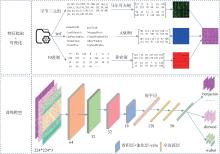
Fig.1
CNN-Based classification method using 3D tensor"
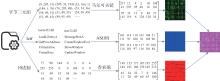
Fig.2
Visualization of malicious code"
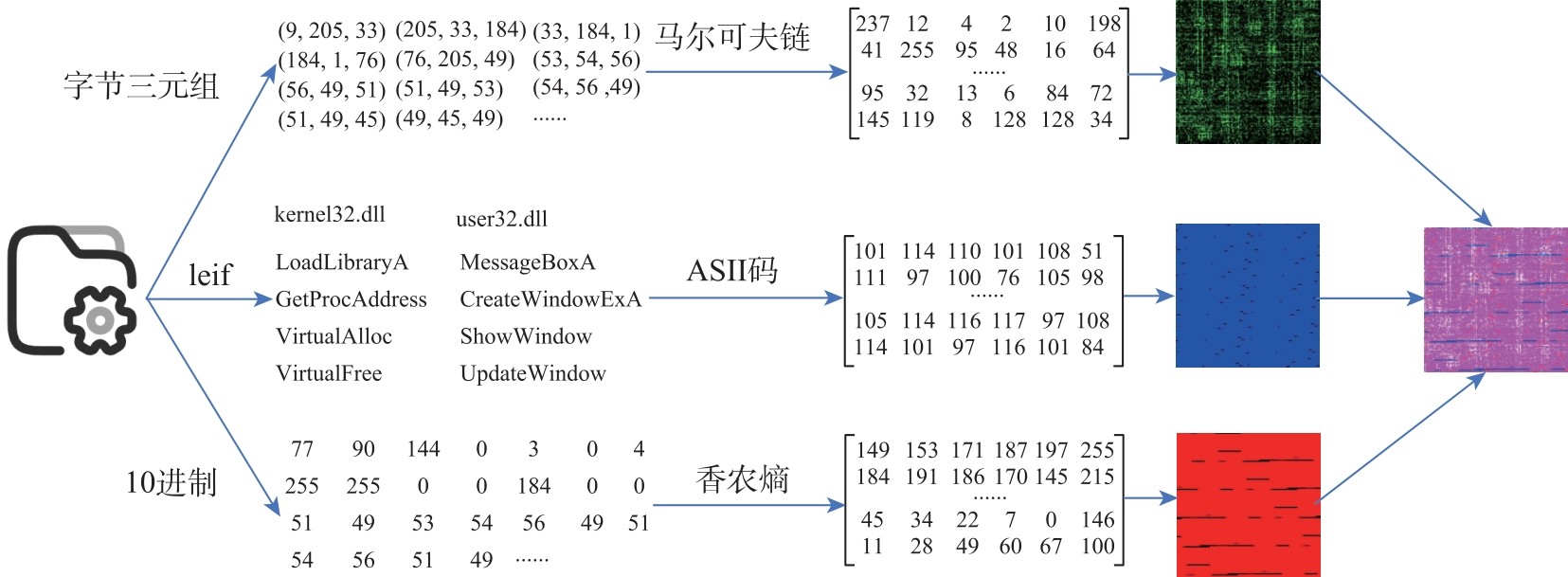
Fig.3
Visualization results"
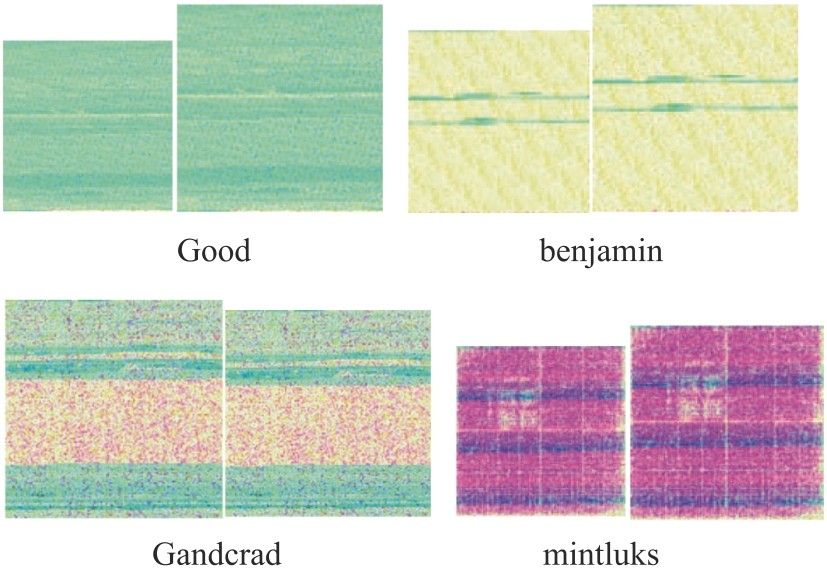
Fig.4
Bilinear interpolation is used to resize the image"
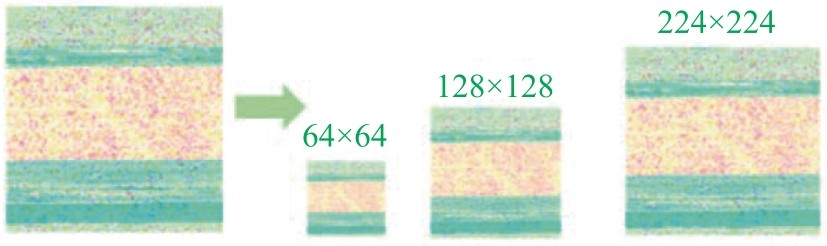
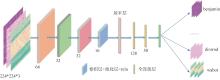
Fig.5
CNN structure"
Table 1
Hardware specifications"
| 参数 | 值 |
|---|---|
| 操作系统 | Windons专业版64bit |
| 随机存取内存 | 8.00 GB |
| 处理器 | Intel(R) Core(TM) i5-8250U CPU @ 1.60GHz 1.80 GHz |
| 硬盘 | 931GB SSD |
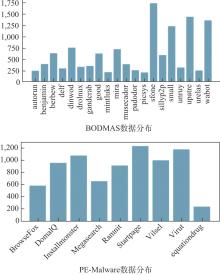
Fig.6
Data distribution details"
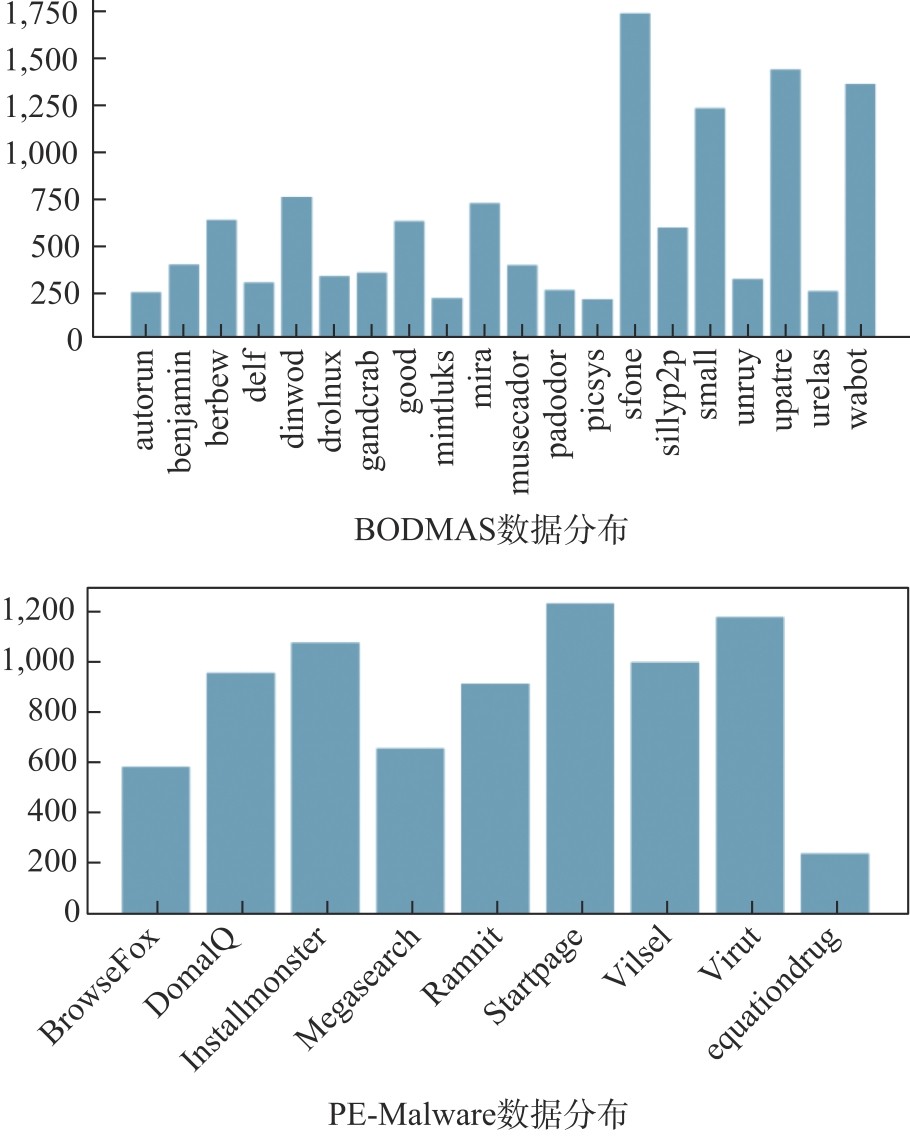
Table 2
Comparative results of Accuracy, Precision, Recall, and F1-Score (%)"
| 方案 | BODMAS | PE-Malware | |||||||
|---|---|---|---|---|---|---|---|---|---|
| 准确率 | 精度 | Recall | F1-Score | 准确率 | 精度 | Recall | F1-Score | ||
| MTE(本方案) | 97.06 | 97.02 | 96.85 | 96.85 | 96.97 | 97.04 | 97.42 | 97.13 | |
| DPP | 91.01 | 91.58 | 92.82 | 91.64 | 92.8 | 94.74 | 93.77 | 93.66 | |
| GEM | 87.03 | 89.17 | 90.76 | 89.29 | 88.64 | 90.25 | 90.03 | 90.09 | |
| Bin2 | 85.12 | 85.67 | 86.88 | 85.22 | 89.52 | 92.26 | 89.54 | 89.83 | |
| AHE | 94.67 | 94.96 | 95.89 | 94.99 | 95.83 | 96.54 | 96.33 | 96.18 | |
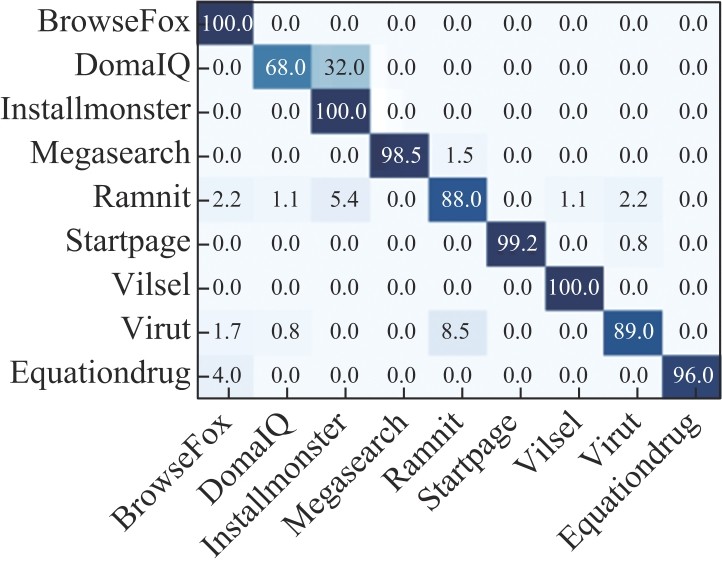
Fig.7
Confusion matrix of the MTE method"
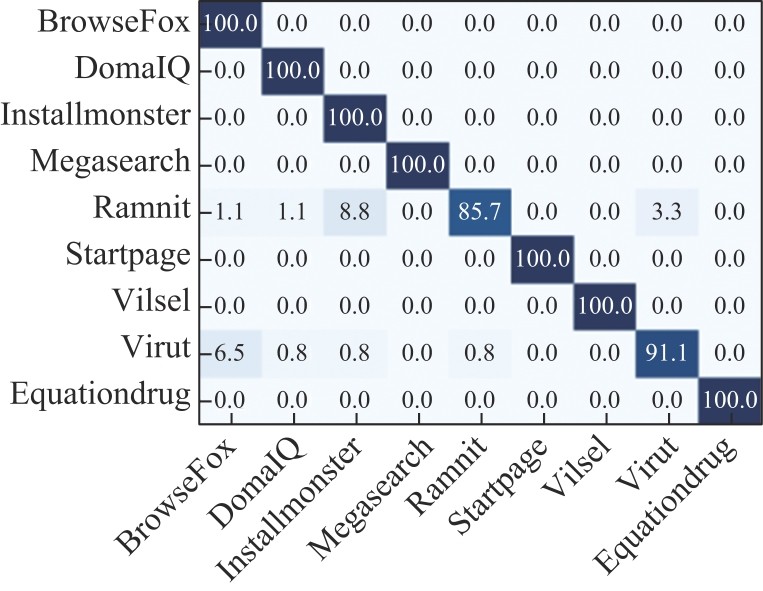
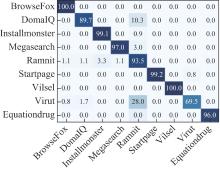
Fig.8
Confusion matrix of the DPP method"
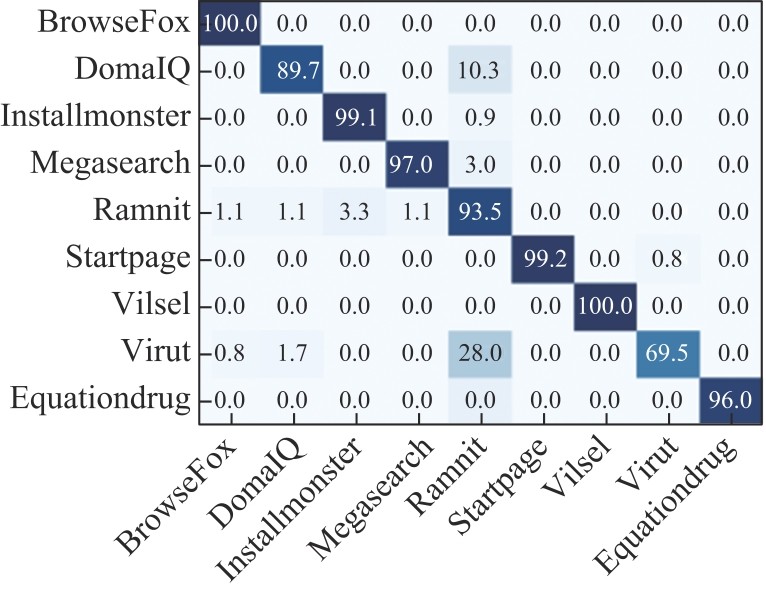
Fig.9
Confusion matrix of the GEM method"
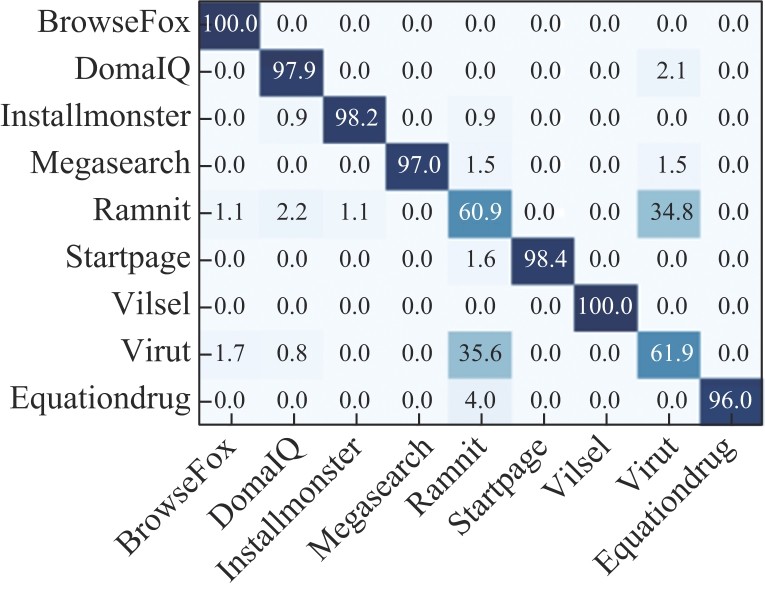
Fig.10
Confusion matrix of the BIN2 method<br"
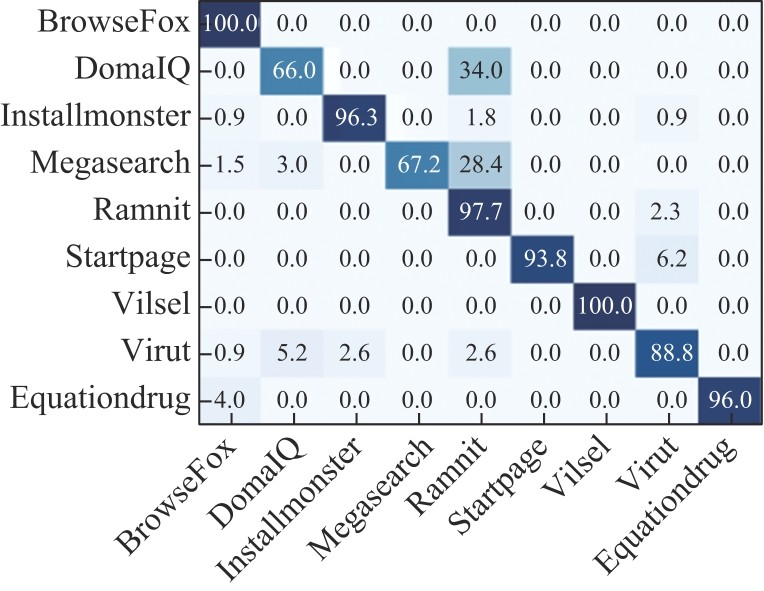
Fig.11
Confusion matrix of the AHE method"
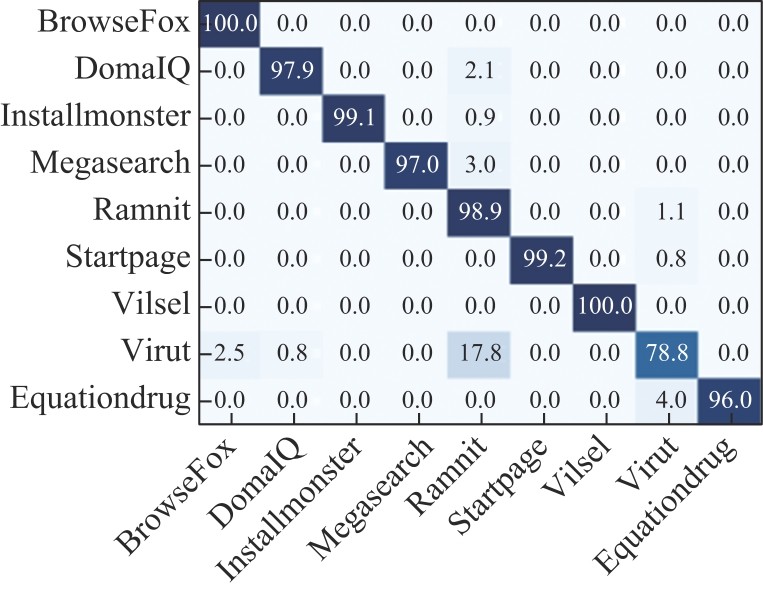
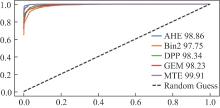
Fig.12
ROC curves of all methods"
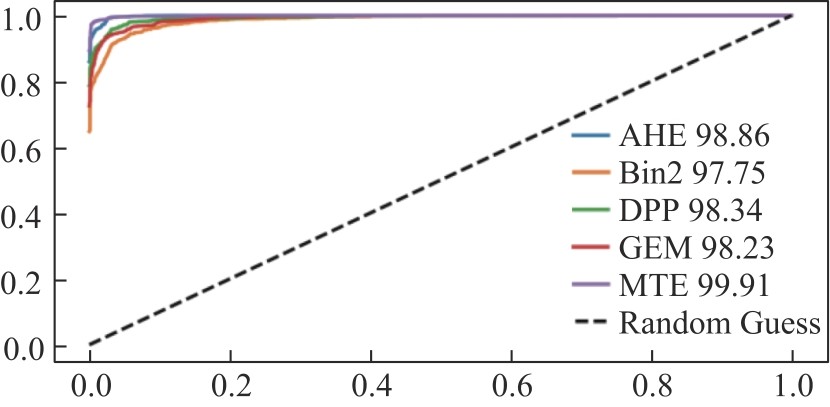
Table 3
Ablation Study Results for Accuracy, Precision, Recall, and F1-Score (%)"
| 特征 | BODMAS | PE-Malware | |||||||
|---|---|---|---|---|---|---|---|---|---|
| 准确率 | 精度 | Recall | F1-Score | 准确率 | 精度 | Recall | F1-Score | ||
| E | 86.4 | 89.76 | 89.83 | 87.99 | 89.52 | 90.15 | 91.04 | 90.35 | |
| M | 83.82 | 92.76 | 88.2 | 88.18 | 88.76 | 92.27 | 88.95 | 89.46 | |
| T | 85.76 | 89.19 | 90.5 | 87.64 | 83.08 | 83.98 | 84.85 | 78.83 | |
| E+M | 91.49 | 91.07 | 94.44 | 92.09 | 91.16 | 93.88 | 92.59 | 92.06 | |
| E+T | 93.56 | 92.75 | 94.4 | 93.12 | 94.19 | 94.4 | 94.79 | 94.42 | |
| T+M | 90.38 | 90.99 | 91.74 | 90.96 | 92.68 | 94.31 | 93.2 | 93.23 | |
| MTE(本方案) | 97.06 | 97.02 | 96.85 | 96.85 | 96.97 | 97.04 | 97.42 | 97.13 | |
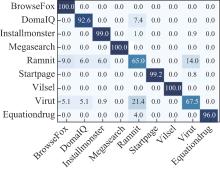
Fig.13
Confusion matrix of the entropy"
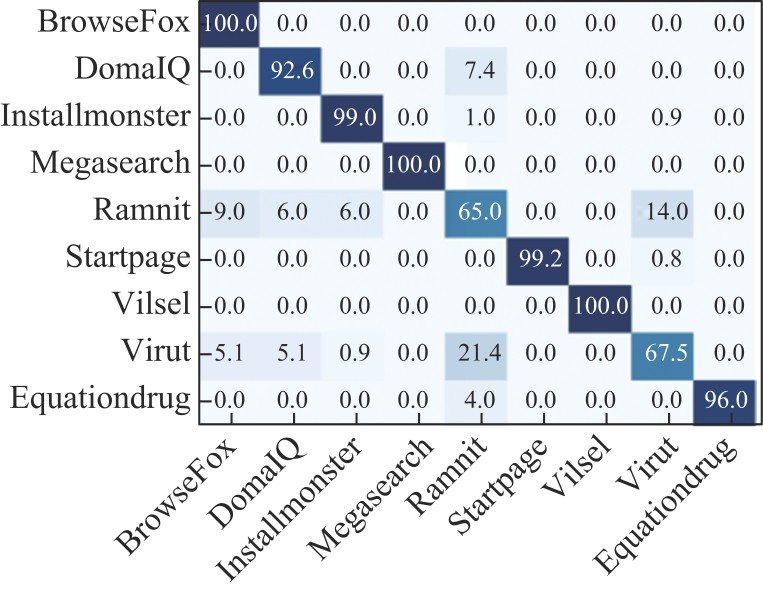
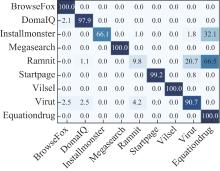
Fig.14
Confusion matrix of the import/export table"
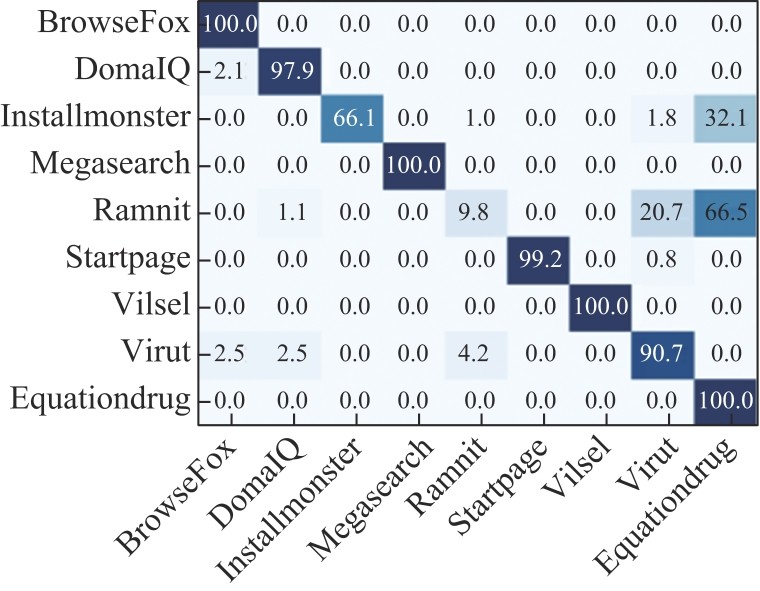
Fig.15
Confusion matrix of the third-order Markov"
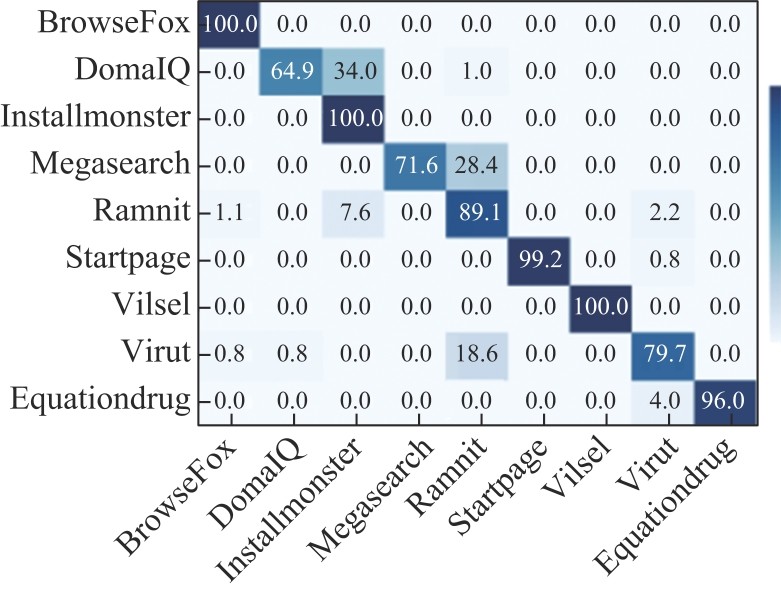
Fig.16
Confusion matrix of entropy + Markov"
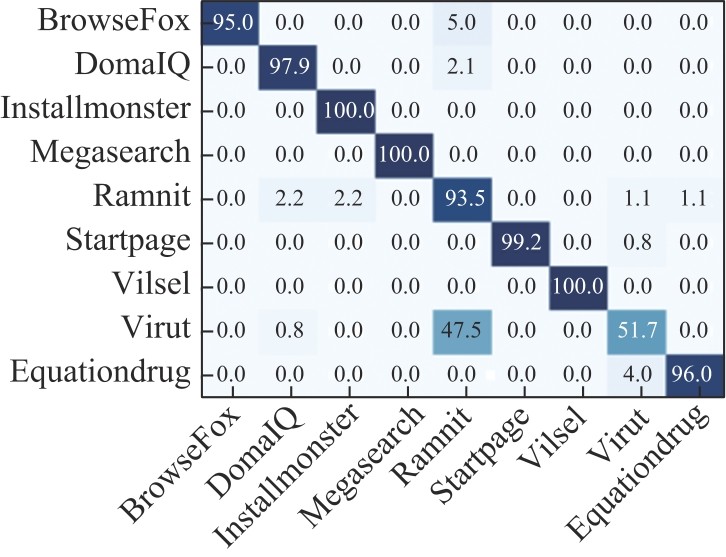
Fig.17
Confusion matrix of entropy + import/export table"
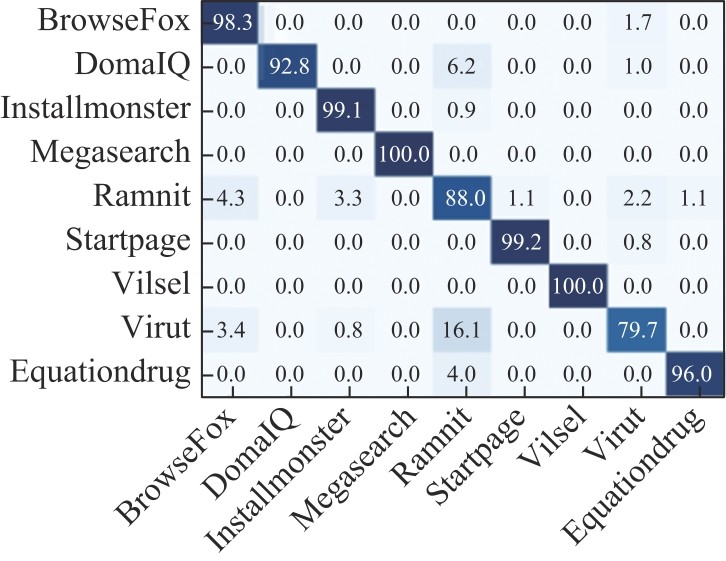
Fig.18
Confusion matrix of import/export table + Markov"
| [1] | Kaspersky. 威胁数量上升: 2023年网络罪犯每天释放411,000个恶意文件[EB/OL]. (2023)[2023-07-14]. https://www.kaspersky.com.cn/about/press-relea-ses/rising-threats. |
| [2] | Federal Office for Information Security. The State of IT Security in Germany 2024[R/OL]. (2024-11-12)[2024-11-12]. https://www.bsi.bund.de/EN/Service-N- avi/Publikationen/Lagebericht/lagebericht_node.html. |
| [3] | NATARAJ L, KARTHIKEYAN S, JACOB G, et al. Malware Images: Visualization and Automatic Classification[C]. Malicious code classification method based on deep residual network and hybrid attention mechanism for edge s, 2011: 1-7. |
| [4] | HAN J, ZHANG Y, WANG H. Malware Analysis Using Visualization Images and Entropy Graphs for Detecting and Distinguishing New Malware and Var-iants[J]. International Journal of Information Security, 2015, 10(4): 789-800. |
| [5] |
FU Y, LI M, WANG X. Malware Visualization for Fine-Grained Classification[J]. IEEE Access, 2018, 6: 14510-14523.
doi: 10.1109/ACCESS.2018.2805301 |
| [6] | SCHULTZ M G, ESKIN E, ZADOK F, et al. Data Mining Methods for Detection of New Malicious Executables[C]// Proceedings of the IEEE Symposium on Security and Privacy (S&P 2001), 2001: 38-49. |
| [7] | KOLTER J Z, MALOOF M A. Learning to detect and classify malicious executables in the wild[J]. Jouenal of Machine Learning Research, 2006, 7(12): 2721-2744. |
| [8] | COULL S E, GARDNER C. Activation analysis of a byte-based deep neural network for malware classification[C]. 2019 IEEE Security and Privacy Workshops (SPW). San Francisco, CA, 2019: 21-27. |
| [9] | SHAFIQ M Z, TABISH S M, MIRZA F, et al. PE-Miner: Mining structural information to detect malicious executables in realtime[C]. Recent Advances in Intrusion Detection. Intrusion Detect, 2009: 121-141. |
| [10] | LI B, ROUNDY K, GATES C, et al. Large-scale identification of malicious singleton files[C]. 7th ACM Conf Data and Application Security and Privacy (CODASPY), 2017: 227-238. |
| [11] | KUMAR A, KUPPUSAMY K S, AGHILA G. A learning model to detect maliciousness of portable executable using integrated feature set[J]. Journal of King Saud University-Computer and Information Sc-iences, 2019, 31(2): 252-265. |
| [12] | REZAEI T, HAMZEH A. An efficient approach for malware detection using PE header specifications[C]// 2020 6th International Conference on Web Research (ICWR). Tehran, Iran, 2020: 234-239. |
| [13] | 赵晓君, 王小英, 张咏梅, 等. 基于恶意代码行为分析的入侵检测技术研究[J]. 计算机仿真, 2015, 32(4): 277-280. |
| [14] |
GALAL H S, MAHDY Y B, ALLATIEA M. Behavior-based features model for malware detection[J]. Journal Of Computer Virology And Hacking Techniques, 2016, 12(2): 59-67.
doi: 10.1007/s11416-015-0244-0 |
| [15] | KIM H, KIM J, KIM Y, et al. Improvement of malware detection and classification using API call sequence alignment and visualization[J]. Cluster Computing-the Journal Of Networks Software Tools And Applications, 2019, 22(1): 921-929. |
| [16] |
AMER E, ZELINKA I. A dynamic Windows malware detection and prediction method based on contextual understanding of API call sequence[J]. Computers & Security, 2020, 92: 101760.
doi: 10.1016/j.cose.2020.101760 |
| [17] | ANDERSON B, QUIST D, NEIL J, et al. Graph-based malware detection using dynamic analysis[J]. Journal of Computer Virology and Hacking Techniques., 2011, 7: 247-258. |
| [18] | BRIDGES R, JIMÉNEZ J H, NICHOLS J, et al. Towards malware detection via CPU power consumption: Data collection design and analytics[C]. 2018 17th IEEE International Conference On Trust, Security And Privacy In Computing And Communications/12th IEEE International Conference On Big Data Science And Engineering (TrustCom/BigDataSE). New York: 2018: 1680-1684. |
| [19] | SAYADI H, PATEL N, SASAN A, et al. Ensemble learning for effective run-time hardware-based malware detection: A comprehensive analysis and classification[C]// Proceedings of the 55th Annual Design Automation Conference. San Francisco, CA: 2018: 1-6. |
| [20] |
BURNAP P, FRENCH R, TURNER F, et al. Malware classification using self organising feature maps and machine activity data[J]. Computers & Security, 2018, 73: 399-410.
doi: 10.1016/j.cose.2017.11.016 |
| [21] |
GHANEI H, MANAVI F, HAMZEH A. A novel method for malware detection based on hardware events using deep neural networks[J]. Journal of Computer Virology and Hacking Techniques, 2021, 17: 1-13.
doi: 10.1007/s11416-020-00358-8 |
| [22] |
CHEN J J, PENG B Z, WU P Z. Malicious code detection method based on dynamic behavior and machine learning[J]. Computer Engineering, 2021, 47(3): 166-173.
doi: 10.19678/j.issn.1000-3428.0056409 |
| [23] | NI S, QIAN Q, ZHANG R. Malware identification using visualization and deep learning[J]. Journal of Computer Virology and Hacking Techniques, 2016, 12(3): 173-182. |
| [24] | WANG J W, CHEN Z J, XIE X, et al. Deep visualization classification method for malicious code based on Ngram-TFIDF[J]. Journal on Communications, 2024, 45(6). |
| [25] |
XIAO X, ZHANG S, MERCALDO F, et al. Android malware detection based on system call sequences and LSTM[J]. Multimedia Tools and Applications, 2018, 78(4): 3979-3999.
doi: 10.1007/s11042-017-5104-0 |
| [26] |
WOJNOWICZ M, CHISHOLM G, WOLFF M, et al. Wavelet decomposition of software entropy reveals symptoms of malicious code[J]. Journal of Innovation in Digital Ecosystems, 2016, 3(2): 130-140.
doi: 10.1016/j.jides.2016.10.009 |
| [27] |
LIU L, HE X, LIU L, et al. Capturing the symptoms of malicious code in electronic documents by files entropy signal combined with machine learning[J]. Applied Soft Computing, 2019, 82: 105598.
doi: 10.1016/j.asoc.2019.105598 |
| [28] | YANLI Y S, YANG L, WANG D, et al. Malicious code classification method based on deep residual network and hybrid attention mechanism for edge security[J]. Wireless Communications & Mobile Computing, 2022, 2022: 6243713. |
| [29] |
QI X, LIU W, LOU R, et al. MC-ISA: A multi-channel code visualization method for malware detection[J]. Electronics, 2023, 12(9): 2272.
doi: 10.3390/electronics12102272 |
| [30] | LI S, WANG J, SONG Y, et al. Tri-channel visualised malicious code classification based on impr-oved ResNet[J]. Applied Intelligence, 2024, 54: 12-453-12475. |
| [31] |
任卓君, 陈光, 卢文科. 恶意软件的操作码可视化方法研究[J]. 计算机工程与应用, 2021, 57(18): 130-134.
doi: 10.3778/j.issn.1002-8331.2005-0327 |
| [32] | JIANG L, ZHANG Y, SHI Y. Visual fileless malware classification via few-shot learning[C]// International Conference on Cyber Security, Artificial Intelligence, and Digital Economy (CSAIDE 2023). SPIE, 2023, 12718: 113-124. |
| [33] |
ZILIN Z, SHUMIAN Y, DAWEI Z. A new framework for visual classification of multi-channel malware based on transfer learning[J]. Applied Sciences, 2023, 13(4): 2484.
doi: 10.3390/app13042484 |
| [34] |
MAURO C, SHUBHAM K, P V. A few-shot malware classification approach for unknown family recognition using malware feature visualization[J]. Computers & Security, 2022, 122: 102889.
doi: 10.1016/j.cose.2022.102889 |
| [35] | SULTANIK E. bin2png:A simple cross-platform script to encode binary files as PNG images[EB/OL]. GitHub. [2023-07-14]. https://github.com/ESultanik/bin2png. |
| [1] | PAN Yuquan,YUAN Deyu,JIA Yuan,WANG Anran. VGAT-VGAN Across Social Networks User Identity Linkage Algorithm Based on Fusion Features [J]. Frontiers of Data and Computing, 2026, 8(1): 103-118. |
| [2] | CAI Yi,WANG Xiaobin,CHEN Ruili,HAN Xun. Review of Research on Gender and Age Detection of Writers Based on Handwriting [J]. Frontiers of Data and Computing, 2026, 8(1): 129-147. |
| [3] | WAN Meng, HE Honglin, REN Xiaoli, NIE Ningming, CAO Rongqiang, WANG Zongguo, LI Kai, WANG Xiaoguang, WANG Yangang, WANG Jue, GAO Chao. The Real-Time Assimilation and Prediction System for Terrestrial Ecosystem Carbon Cycling Based on Workflow [J]. Frontiers of Data and Computing, 2026, 8(1): 168-182. |
| [4] | DENG Yiru,HE Hongbo,WANG Ying,WANG Runqiang. Network Public Opinion Tendency Detection Method Based on Sentiment Analysis [J]. Frontiers of Data and Computing, 2026, 8(1): 91-102. |
| [5] | YANG Qinmeng, NIE Ningming, ZHOU Chunbao, WANG Yangang. Algorithm for Taylor Bar Collision Data Simulation Based on Deep Learning [J]. Frontiers of Data and Computing, 2025, 7(6): 101-110. |
| [6] | ZHOU Faguo, LIU Fang, WANG Yangang, WANG Jue, YU Miao, LI Shunde, ZHOU Chunbao, WANG Jing, YANG Qinmeng. Porting and Adapting Deep Learning Framework Operators on Domestic Supercomputers [J]. Frontiers of Data and Computing, 2025, 7(6): 136-148. |
| [7] | XIN Yuhang,WANG Qiyi,SUN Jing,ZHAO Chunyan,LIU Yujia,LIANG Xue,CHEN Jie. Application of Radar Echo Extrapolation Based Model TrajCast on Domestic Accelerators for Short-Term and Imminent Precipitation Forecasting [J]. Frontiers of Data and Computing, 2025, 7(5): 113-122. |
| [8] | WANG Peng,YANG Xiaofeng,HE Zhongchen,DU Jun. Multispectral Remote Sensing Image Pansharpening Method Based on Shallow-Deep Convolutional Recurrent Neural Network [J]. Frontiers of Data and Computing, 2025, 7(5): 138-152. |
| [9] | ZENG Yan,WU Baofu,YI Guangzheng,HUANG Chengchuang,QIU Yang,CHEN Yue,WAN Jian,HU Fan,JIN Sicong,LIANG Jiajun,LI Xin. FlowAware: A Feature-Aware Automated Model Parallelization Method for AI-for-Science Tasks [J]. Frontiers of Data and Computing, 2025, 7(5): 65-87. |
| [10] | LIU Fangchao, ZHANG Li, GUO Dijun, CHEN Jian, LYU Yingbo, LING Zongcheng, LI Boran, LI Xinyu, MA Yunlong. A Multi-Dimensional Clustering Method for Morphological Characterization of Lunar Impact Craters [J]. Frontiers of Data and Computing, 2025, 7(4): 89-100. |
| [11] | LING Zongcheng, LI Bo, WEI Guangfei, GUO Dijun, LYU Yingbo, LIU Changqing, ZHU Kai, CHEN Jian, ZHAO Qiang, LI Jing, HU Guoping, WANG Jiao, LIU Jianzhong. Research on Key Technologies and Applications of Feature Extraction and Knowledge Mining in Planetary Exploration [J]. Frontiers of Data and Computing, 2025, 7(4): 3-19. |
| [12] | ZHONG Jia, ZOU Ziming. Extracting the Magnetopause Structure Based on Direct Volume Visualization Methods [J]. Frontiers of Data and Computing, 2025, 7(4): 79-88. |
| [13] | CUI Xiaoxiao, ZHAO Yuli, XIU Hanwen, XUE Xiaoguang, HUANG Yongzheng, HE Xiaohui, ZHU Jiang. Research on the High-Efficiency Generation Technology of Material Points for the Discretization of Irregular Bodies [J]. Frontiers of Data and Computing, 2025, 7(3): 174-184. |
| [14] | LI Yucheng, HUANG Zhidu, YANG Qin. Design of a Large-scale Automatic Inspection Technology for Fixed Wing Unmanned Aerial Vehicles Taking off and Landing in Different Locations [J]. Frontiers of Data and Computing, 2025, 7(3): 185-193. |
| [15] | FENG Zhichen, LI Jialin, GAO Yaqian, TIAN Shaobo, YE Huang, ZHANG Jian. Enabling In-situ Feature Extraction in Extreme Scale Phase Field Simulations [J]. Frontiers of Data and Computing, 2025, 7(3): 67-80. |
| Viewed | ||||||
|
Full text |
|
|||||
|
Abstract |
|
|||||

