Frontiers of Data and Computing ›› 2026, Vol. 8 ›› Issue (4): 149-161.
CSTR: 32002.14.jfdc.CN10-1649/TP.2026.04.011
doi: 10.11871/jfdc.issn.2096-742X.2026.04.011
Previous Articles Next Articles
ZHANG Zihao1( ),ZHANG Xiaorui2,*(),SUN Wei3,ZHOU Shiyu1
Received:2026-02-24
Online:2026-08-20
Published:2026-08-21
ZHANG Zihao, ZHANG Xiaorui, SUN Wei, ZHOU Shiyu. A Multi-Scale Temporal Difference Network for Depression Level Assessment from Facial Video[J]. Frontiers of Data and Computing, 2026, 8(4): 149-161, https://cstr.cn/32002.14.jfdc.CN10-1649/TP.2026.04.011.
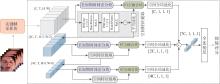
Fig.1
Framework of the proposed multi-scale temporal difference network"
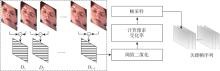
Fig.2
Framework of the proposed key frame sampling block"
Fig.3
Framework of the proposed temporal difference block"
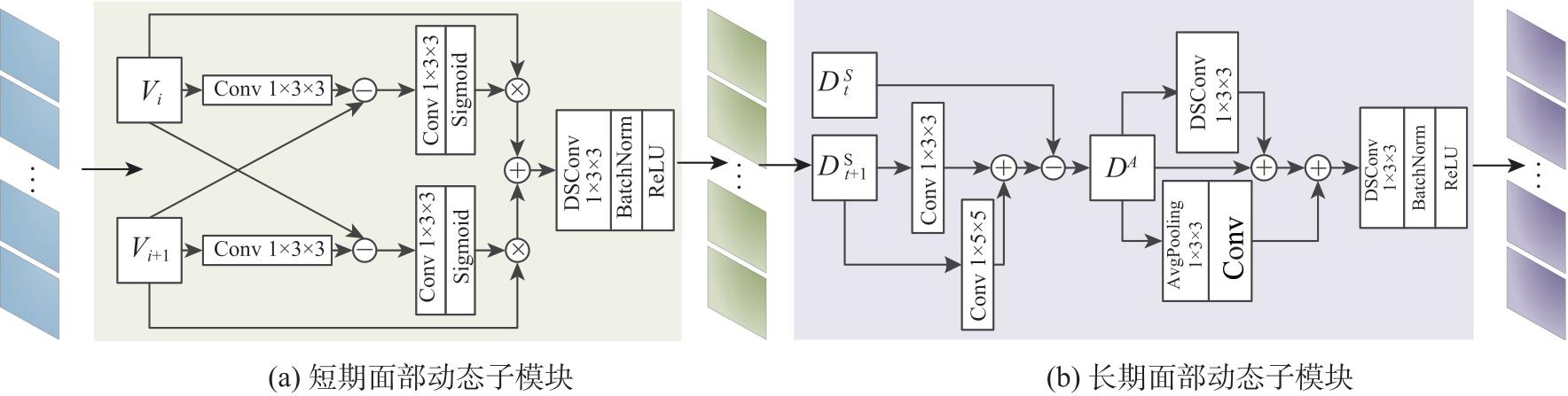
Fig.4
Framework of the proposed spatial-temporal block"
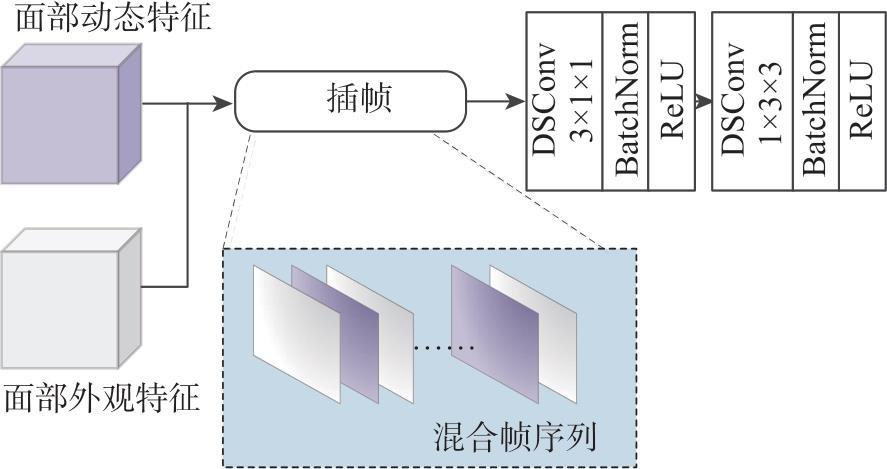
Table 1
Performance comparisons of different parts in MTDN"
| 方法 | AVEC2013 | AVEC2014 | |||
|---|---|---|---|---|---|
| RMSE | MAE | RMSE | MAE | ||
| TSN | 8.37 | 6.61 | 8.46 | 6.77 | |
| Spatial | 8.89 | 7.02 | 9.31 | 7.47 | |
| Temporal | 8.93 | 7.08 | 9.17 | 7.25 | |
| Sbranch | 8.95 | 6.77 | 9.05 | 6.98 | |
| Lbranch | 9.08 | 6.74 | 9.26 | 7.11 | |
| Features-level Fusion | 8.54 | 6.86 | 8.84 | 6.86 | |
| MTDN | 8.04 | 6.32 | 8.21 | 6.57 | |
Table 2
Performance comparisons of different sampling quantity in MTDN"
| 采样数量 | AVEC2013 | AVEC2014 | |||
|---|---|---|---|---|---|
| RMSE | MAE | RMSE | MAE | ||
| 8 | 8.44 | 6.57 | 8.93 | 7.07 | |
| 16 | 8.04 | 6.32 | 8.21 | 6.57 | |
| 24 | 8.61 | 6.70 | 8.57 | 6.84 | |
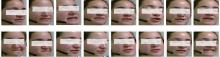
Fig.5
Comparisons of uniform sampling (top) and the proposed key frame sampling (bottom)"
Fig.6
Comparisons of uniform difference map (top) and keyframe difference map (bottom)"
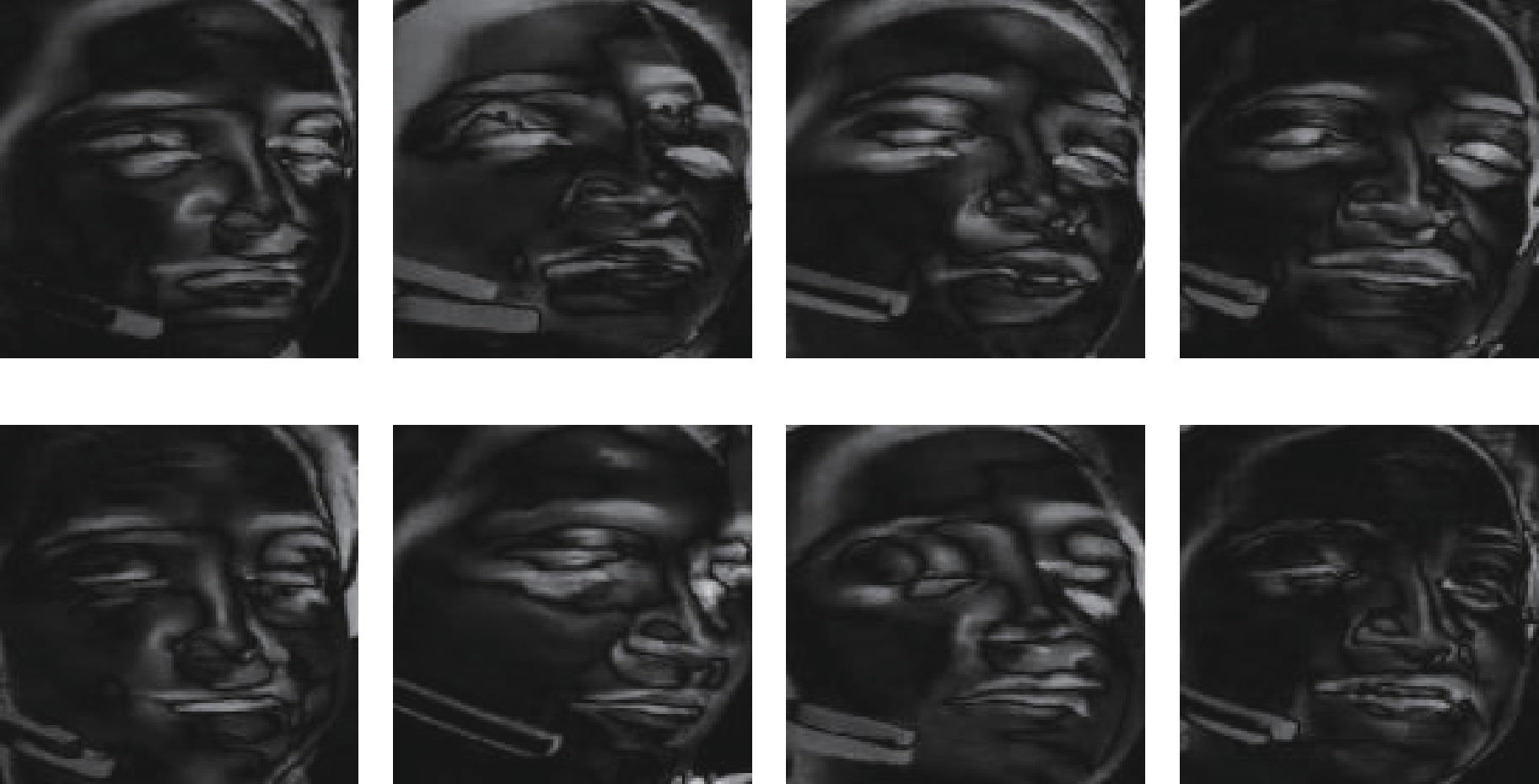
Table 3
Performance comparisons of different methods on AVEC2013"
| 方法 | RMSE | MAE |
|---|---|---|
| LPQ+SVR[ | 13.61 | 10.88 |
| MHH+PLS[ | 11.19 | 9.14 |
| LBP-TOP+SVR[ | 8.91 | 7.08 |
| DCNNs[ | 9.82 | 7.58 |
| RNN-C3D[ | 9.28 | 7.37 |
| Global-Local C3D[ | 8.26 | 6.40 |
| ResNet50[ | 8.25 | 6.30 |
| MSN[ | 7.90 | 5.98 |
| Bi-LSTM[ | 8.93 | 7.04 |
| LQGDNet[ | 8.20 | 6.38 |
| MDN-152[ | 7.55 | 6.24 |
| DAER[ | 8.13 | 6.28 |
| DMSN[ | 7.66 | 6.14 |
| MTDAN[ | 8.08 | 6.14 |
| STA-DRN[ | 7.98 | 6.15 |
| LSCAformer[ | 7.69 | 5.89 |
| LMTformer[ | 7.75 | 6.12 |
| Ours | 8.04 | 6.32 |
Table 4
Performance comparisons of different methods on AVEC2014"
| 方法 | RMSE | MAE |
|---|---|---|
| LGBP-TOP+SVR[ | 10.86 | 8.86 |
| MHH+PLS[ | 10.50 | 8.44 |
| LBP-TOP+SVR[ | 8.91 | 7.08 |
| DCNNs[ | 9.55 | 7.47 |
| RNN-C3D[ | 9.20 | 7.22 |
| Global-Local C3D[ | 8.31 | 6.59 |
| ResNet50[ | 8.23 | 6.15 |
| MSN[ | 7.61 | 5.82 |
| Bi-LSTM[ | 8.78 | 6.86 |
| LQGDNet[ | 7.84 | 6.08 |
| MDN-152[ | 7.65 | 6.06 |
| DAER[ | 8.07 | 6.14 |
| DMSN[ | 7.50 | 5.69 |
| MTDAN[ | 7.93 | 6.35 |
| STA-DRN[ | 7.75 | 6.00 |
| LSCAformer[ | 7.55 | 5.91 |
| LMTformer[ | 7.97 | 6.05 |
| Ours | 8.21 | 6.57 |
Table 5
Performance comparisons of computational complexity"
| 方法 | AVEC2013 | AVEC2014 | Param/M | FLOPs/G | |||
|---|---|---|---|---|---|---|---|
| RMSE | MAE | RMSE | MAE | ||||
| I3D | 8.66 | 6.64 | 8.55 | 6.36 | ≈13 | 6.99 | |
| T3D | 8.75 | 6.76 | 8.55 | 6.54 | ≈68 | 51.64 | |
| ResNet-50 | 8.25 | 6.30 | 8.23 | 6.15 | ≈25 | 3.80 | |
| MDN-50 | 8.13 | 6.39 | 8.16 | 6.45 | ≈21 | 7.40 | |
| MDN-152 | 7.55 | 6.24 | 7.65 | 6.06 | ≈52 | 13.36 | |
| Ours | 8.04 | 6.32 | 8.21 | 6.57 | 1.03 | 1.97 | |
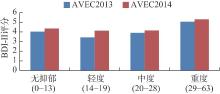
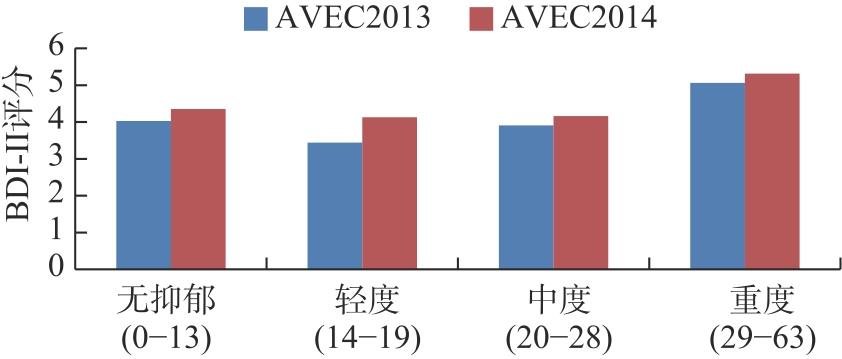
Fig.7
Comparison of mean absolute error across depression severity levels on AVEC2013 and AVEC2014"
| [1] | DEPRESSION W H O. Other common mental disorders: global health estimates[J]. Geneva: World Health Organization, 2017, 24(1): 1-24. |
| [2] |
JAMES S L, ABATE D, ABATE K H, et al. Global, regional, and national incidence, prevalence, and years lived with disability for 354 diseases and injuries for 195 countries and territories, 1990-2017: a systematic analysis for the Global Burden of Disease Study 2017[J]. The lancet, 2018, 392(10159): 1789-1858.
doi: 10.1016/S0140-6736(18)32279-7 |
| [3] |
VAHIA V N. Diagnostic and statistical manual of mental disorders 5: A quick glance[J]. Indian journal of psychiatry, 2013, 55(3): 220-223.
doi: 10.4103/0019-5545.117131 pmid: 24082241 |
| [4] |
NODA T, YOSHIDA S, MATSUDA T, et al. Frontal and right temporal activations correlate negatively with depression severity during verbal fluency task: a multi-channel near-infrared spectroscopy study[J]. Journal of psychiatric research, 2012, 46(7): 905-912.
doi: 10.1016/j.jpsychires.2012.04.001 pmid: 22572569 |
| [5] |
HAWTON K, I COMABELLA C C, HAW C, et al. Risk factors for suicide in individuals with depression: a systematic review[J]. Journal of affective disorders, 2013, 147(1-3): 17-28.
doi: 10.1016/j.jad.2013.01.004 pmid: 23411024 |
| [6] |
PAMPOUCHIDOU A, SIMOS P G, MARIAS K, et al. Automatic assessment of depression based on visual cues: A systematic review[J]. IEEE Transactions on Affective Computing, 2017, 10(4): 445-470.
doi: 10.1109/T-AFFC.5165369 |
| [7] |
Zhang Z, Meng Q, Jin L C, et al. A novel EEG-based graph convolution network for depression detection: incorporating secondary subject partitioning and attention mechanism[J]. Expert Systems with Applications, 2024, 239(1): 122356.
doi: 10.1016/j.eswa.2023.122356 |
| [8] |
ZHONG J, WU Y, LIU H, et al. Soft fusion of channel information in depression detection using functional near-infrared spectroscopy[J]. Information Processing & Management, 2025, 62(3): 104003.
doi: 10.1016/j.ipm.2024.104003 |
| [9] |
Kotoula V, Evans J W, Punturieri C E, et al. The use of functional magnetic resonance imaging (fMRI) in clinical trials and experimental research studies for depression[J]. Frontiers in Neuroimaging, 2023, 2(1): 1110258.
doi: 10.3389/fnimg.2023.1110258 |
| [10] | SONG S, LUO Y, TUMER T, et al. Loss relaxation strategy for noisy facial video-based automatic depression recognition[J]. ACM Transactions on Computing for Healthcare, 2024, 5(2): 1-24. |
| [11] | HE L, JIANG D, SAHLI H. Multimodal depression recognition with dynamic visual and audio cues[C]// 2015 International conference on affective computing and intelligent interaction (ACII), IEEE, 2015: 260-266. |
| [12] | CUMMINS N, SETHU V, JOSHI J, et al. Diagnosis of Depression by Behavioural Signals: A Multimodal Approach[C]// ACM International Workshop on Audio/Visual Emotion Challenge, Association for Computing Machinery (ACM), 2013: 11-20. |
| [13] | DHALL A, GOECKE R. A temporally piece-wise fisher vector approach for depression analysis[C]// 2015 International conference on affective computing and intelligent interaction (ACII), IEEE, 2015: 255-259. |
| [14] | JAN A, MENG H, GAUS Y F A, et al. Automatic depression scale prediction using facial expression dynamics and regression[C]// Proceedings of the 4th International Workshop on Audio/Visual Emotion Challenge, 2014: 73-80. |
| [15] | OTTE C, GOLD S M, PENNINX B W, et al. Major depressive disorder[J]. Nature reviews Disease primers, 2016, 2(1): 1-20. |
| [16] |
SHANG Y, PAN Y, JIANG X, et al. LQGDNet: A local quaternion and global deep network for facial depression recognition[J]. IEEE transactions on affective computing, 2021, 14(3): 2557-2563.
doi: 10.1109/TAFFC.2021.3139651 |
| [17] |
DE MELO W C, GRANGER E, HADID A. A deep multiscale spatiotemporal network for assessing depression from facial dynamics[J]. IEEE transactions on affective computing, 2020, 13(3): 1581-1592.
doi: 10.1109/TAFFC.2020.3021755 |
| [18] | HADjI I, WILDES R P. A new large scale dynamic texture dataset with application to convnet understanding[C]// Proceedings of the European Conference on Computer Vision (ECCV), 2018: 320-335. |
| [19] |
DE MELO W C, GRANGER E, LOPEZ M B. MDN: A deep maximization-differentiation network for spatio-temporal depression detection[J]. IEEE transactions on affective computing, 2021, 14(1): 578-590.
doi: 10.1109/TAFFC.2021.3072579 |
| [20] | MENG H, HUANG D, WANG H, et al. Depression recognition based on dynamic facial and vocal expression features using partial least square regression[C]// Proceedings of the 3rd ACM international workshop on Audio/visual emotion challenge, 2013: 21-30. |
| [21] | WANG Y, MA J, HAO B, et al. Automatic depression detection via facial expressions using multiple instance learning[C]// 2020 IEEE 17th International Symposium on Biomedical Imaging (ISBI), IEEE, 2020: 1933-1936. |
| [22] | TRAN D, WANG H, TORRESANI L, et al. A closer look at spatiotemporal convolutions for action recognition[C]// Proceedings of the IEEE conference on Computer Vision and Pattern Recognition, 2018: 6450-6459. |
| [23] |
NIU M, ZHAO Z, TAO J, et al. Dual attention and element recalibration networks for automatic depression level prediction[J]. IEEE Transactions on Affective Computing, 2022, 14(3): 1954-1965.
doi: 10.1109/TAFFC.2022.3177737 |
| [24] | VALSTAR M, SCHULLER B, SMITH K, et al. Avec 2013: the continuous audio/visual emotion and depression recognition challenge[C]// Proceedings of the 3rd ACM international workshop on Audio/visual emotion challenge, 2013: 3-10. |
| [25] | VALSTAR M, SCHULLER B, SMITH K, et al. Avec 2014: 3d dimensional affect and depression recognition challenge[C]// Proceedings of the 4th international workshop on audio/visual emotion challenge, 2014: 3-10. |
| [26] |
AL JAZAERY M, GUO G. Video-based depression level analysis by encoding deep spatiotemporal features[J]. IEEE Transactions on Affective Computing, 2018, 12(1): 262-268.
doi: 10.1109/T-AFFC.5165369 |
| [27] |
NIU M, TAO J, LIU B, et al. Multimodal spatiotemporal representation for automatic depression level detection[J]. IEEE transactions on affective computing, 2020, 14(1): 294-307.
doi: 10.1109/TAFFC.2020.3031345 |
| [28] | WANG L, XIONG Y, WANG Z, et al. Temporal segment networks: Towards good practices for deep action recognition[C]// European conference on computer vision, Cham: Springer International Publishing, 2016: 20-36. |
| [29] |
UDDIN M A, JOOLEE J B, LEE Y K. Depression level prediction using deep spatiotemporal features and multilayer bi-ltsm[J]. IEEE Transactions on Affective Computing, 2020, 13(2): 864-870.
doi: 10.1109/TAFFC.2020.2970418 |
| [30] | CARREIRA J, ZISSERMAN A. Quo vadis, action recognition? a new model and the kinetics dataset[C]// proceedings of the IEEE Conference on Computer Vision and Pattern Recognition, 2017: 6299-6308. |
| [31] |
DE MELO W C, GRANGER E, LOPEZ M B. Facial expression analysis using decomposed multiscale spatiotemporal networks[J]. Expert Systems with Applications, 2024, 236(1): 121276.
doi: 10.1016/j.eswa.2023.121276 |
| [32] |
HE L, LI Z, TIWARI P, et al. LSCAformer: Long and short-term cross-attention-aware transformer for depression recognition from video sequences[J]. Biomedical Signal Processing and Control, 2024, 98(1): 106767.
doi: 10.1016/j.bspc.2024.106767 |
| [33] |
ZHANG S, ZHANG X, ZHAO X, et al. MTDAN: A lightweight multi-scale temporal difference attention networks for automated video depression detection[J]. IEEE transactions on affective computing, 2023, 15(3): 1078-1089.
doi: 10.1109/TAFFC.2023.3312263 |
| [34] |
ZHU Y, SHANG Y, SHAO Z, et al. Automated depression diagnosis based on deep networks to encode facial appearance and dynamics[J]. IEEE Transactions on Affective Computing, 2017, 9(4): 578-584.
doi: 10.1109/T-AFFC.5165369 |
| [35] | DE MELO W C, GRANGER E, HADID A. Depression detection based on deep distribution learning[C]// 2019 IEEE international conference on image processing (ICIP), IEEE, 2019: 4544-4548. |
| [36] |
CHEN Q, CHATURVEDI I, JI S, et al. Sequential fusion of facial appearance and dynamics for depression recognition[J]. Pattern Recognition Letters, 2021, 150(1): 115-121.
doi: 10.1016/j.patrec.2021.07.005 |
| [37] | DE MELO W C, GRANGER E, HADID A. Combining global and local convolutional 3d networks for detecting depression from facial expressions[C]// 2019 14th ieee international conference on automatic face & gesture recognition (fg 2019), IEEE, 2019: 1-8. |
| [38] |
PAN Y, SHANG Y, LIU T, et al. Spatial-temporal attention network for depression recognition from facial videos[J]. Expert systems with applications, 2024, 237(1): 121410.
doi: 10.1016/j.eswa.2023.121410 |
| [39] |
HE L, ZHAO J, ZHANG J, et al. LMTformer: facial depression recognition with lightweight multi-scale transformer from videos.[J]. Applied Intelligence, 2025, 55(2): 195.
doi: 10.1007/s10489-024-05908-x |
| [1] | LIN Yusong, LIANG Zhenyu, ZHAO Zhe. PMDeUNet: a Lightweight Network Model for the Efficient Segmentation of Abdominal Medical Image [J]. Frontiers of Data and Computing, 2026, 8(4): 162-178. |
| [2] | ZHANG Siyang, HU Lin. Fusing Label Semantics for Hierarchical Multi-Label Classification of Agricultural Science Data [J]. Frontiers of Data and Computing, 2026, 8(4): 246-256. |
| [3] | JU Zizheng, CHEN Peng, SUI Jinguang, ZHU Longsheng. A Police Incident Prediction Model Based on Multi-Scale Spatio-Temporal Graph Fusion [J]. Frontiers of Data and Computing, 2026, 8(2): 154-170. |
| [4] | ZHOU Yuming, ZHANG Yiming, LIU Yuanyuan, HUANG Shan. A Review of the Research on Remote Sensing Satellite Image Ship Detection Sample Dataset [J]. Frontiers of Data and Computing, 2026, 8(2): 215-226. |
| [5] | WANG Zhaobin, WANG Rui, LYU Yongke, ZHANG Yaonan. Desert Segmentation Based on Adaptive Semantic Connectivity and Perceptual Attention [J]. Frontiers of Data and Computing, 2026, 8(2): 25-39. |
| [6] | HAN Liqin, LI Longyuan, WANG Yukang, ZHANG Yaonan, CHANG Mengmeng, PAN Qingyuan. Research on the Construction of Semantic Segmentation Network for Post-Mudslide Remote Sensing Images Based on Frequency Domain Guided Features [J]. Frontiers of Data and Computing, 2026, 8(2): 54-65. |
| [7] | PAN Yuquan,YUAN Deyu,JIA Yuan,WANG Anran. VGAT-VGAN Across Social Networks User Identity Linkage Algorithm Based on Fusion Features [J]. Frontiers of Data and Computing, 2026, 8(1): 103-118. |
| [8] | CAI Yi,WANG Xiaobin,CHEN Ruili,HAN Xun. Review of Research on Gender and Age Detection of Writers Based on Handwriting [J]. Frontiers of Data and Computing, 2026, 8(1): 129-147. |
| [9] | WAN Meng, HE Honglin, REN Xiaoli, NIE Ningming, CAO Rongqiang, WANG Zongguo, LI Kai, WANG Xiaoguang, WANG Yangang, WANG Jue, GAO Chao. The Real-Time Assimilation and Prediction System for Terrestrial Ecosystem Carbon Cycling Based on Workflow [J]. Frontiers of Data and Computing, 2026, 8(1): 168-182. |
| [10] | DENG Yiru,HE Hongbo,WANG Ying,WANG Runqiang. Network Public Opinion Tendency Detection Method Based on Sentiment Analysis [J]. Frontiers of Data and Computing, 2026, 8(1): 91-102. |
| [11] | YANG Qinmeng, NIE Ningming, ZHOU Chunbao, WANG Yangang. Algorithm for Taylor Bar Collision Data Simulation Based on Deep Learning [J]. Frontiers of Data and Computing, 2025, 7(6): 101-110. |
| [12] | ZHOU Faguo, LIU Fang, WANG Yangang, WANG Jue, YU Miao, LI Shunde, ZHOU Chunbao, WANG Jing, YANG Qinmeng. Porting and Adapting Deep Learning Framework Operators on Domestic Supercomputers [J]. Frontiers of Data and Computing, 2025, 7(6): 136-148. |
| [13] | LINGHU Rongwei, ZHANG Yu, SHI Yuanquan, YANG Yujun. Multi-Feature Fusion-Based Detection and Classification of Portable Executable Malware [J]. Frontiers of Data and Computing, 2025, 7(6): 77-91. |
| [14] | XIN Yuhang,WANG Qiyi,SUN Jing,ZHAO Chunyan,LIU Yujia,LIANG Xue,CHEN Jie. Application of Radar Echo Extrapolation Based Model TrajCast on Domestic Accelerators for Short-Term and Imminent Precipitation Forecasting [J]. Frontiers of Data and Computing, 2025, 7(5): 113-122. |
| [15] | WANG Peng,YANG Xiaofeng,HE Zhongchen,DU Jun. Multispectral Remote Sensing Image Pansharpening Method Based on Shallow-Deep Convolutional Recurrent Neural Network [J]. Frontiers of Data and Computing, 2025, 7(5): 138-152. |
| Viewed | ||||||
|
Full text |
|
|||||
|
Abstract |
|
|||||

