Frontiers of Data and Computing ›› 2026, Vol. 8 ›› Issue (4): 1-18.
CSTR: 32002.14.jfdc.CN10-1649/TP.2026.04.001
doi: 10.11871/jfdc.issn.2096-742X.2026.04.001
Previous Articles Next Articles
CUI Chenzhou1,2,*( ),XU Yunfei1,2,FAN Dongwei1,2,LI Changhua1,2,LI Shanshan1,2,MI Linying1,2,GAN Qingbo1,2,ZHAO Gongbo1,2,China-VO Collaboration
Received:2026-02-05
Online:2026-08-20
Published:2026-08-21
CUI Chenzhou, XU Yunfei, FAN Dongwei, LI Changhua, LI Shanshan, MI Linying, GAN Qingbo, ZHAO Gongbo, China-VO Collaboration. Building an AI4S-Oriented Intelligent Data Service System for Astronomy: Practices from the National Astronomical Data Center[J]. Frontiers of Data and Computing, 2026, 8(4): 1-18, https://cstr.cn/32002.14.jfdc.CN10-1649/TP.2026.04.001.
Fig.1
The conceptual framework of NADC’s intelligent data service system"
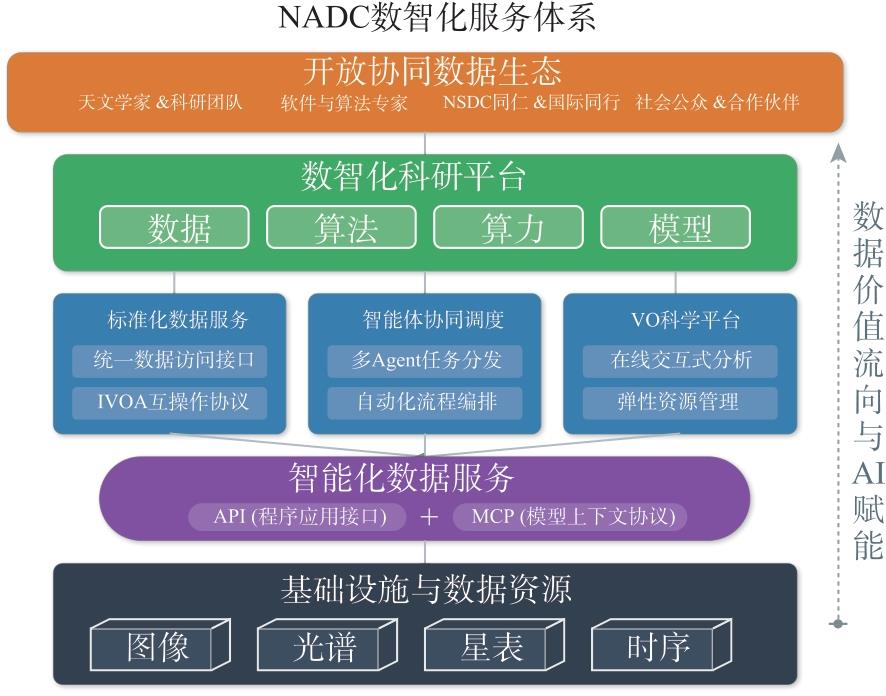
Fig.2
MCP application framework"
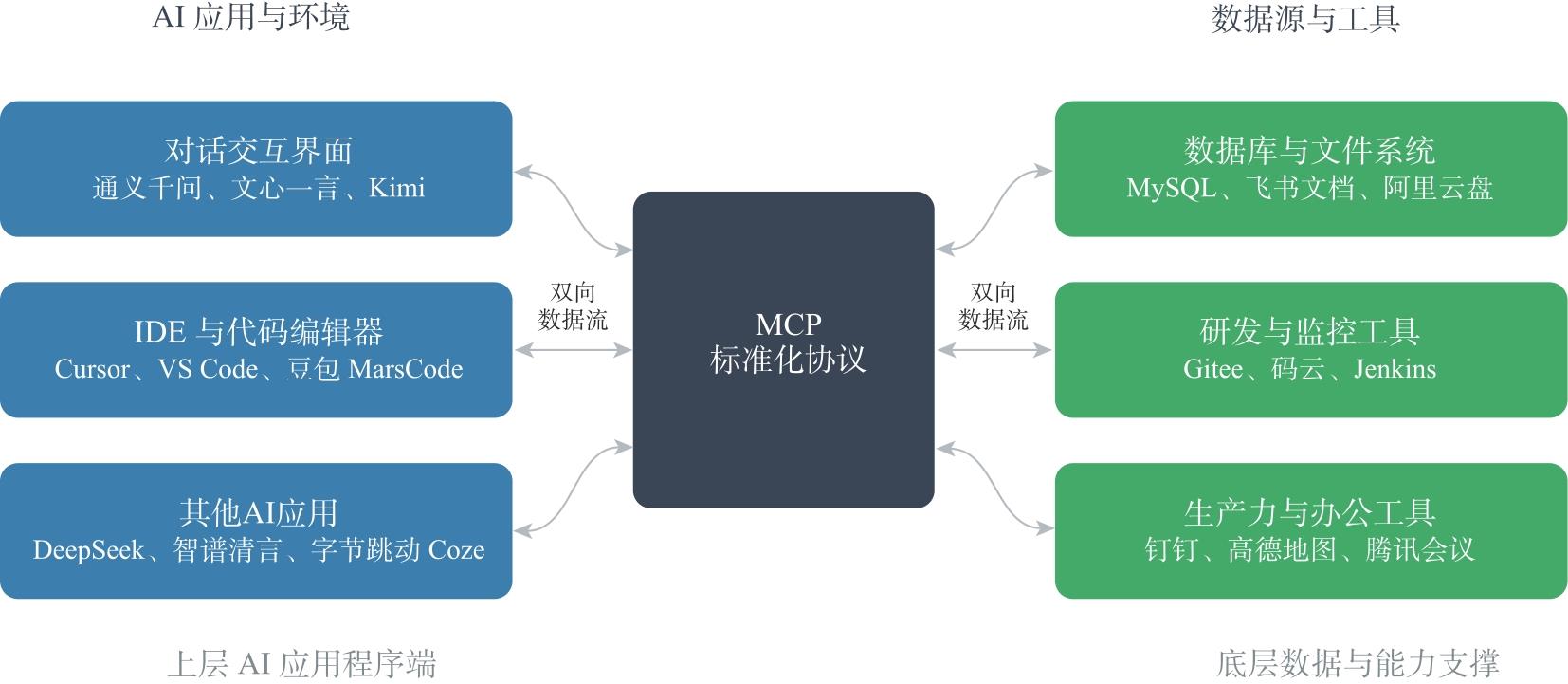
Table 1
IVOA Specifications supported by LAMOST DR11"
| 协议名称 | 主要用途 |
|---|---|
| VOTable | IVOA标准数据交换格式,用于存储和传输LAMOST星表、光谱元数据与观测参数,支持多平台、多软件的数据互通与解析,保障数据结构的标准化与可重用性。 |
| SAMP | 简单应用消息协议,用于天文软件的互操作,支持LAMOST数据在TOPCAT、Aladin等主流天文软件间的实时数据共享与协同分析,实现检索结果的跨软件同步可视化。 |
| ConeSearch | 天球锥形区域检索协议,支持用户通过指定赤经、赤纬与搜索半径,快速检索目标天区内的LAMOST天体数据。 |
| SSAP | 简单光谱访问协议,专门用于光谱数据的标准化检索与访问,返回光谱数据及配套元信息。 |
| TAP | 数据表访问协议,支持用户通过天文数据查询语言ADQL语句对LAMOST光谱数据库进行复杂检索,可实现多条件组合筛选、跨表关联查询,满足深度数据挖掘需求。 |
Table 2
Core API interfaces supported by LAMOST DR11"
| API名称 | 功能描述 | 访问方式 | 访问地址(URL) |
|---|---|---|---|
| 数据版本查询 | 获取LAMOST所有已公开的数据版本列表 | GET请求 | https://www.lamost.org/openapi/dr_versions |
| 表数据查询 | 针对指定数据表执行结构化条件查询 | POST请求 | https://www.lamost.org/openapi/{dr_version}/{sub_version}/query/{table_name} |
| SQL语句查询 | 支持通过ADQL/SQL语句执行复杂的自定义查询 | GET请求 | https://www.lamost.org/openapi/{dr_version}/{sub_version}/sql |
| 星表文件下载 | 下载指定分辨率光谱的全量星表文件 | GET请求 | https://www.lamost.org/openapi/{dr_version}/{sub_version}/{resolution}/catalog |
| 光谱FITS获取 | 获取指定天体的光谱数据FITS文件 | GET请求 | https://www.lamost.org/openapi/{dr_version}/{sub_version}/{resolution}/spectrum/fits |
| 光谱CSV转换 | 将光谱数据转换为CSV格式 | GET请求 | https://www.lamost.org/openapi/{dr_version}/{sub_version}/{resolution}/spectrum/fits2csv |
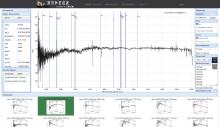
Fig.3
Low-resolution spectra online visualization interface for LAMOST DR11"
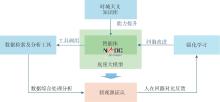
Fig.4
NADC AI agent technical architecture for transient source identification"
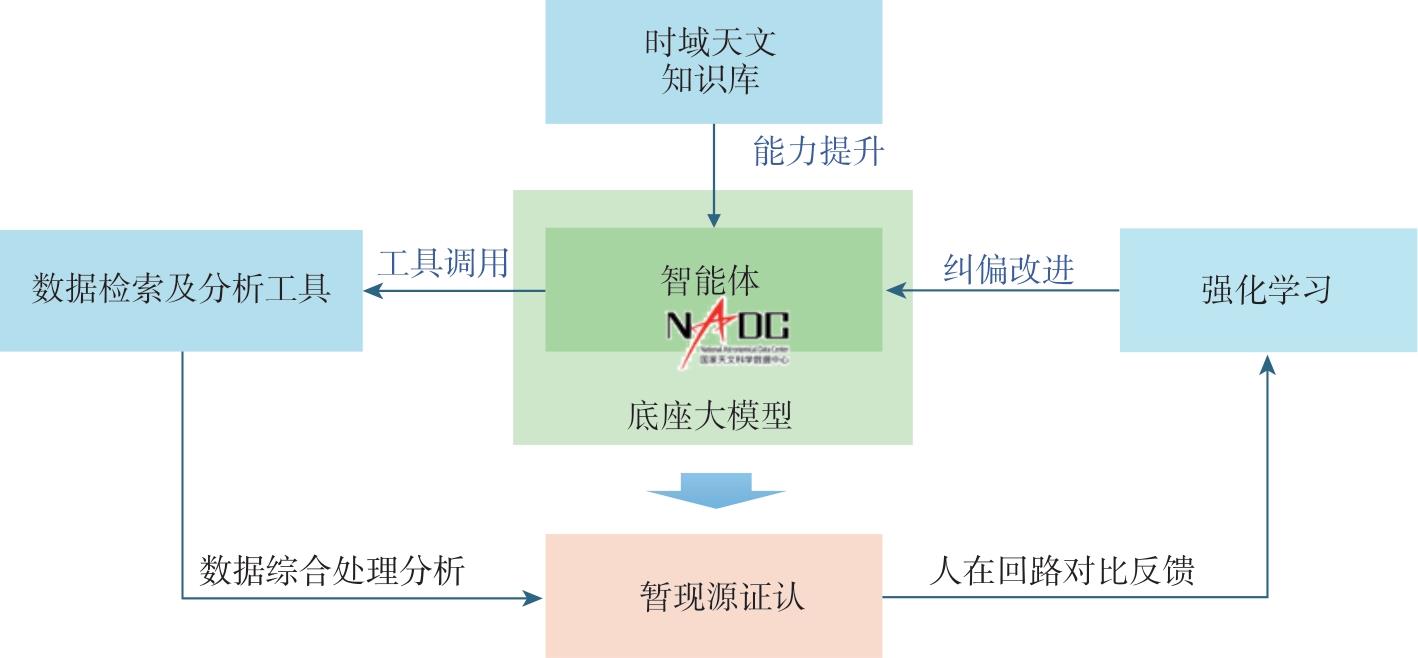
Fig.5
Multi-layer decision-making model for transient sources identification"
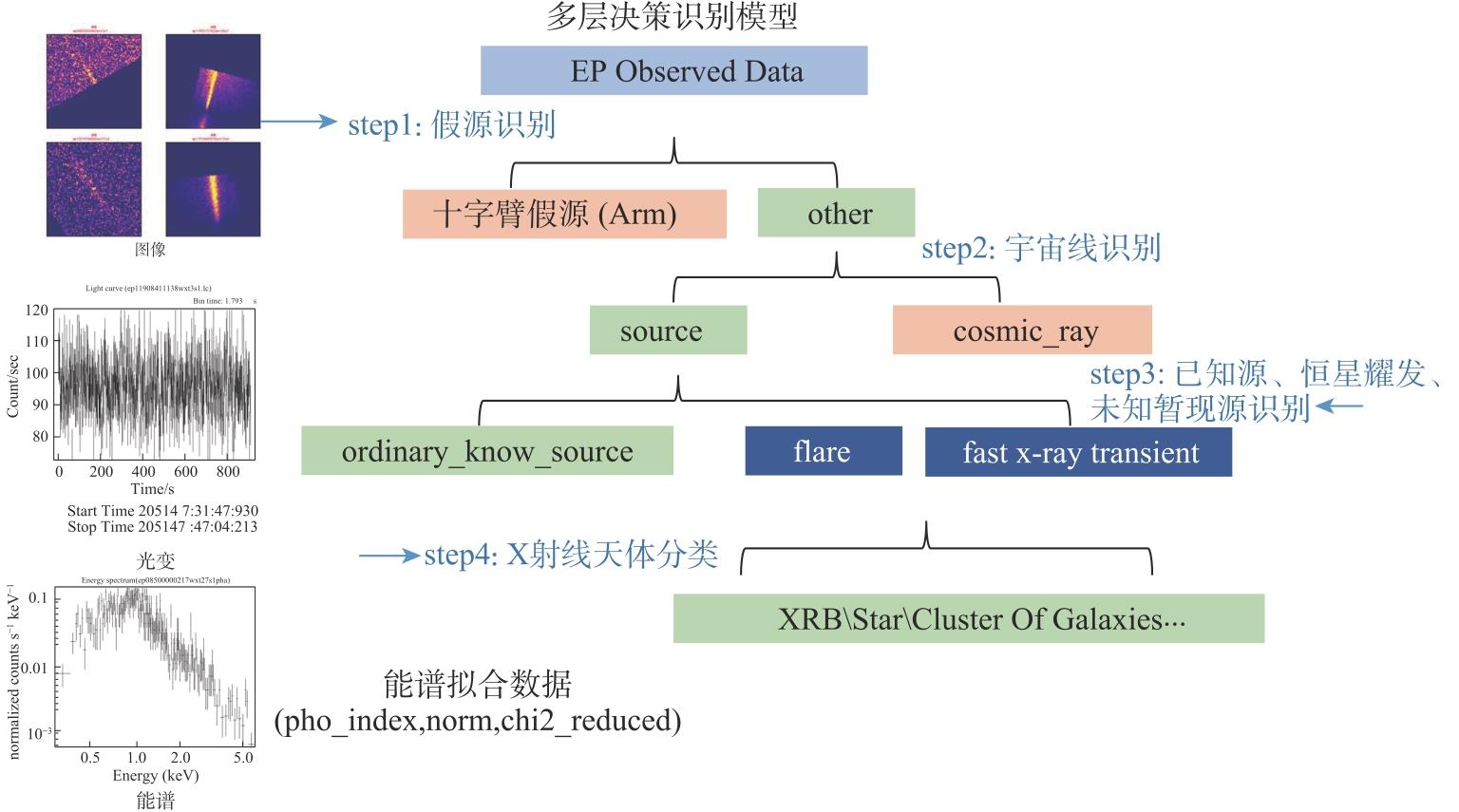
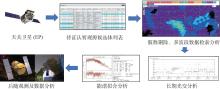
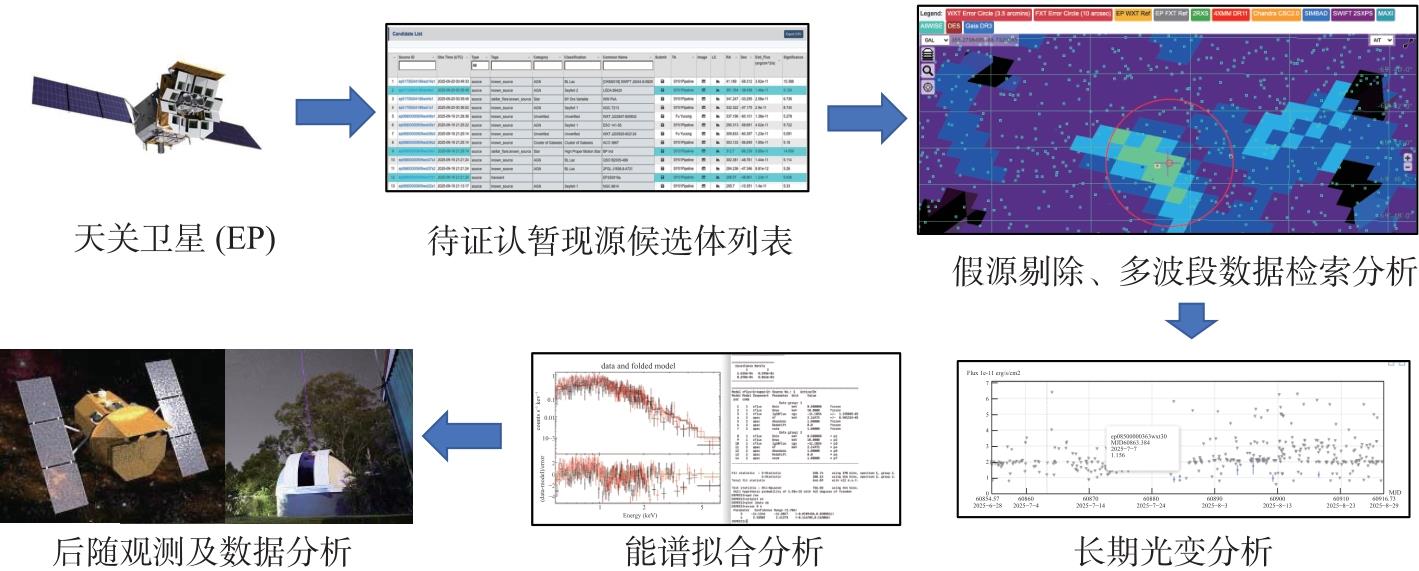
Fig.6
Intelligent closed loop from scientific discovery to follow-up observation"
| [1] |
CUI X Q, ZHAO Y H, CHU Y Q, et al. The Large Sky Area Multi-Object Fiber Spectroscopic Telescope (LAMOST)[J]. Research in Astronomy and Astrophysics, 2012, 12:1197. https://doi.org/10.1088/1674-4527/12/9/003.
doi: 10.1088/1674-4527/12/9/003 |
| [2] |
NAN R D, LI D, JIN C J, et al. The Five-Hundred-Meter Aperture Spherical Radio Telescope (FAST) Project[J]. Int J Mod Phys D, 2011, 20:989. https://arxiv.org/abs/1105.3794.
doi: 10.1142/S0218271811019335 |
| [3] | IVEZI´C ˇZ, KAHN S M, TYSON J A, et al. LSST: From Science Drivers to Reference Design and Anticipated Data Products[J]. ApJ, 2019, 873: 111. https://doi.org/10.3847/1538-4357/ab042c. |
| [4] | HALL P J, SCHILIZZI R T, DDWDNEY P E F, et al. The square kilometer array (SKA) radio telescope: Progress and technical directions[C]. In: URSI Radio Science Bulletin, Sep. 2008, 326: 4-19. https://doi.org/10.23919/URSIRSB.2008.7909649. |
| [5] | YUAN W, ZHANG C, FENG H, et al. Einstein Probe - a small mission to monitor and explore the dynamic X-ray Universe[J]. arXiv e-prints, 2015. https://doi.org/10.48550/arXiv.1506.07735. |
| [6] | CSST Collaboration, GONG Y, MIAO H, et al. Introduction to the Chinese Space Station Survey Telescope (CSST)[J]. SCIENCE CHINA Physics, Mechanics & Astronomy, 2026, 69(3): 239501. https://doi.org/10.1007/s11433-025-2809-0. |
| [7] | Euclid Collaboration, MELLIER Y, ABDURRO’UF, et al. Euclid. I. Overview of the Euclid mission[J]. arXiv:2405.13491, 2024. https://doi.org/10.1051/00-04-6361/202450810. |
| [8] | GREEN J, SCHECHTER P, BALTAY C, et al. Wide-Field InfraRed Survey Telescope (WFIRST) Final Report[J/OL]. 2012. https://arxiv.org/abs/1208.4012. |
| [9] | DOE Office of Science. THE AMERICAN SCIENCE CLOUD (AmSC). DOE National Laboratory Program Announcement Number: LAB 25-3555. 2025[EB/OL]. https://science.osti.gov/-/media/grants/pdf/lab-announcements/2025/LAB-25-3555.pdf. |
| [10] | 赵永恒, 崔辰州. 天文数据处理与虚拟天文台[M]. 北京: 中国科学技术出版社, 2024: 275-432. ISBN: 978-7-5236-0827-2. |
| [11] | QUINN P J, BARNES D G, CSABAI I, et al. The International Virtual Observatory Alliance: recent technical developments and the road ahead[C]. In: P. J. Quinn & A. Bridger (eds.), Proceedings of the SPIE, Optimizing Scientific Return for Astronomy through Information Technologies, 2004, 5493: 137. https://doi.org/10.1117/12.551247. |
| [12] | GINSBURG A, SIPOCZ B M, BRASSEUR C E, et al. astroquery: An Astronomical Web-querying Package in Python[J]. The Astronomical Journal, 2019, Volume 157, Issue 3, article id. 98, 7 pp. https://doi.org/10.3847/1538-3881/aafc33. |
| [13] | Astropy Collaboration, ROBITAILLE T P, TOLLERUD E J, et al. Astropy: A community Python package for astronomy[J]. Astronomy & Astrophysics, 2013, Volume 558, id.A33, 9 pp. https://doi.org/10.1051/0004-6361/201322068. |
| [14] |
GENOVA F, EGRET D, BIENAYME O, et al. The CDS information hub. On-line services and links at the Centre de Données astronomiques de Strasbourg[J]. Astronomy and Astrophysics Supplement, 2000, 143: 1-7. https://doi.org/10.1051/aas:2000333.
doi: 10.1051/aas:2000333 |
| [15] |
CUI C, TAO Y, LI C, et al. Towards an astronomical science platform: Experiences and lessons learned from Chinese Virtual Observatory[J]. Astronomy and Computing, 2020, 32:100392. https://doi.org/10.1016/j.ascom.2020.100392.
doi: 10.1016/j.ascom.2020.100392 |
| [16] | ARVISET C, NAVARRO V, BASSO D, et al. ESA DATALABS: Towards a Collaborative E-Science Platform for ESA[C]. In:5th Planetary Data Workshop & Planetary Science Informatics & Analytics, held virtually June 28-July 2, 2021. LPI Contribution No. 2549, id. 701. June 2021. https://ui.adsabs.harvard.edu/abs/2021LPICo2549.7014A. |
| [17] | GAUDET S, DOWLER P, GOLIATH S, et al. The Canadian Advanced Network For Astronomical Research[C]. In: Astronomical Data Analysis Software and Systems XVIII ASP Conference Series, 2009, Vol. 411, proceedings of the conference held 2-5 November 2008 in Québec City, QC, Canada. Edited by David A. Bohlender, Daniel Durand, and Patrick Dowler. San Francisco: Astronomical Society of the Pacific, 2009: 185. https://ui.adsabs.harvard.edu/abs/2009ASPC.411.185G. |
| [18] | TAGHIZADEH-POPP M, KIM J W, LEMSON G, et al. SciServer: A science platform for astronomy and beyond[J]. Astronomy and Computing, 2020, Volume 33, article id. 100412. https://doi.org/10.1016/j.ascom.2020.100412. |
| [19] | O’MULLANE W, ECONOMOU F, HUANG F, et al. Rubin Science Platform on Google: the story so far[C]. In: ADASS XXXI, ASP Conference Series, 2024, Vol. 535, Proceedings of the conference held 24-28 October 2021 at Cape Town, South Africa. San Francisco: Astronomical Society of the Pacific:227. https://arxiv.org/pdf/2111.15030. |
| [20] | Gaia Collaboration, VALLENARI A, BROWN A G A, et al. Gaia Data Release 3. Summary of the content and survey properties[J]. Astronomy & Astrophysics, 2023, Volume 674, id.A1, 22 pp. https://doi.org/10.1051/0004-6361/202243940. |
| [21] | ABAZAJIAN K, ADELMAN-MCCARTHY J K, Agüeros M A, et al. The First Data Release of the Sloan Digital Sky Survey[J]. ApJS, 2003, 126(4): 2081. https://doi.org/10.1086/378165. |
| [22] | ZHANG H L, WWANG J, ZHANG Y Z, et al. Review of artificial intelligence applications in astronomical data processing[J]. Astronomical Techniques and Instruments, 2024, 1(1): 1-15. https://doi.org/10.61977/ati2024001. |
| [23] | 李国杰. 智能化科研(AI4R):第五科研范式[J]. 中国科学院院刊, 2024, 39(1): 1-9. https://doi.org/10.16418/j.issn.1000-3045.20231007002. |
| [24] | 鄂维南. AI助力打造科学研究新范式[J]. 中国科学院院刊, 2024, 39(1): 10-16. https://doi.org/10.16418/j.issn.1000-3045.20231224001. |
| [25] | 臧冀原, 季桓永, 黄庆学. 数智化赋能传统产业转型升级[J]. 中国科学院院刊, 2024, 39 (7):1183-1190. https://doi.org/10.16418/j.issn.1000-3045.202404070-04. |
| [26] | ZHANG Z D, ZHANG Y Y, YAO H D, et al. Xiwu: A Basis Flexible and Learnable LLM for High Energy Physics[J]. arXiv e-print, 2024. https://arxiv.org/abs/2404.08001. |
| [27] |
米琳莹, 崔辰州, 樊东卫, 等. 国家天文科学数据中心发展思路浅析[J]. 农业大数据学报, 2019, 1(4): 37-45. https://doi.org/10.19788/j.issn.2096-6369.190-404.
doi: 10.19788/j.issn.2096-6369.190404 |
| [28] | WILKINSON M, DUMONTIER M, AALBERSBERT I, et al. The FAIR Guiding Principles for scientific data management and stewardship[J]. Sci Data 3, 2016, 160018. https://doi.org/10.1038/sdata.2016.18. |
| [29] | ROY T F. Architectural Styles and the Design of Network-based Software Architectures, CHAPTER 5: Representational State Transfer (REST)[D]. PhD DISSERTATION of UNIVERSITY OF CALIFORNIA, IRVINE, 2000. https://roy.gbiv.com/pubs/dissertation/top.htm. |
| [30] | ANTHROPIC. Introducing the Model Context Protocol[EB/OL]. 2024. https://www.anthropic.com/news/model-context-protocol. |
| [31] | UNESCO. UNESCO Recommendation on Open Science[EB/OL]. 2021. https://doi.org/10.54677/MNMH8546. |
| [32] | LI S S, CUI C Z, FAN D W, et al. Astronomy Citizen Science Projects in China. In: Integrating Science Education, Scientific Discovery, and AI Empowerment[C]. EDULEARN25 Proceedings, 2025: 1688-1697. https://doi.org/10.21125/edulearn.2025.0512. |
| [33] | ZUO X X, TAO Y H, HUANG Y, et al. FALCO: Foundation Model of Astronomical Light Curves for Time Domain Astronomy. Implementation and Applications on Kepler Data[J]. The Astronomical Journal, 2026, Volume 171, Issue 1, id.10, 19 pp. https://doi.org/10.3847/1538-3881/ae1467. |
| [34] | ZHAO X S, HUANG Y, XUE G, et al. SpecCLIP: Aligning and Translating Spectroscopic Measurements for Stars[J]. The Astrophysical Journal, 2026, 98:189. doi.org/10.3847/1538-4357/ae2c7e. |
| [35] | LI S S, LI C Q, LI C H, et al. Mining Double-line Spectroscopic Candidates in the LAMOST Medium-resolution Spectroscopic Survey Using a Human-AI Hybrid Method[J]. ApJS, 2025, 276,11: 14. https://doi.org/10.3847/1538-4365/ad9010. |
| [36] |
YANG X Y, LI C H, ZHANG Y X, et al. Quasar candidate selection and redshift estimation using J-PLUS DR3 data[J]. MNRAS, 2025, 542:2910-2924. https://doi.org/10.1093/mnras/staf1427.
doi: 10.1093/mnras/staf1427 |
| [37] | WEI S R, LI C H, ZHANG Y X, et al. Photometric redshift estimation for emission line galaxies of DESI Legacy Imaging Surveys by CNN-MLP[J]. PASA, 2025, 42: e092. https://doi.org/10.1017/pasa.2025.10-056. |
| [38] |
MA X Y, ZHANG Y X, ZHANG J Y, et al. Search for Young Stellar Objects within 4XMM-DR13 Using CatBoost and SPE[J]. AJ, 2024, 168: 210. https://doi.org/10.3847/1538-3881/ad781c.
doi: 10.3847/1538-3881/ad781c |
| [39] | 陈学雷, 阎敬业, 徐怡冬, 等. 宇宙黑暗时代探路者——鸿蒙计划[J]. 空间科学学报, 2023, 43(1): 43-59. https://doi.org/10.11728/cjss2023.01.220104001. |
| [40] | 邓元勇, 周桂萍, 代树武, 等. 太阳极轨天文台[J]. 科学通报, 2023, 68 (4): 298-308. https://doi.org/10.1360/TB-2022-0674. |
| [41] |
LI G C, HU M K, LI W X, et al. A Shock Flash Breaking Out of a Dusty Red Supergiant[J]. Nature, 2023, 627(8005):754-758. https://doi.org/10.1038/s4-1586-023-06843-6.
doi: 10.1038/s41586-023-06843-6 |
| [42] | FABRIZIO G, YAGO A, LUCA C, et al. Hierarchical Progressive Survey (HiPS) format: Moving from visualization to scientific analysis[J]. A&A, 2025, Volume 703, id.A194, 10 pp. https://doi.org/10.1051/0004-6361/202555224. |
| [43] |
RUTLEDGE R E. The Astronomer's Telegram: A Web-based Short-Notice Publication System for the Professional Astronomical Community[J]. PASP, 1998, 110(748): 754-756. https://doi.org/10.1086/31-6184.
doi: 10.1086/pasp.1998.110.issue-748 |
| [44] | DEY A, SCHLEGEL D J, LANG D, et al. Overview of the DESI Legacy Imaging Surveys[J]. The Astronomical Journal, 2019, Volume 157, Issue 5, article id. 168, 29 pp. https://doi.org/10.3847/1538-3881/ab-089d. |
| [45] | SCHULMAN J, WOLSKI F, DHARIWAL P, et al. Proximal Policy Optimization Algorithms[J/OL]. 2017. https://arxiv.org/abs/1707.06347. |
| [46] | 崔辰州. 公众科学, 让每个人享受探索宇宙的乐趣[J]. 中国国家天文, 2025, 19(11): 16-17. |
| [47] | LI S S, FAN D W, GAO X, et al. Popular Supernova Project: A Citizen Science Program Based on Amateur Astronomical Observations[C]. In INTED2016 Proceedings, 2016: 7561-7569. DOI:10.21125/inted.2016.0780. |
| [48] | 李珊珊, 崔辰州. 公众科学, 让兴趣爱好连接真实科学发现[J]. 中国国家天文, 2025, 19(11): 34-41. |
| [49] | 高兴. 你我的星辰大海: 中国公众科学之路与PSP项目的十年探索[J]. 中国国家天文, 2025, 19(11): 42-47. |
| [50] | 王艺. 从赋能到重塑,AI Agent 构建企业智能新引擎[EB/OL]. 云栖战略参考, 2025. https://developer.aliyun.com/article/1689470?spm=a2c6h.12873581.te-chnical-group.dArticle1689470.13b42cb4r21y6I. |
| [1] | GENG Hua, WANG Lina, GAO Manda, WANG Wenbin, LI Yawei, YOU Bo. A Review of Modeling and Simulation Research for Coal Supply Chains Based on Multi-Method Integration: Methods, Applications, and Development Trends [J]. Frontiers of Data and Computing, 2026, 8(4): 203-213. |
| [2] | ZHOU Xiaofang, BAO Yanrong, GU Rongjie, WANG Xin. Construction of Trade Event Knowledge Graph Based on Multi-Agent Collaboration and Complex Network Theory [J]. Frontiers of Data and Computing, 2026, 8(4): 234-245. |
| [3] | LIU Jingqi, ZHANG Yaonan, KANG Jianfang, LIU Jie, YANG Zhiwei, ZHANG Zhixing, WANG Baode. Multi-Agent Collaborative Data-Engineering-Based Early Warning for Road Icing in High-Altitude Cold Mountainous Regions [J]. Frontiers of Data and Computing, 2026, 8(2): 40-53. |
| [4] | WANG Zhenyuan, TIAN Dong, DONG Yu, QIAO Na, SHAN Guihua. Multimodal Interaction: From Human-Computer Collaboration to Human-Intelligence Collaboration [J]. Frontiers of Data and Computing, 2025, 7(3): 81-93. |
| [5] | ZHAO Jingyi, CHEN Xin, ZHOU Yuanchun. International Experience and Enlightenment of Open Science Monitor [J]. Frontiers of Data and Computing, 2024, 6(5): 46-56. |
| [6] | LI Jianhui, ZHANG Lili, CHEN Wei, LIU Yude, LI Jingjing, MA Tongyu, LUO Ze, ZHANG Haiming, YU Ning, REN Yongmao, PEI Changhua, LI Jian, NIU Tie, ZHANG Bo, WU Kaichao, ZHENG Yihua. Links, Interconnectivity, and Partnerships——30 Years of CSTNET [J]. Frontiers of Data and Computing, 2024, 6(2): 10-24. |
| [7] | ZHANG Lili, CHEN Can, ZHANG Haiming, ZHENG Yihua, LUO Ze, LI Jianhui. Towards Trustworthy, Interconnected and Interoperable Open Science Infrastructures: Review of the Global Open Science Cloud Initiative [J]. Frontiers of Data and Computing, 2024, 6(2): 25-38. |
| [8] | ZHANG Lili,LI Jianhui. Governance Model for Research e-Infrastructures [J]. Frontiers of Data and Computing, 2022, 4(6): 92-104. |
| [9] | LIANG Sili,JIANG Guifei,CHEN Taijie,DENG Yichao,ZHAN Yufan,ZHANG Yuzhi. Optimizing Monte Carlo Tree Search for General Game Playing [J]. Frontiers of Data and Computing, 2022, 4(3): 66-77. |
| Viewed | ||||||
|
Full text |
|
|||||
|
Abstract |
|
|||||

