Frontiers of Data and Computing ›› 2025, Vol. 7 ›› Issue (6): 158-169.
CSTR: 32002.14.jfdc.CN10-1649/TP.2025.06.015
doi: 10.11871/jfdc.issn.2096-742X.2025.06.015
• Technology and Application • Previous Articles Next Articles
GUO Jianping1( ),MAO Ruichao1,ZHANG Han1,ZHANG Yong2,GAO Jun1,*()
Received:2025-02-20
Online:2025-12-20
Published:2025-12-17
GUO Jianping, MAO Ruichao, ZHANG Han, ZHANG Yong, GAO Jun. Parallel Implementation of the Quantum Mechanics Force Field Program of Biosystem Using Tens of Millions of Cores on the New-Generation Sunway Supercomputer[J]. Frontiers of Data and Computing, 2025, 7(6): 158-169, https://cstr.cn/32002.14.jfdc.CN10-1649/TP.2025.06.015.
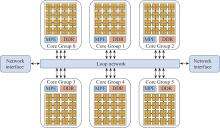
Fig.1
Architecture of the SW26010-Pro processor"
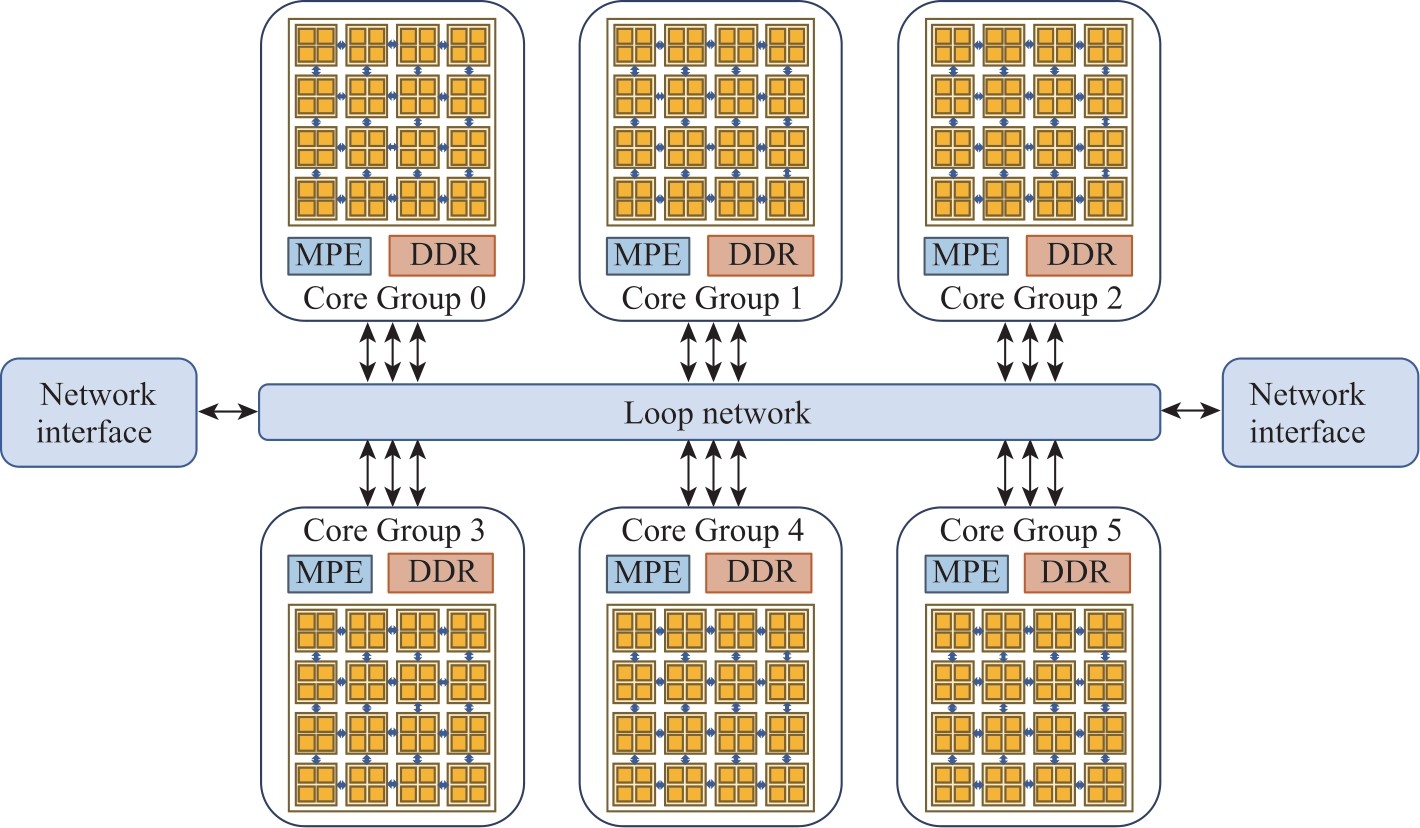
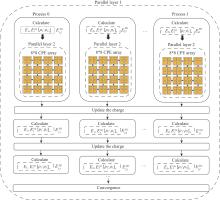
Fig.2
A two-layer parallel framework for quantum mechanical force field"
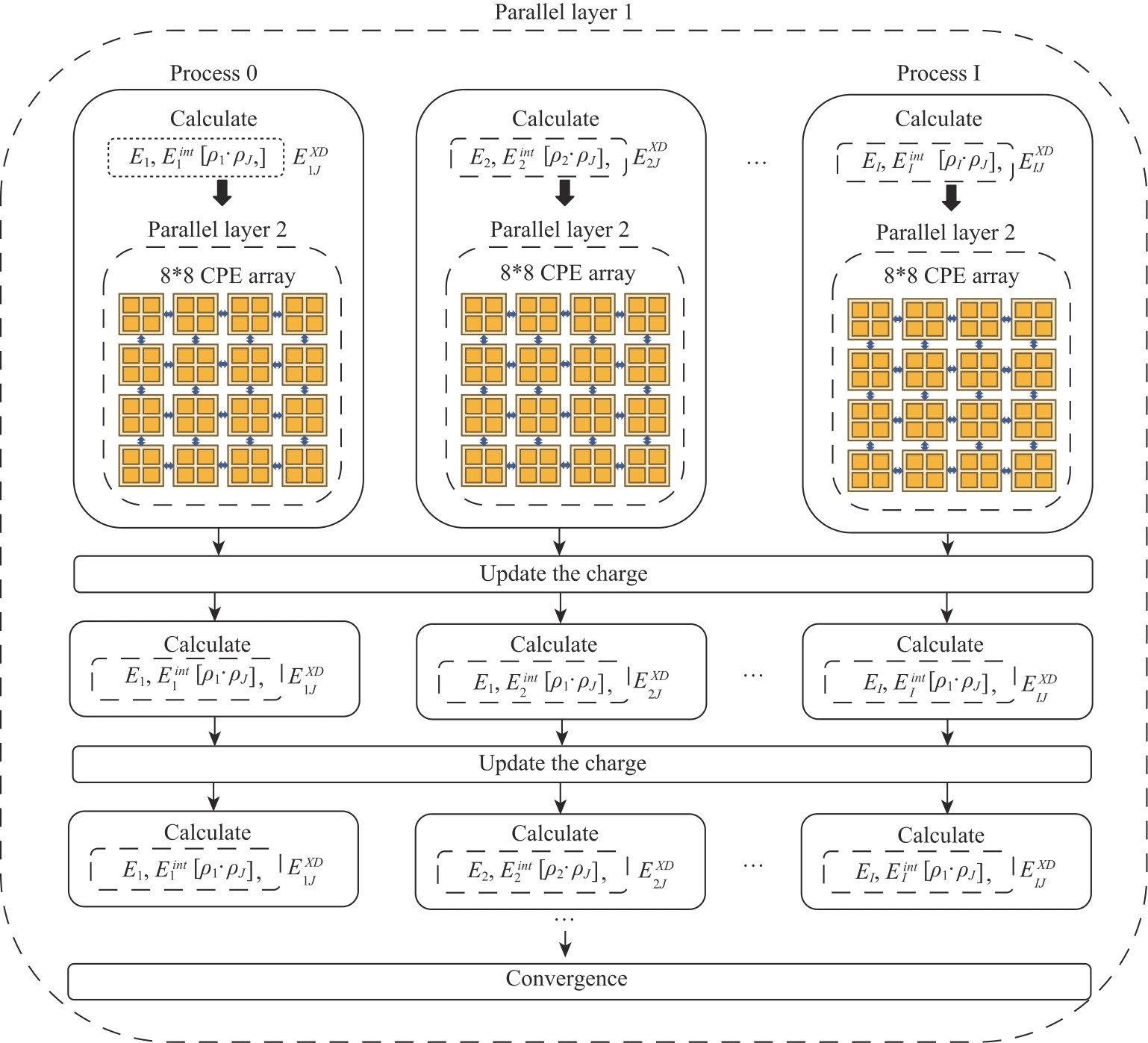
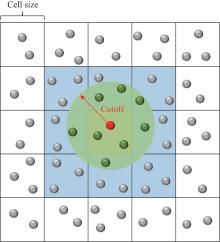
Fig.3
Schematic diagram of calculation of non-bond interaction"
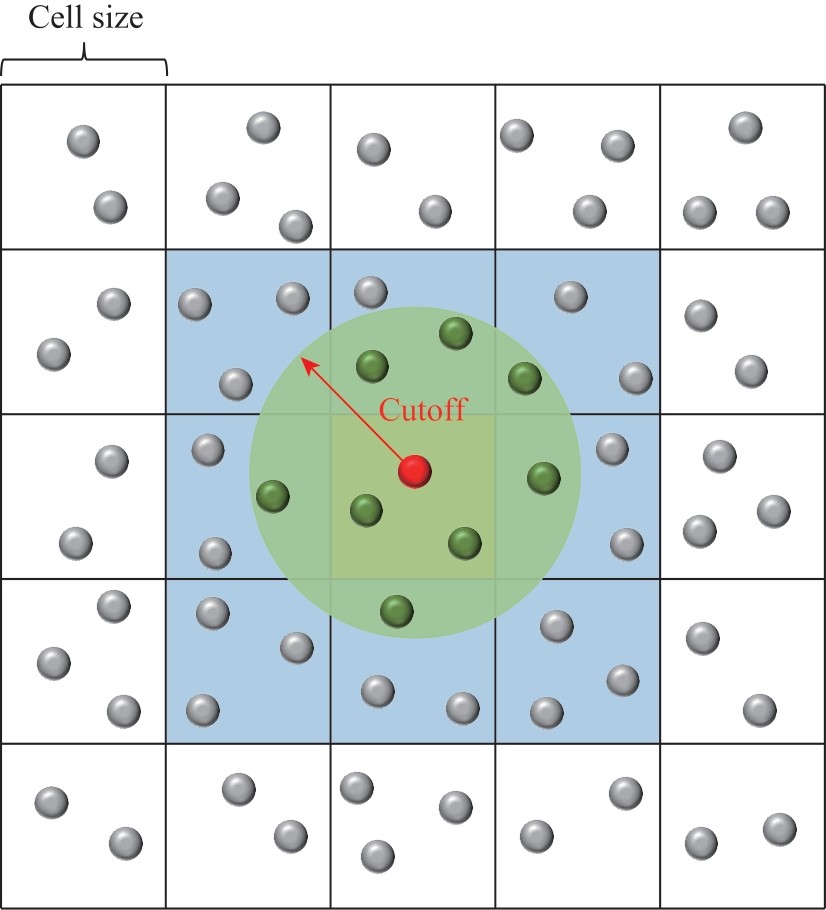
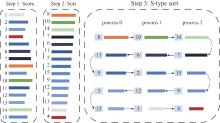
Fig.4
Diagram of the S-type sorting method for load balancing"
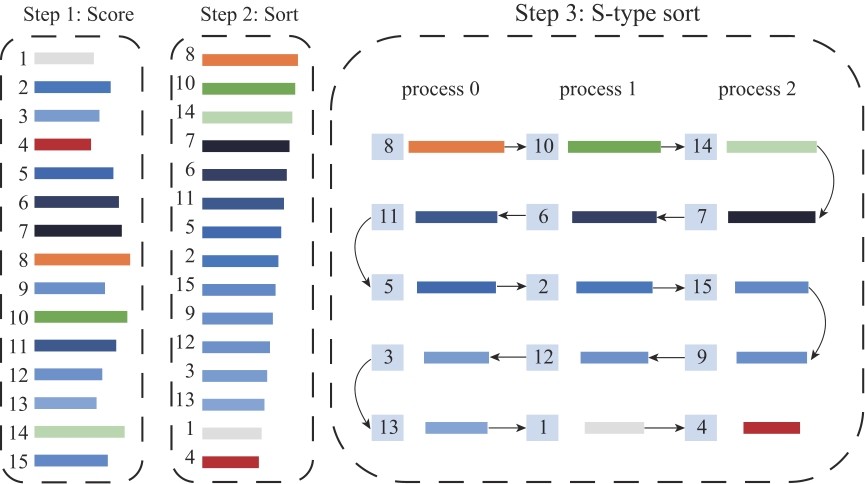
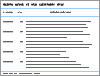
Table 1
Statistical table of computation time of (H2O)192"
| 计算函数 | 运行时间/s | 时间占比 |
|---|---|---|
| DIIS | 710 | 48.0% |
| DENSITY_CALCULATE | 289 | 20.0% |
| SYMMETRIC_UPPER | 478 | 32.0% |
| 其他 | 5 | 0.3% |
| 总计 | 1,482 | 100% |
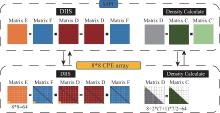
Fig.5
The optimization method of DIIS and density calculate"
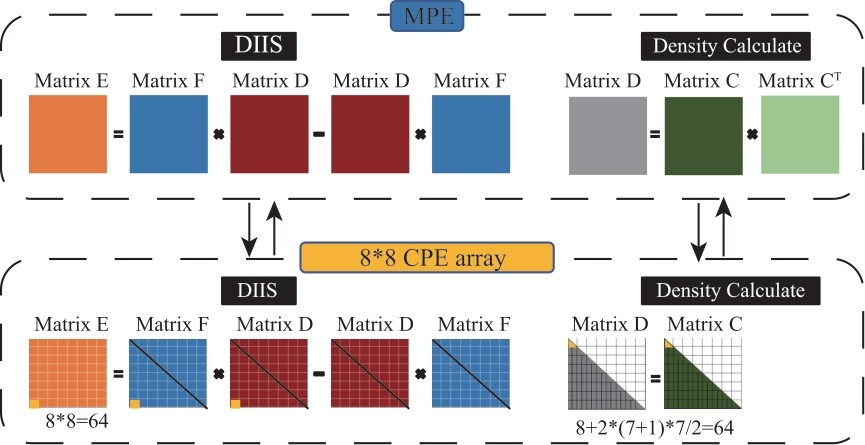
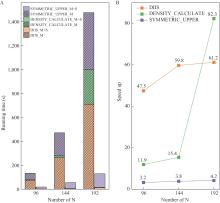
Fig.6
The running time and speed up of energy calculations for water molecular clusters of different scales"
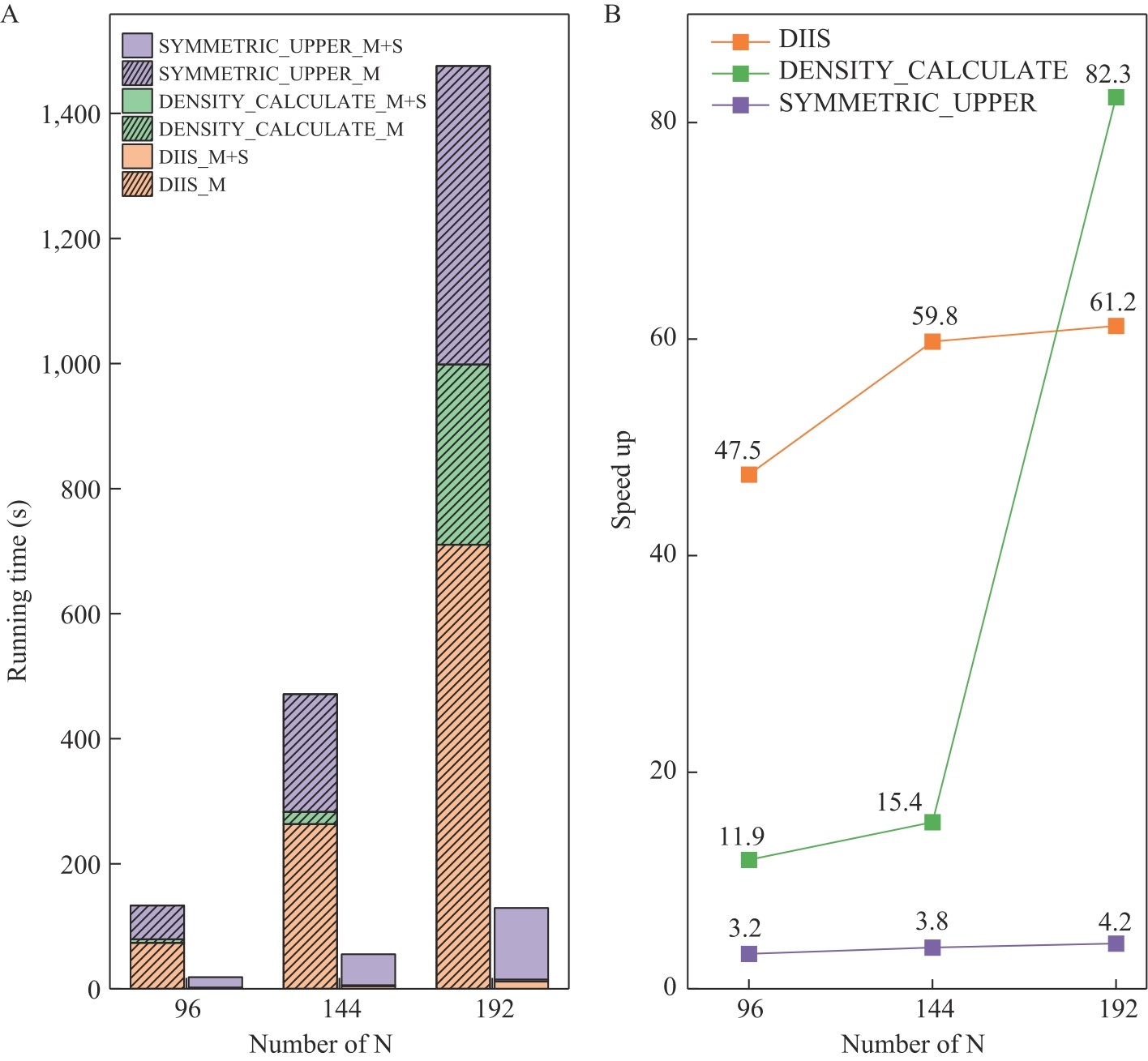
Table 2
Setting of the computation scale for weak scalability calculations"
| 核数 | 帧数 |
|---|---|
| 50,050 | 1 |
| 500,500 | 10 |
| 1,001,000 | 20 |
| 3,003,000 | 60 |
| 5,005,000 | 100 |
| 7,507,500 | 150 |
| 10,010,000 | 200 |
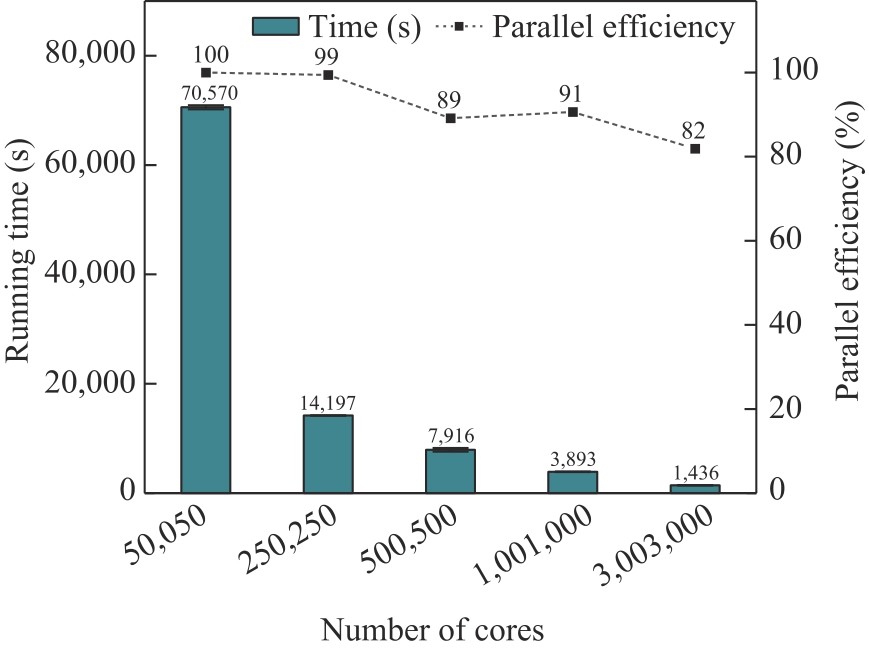
Fig.7
Computational time and parallel efficiency of quantum mechanical force fields in water boxes"
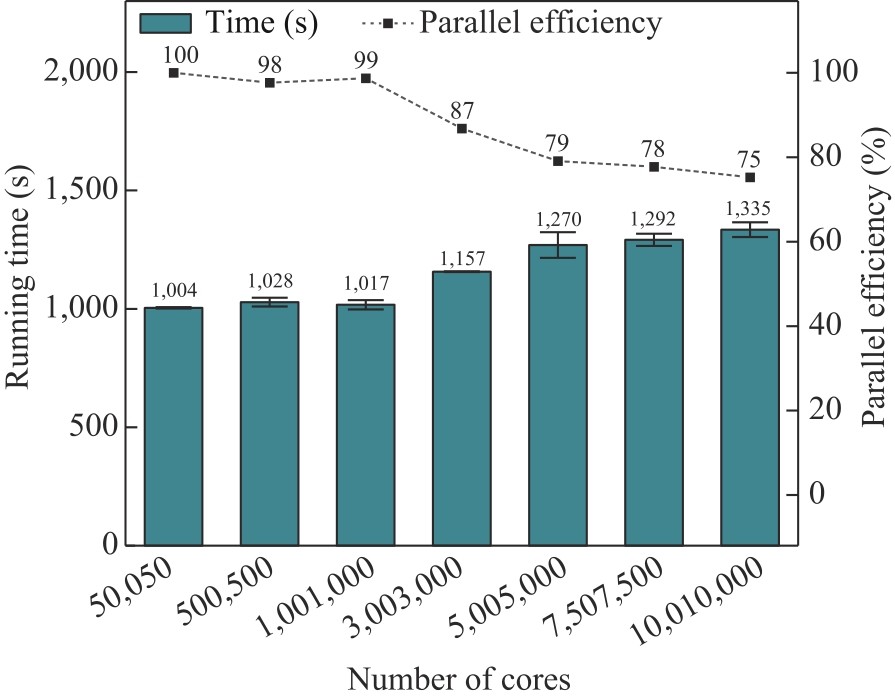
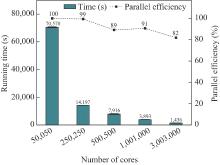
Fig.8
Computational time and parallel efficiency of quantum mechanical force fields in biological systems."
| [1] |
PERILLA J R, GOH B C, CASSIDY C K, et al. Molecular dynamics simulations of large macromolecular complexes[J]. Current Opinion in Structural Biology, 2015, 31: 64-74.
doi: 10.1016/j.sbi.2015.03.007 pmid: 25845770 |
| [2] |
VENABLE R M, KRäMER A, PASTOR R W. Molecular Dynamics Simulations of Membrane Permeability[J]. Chemical Reviews, 2019, 119(9): 5954-5997.
doi: 10.1021/acs.chemrev.8b00486 pmid: 30747524 |
| [3] |
LIGUORI N, CROCE R, MARRINK S J, et al. Molecular dynamics simulations in photosynthesis[J]. Photosynthesis Research, 2020, 144(2): 273-295.
doi: 10.1007/s11120-020-00741-y pmid: 32297102 |
| [4] |
BARCA G M J, BERTONI C, CARRINGTON L, et al. Recent developments in the general atomic and molecular electronic structure system[J]. Journal of Chemical Physics, 2020, 152(15): 154102.
doi: 10.1063/5.0005188 |
| [5] |
HE X B, MAN V H, YANG W, et al. A fast and high-quality charge model for the next generation general AMBER force field[J]. Journal of Chemical Physics, 2020, 153(11): 114502.
doi: 10.1063/5.0019056 |
| [6] |
TIAN C, KASAVAJHALA K, BELFON K A A, et al. ff19SB: Amino-Acid-Specific Protein Backbone Parameters Trained against Quantum Mechanics Energy Surfaces in Solution[J]. Journal of Chemical Theory and Computation, 2020, 16(1): 528-552.
doi: 10.1021/acs.jctc.9b00591 pmid: 31714766 |
| [7] |
MAO R, WANG X, GAO J. Bridging Carotenoid-to-Bacteriochlorophyll Energy Transfer of Purple Bacteria LH2 With Temperature Variations: Insights From Conformational Changes[J]. Frontiers in Chemistry, 2021, 9: 764107.
doi: 10.3389/fchem.2021.764107 |
| [8] |
MARRINK S J, MONTICELLI L, MELO M N, et al. Two decades of Martini: Better beads, broader scope[J]. Wiley Interdisciplinary Reviews-Computational Molecular Science, 2023, 13(1): e1620.
doi: 10.1002/wcms.1620 |
| [9] | 王英杰, 刘梅怡, 高加力. 生物大分子全量子力学方法:显性极化(X-Pol)模型[J]. 分子科学学报, 2013, 29(6): 505-514. |
| [10] |
LI W, MA H, LI S, et al. Computational and data driven molecular material design assisted by low scaling quantum mechanics calculations and machine learning[J]. Chemical Science, 2021, 12(45): 14987-15006.
doi: 10.1039/d1sc02574k pmid: 34909141 |
| [11] |
ORTIZ DE LUZURIAGA I, ELLEUCHI S, JARRAYA K, et al. Semi-empirical and linear-scaling DFT methods to characterize duplex DNA and G-quadruplexes in the presence of interacting small molecules[J]. Physical Chemistry Chemical Physics, 2022, 24(19): 11510-11519.
doi: 10.1039/d2cp00214k pmid: 35362496 |
| [12] |
LIU M, WANG Y, CHEN Y, et al. QM/MM through the 1990s: The First Twenty Years of Method Development and Applications[J]. Israel Journal of Chemistry, 2014, 54(8-9): 1250-1263.
doi: 10.1002/ijch.201400036 pmid: 29386687 |
| [13] |
BRUNK E, ROTHLISBERGER U. Mixed Quantum Mechanical/Molecular Mechanical Molecular Dyna-mics Simulations of Biological Systems in Ground and Electronically Excited States[J]. Chemical Reviews, 2015, 115(12): 6217-6263.
doi: 10.1021/cr500628b |
| [14] | CHUNG L W, SAMEERA W M C, RAMOZZI R, et al. The ONIOM Method and Its Applications[J]. Che-mical Reviews, 2015, 115(12): 5678-5796. |
| [15] |
MORZAN U N, ALONSO DE ARMIñO D J, FOGLIA N O, et al. Spectroscopy in Complex Environments from QM-MM Simulations[J]. Chemical Reviews, 2018, 118(7): 4071-4113.
doi: 10.1021/acs.chemrev.8b00026 pmid: 29561145 |
| [16] |
JONES L O, MOSQUERA M A, SCHATZ G C, et al. Embedding Methods for Quantum Chemistry: Applications from Materials to Life Sciences[J]. Journal of the American Chemical Society, 2020, 142(7): 3281-3295.
doi: 10.1021/jacs.9b10780 pmid: 31986877 |
| [17] |
MYSOVSKY A S, BOGDANOV A I. Seamless Multilayer─A Novel Total Energy Partition Scheme for Embedded and Hybrid Calculations[J]. Journal of Chemical Theory and Computation, 2023, 19(23): 8839-8854.
doi: 10.1021/acs.jctc.3c00666 |
| [18] |
KITAURA K, IKEO E, ASADA T, et al. Fragment molecular orbital method: an approximate computational method for large molecules[J]. Chemical Physics Letters, 1999, 313(3): 701-706.
doi: 10.1016/S0009-2614(99)00874-X |
| [19] |
NAKANO T, KAMINUMA T, SATO T, et al. Fragment molecular orbital method: use of approximate electrostatic potential[J]. Chemical Physics Letters, 2002, 351(5): 475-480.
doi: 10.1016/S0009-2614(01)01416-6 |
| [20] |
CHEN X H, ZHANG D W, ZHANG J Z H. Fractionation of peptide with disulfide bond for quantum mechanical calculation of interaction energy with molecules[J]. The Journal of Chemical Physics, 2004, 120(2): 839-844.
doi: 10.1063/1.1630964 |
| [21] |
LI W, LI S, JIANG Y. Generalized Energy-Based Fragmentation Approach for Computing the Ground-State Energies and Properties of Large Molecules[J]. The Journal of Physical Chemistry A, 2007, 111(11): 2193-2199.
doi: 10.1021/jp067721q |
| [22] |
GORDON M S, FEDOROV D G, PRUITT S R, et al. Fragmentation Methods: A Route to Accurate Calculations on Large Systems[J]. Chemical Reviews, 2012, 112(1): 632-672.
doi: 10.1021/cr200093j pmid: 21866983 |
| [23] |
RAMABHADRAN R O, RAGHAVACHARI K. The Successful Merger of Theoretical Thermochemistry with Fragment-Based Methods in Quantum Chemistry[J]. Accounts of Chemical Research, 2014, 47(12): 3596-3604.
doi: 10.1021/ar500294s pmid: 25393551 |
| [24] |
LIU J, ZHU T, WANG X, et al. Quantum Fragment Based ab Initio Molecular Dynamics for Proteins[J]. Journal of Chemical Theory and Computation, 2015, 11(12): 5897-5905.
doi: 10.1021/acs.jctc.5b00558 pmid: 26642993 |
| [25] |
AKINAGA Y, KATO K, NAKANO T, et al. Fragmentation at sp2 carbon atoms in fragment molecular orbital method[J]. Journal of Computational Chemistry, 2020, 41(15): 1416-1420.
doi: 10.1002/jcc.v41.15 |
| [26] |
FEDOROV D G. Three-Body Energy Decomposition Analysis Based on the Fragment Molecular Orbital Method[J]. The Journal of Physical Chemistry A, 2020, 124(24): 4956-4971.
doi: 10.1021/acs.jpca.0c03085 |
| [27] |
LI W, DONG H, MA J, et al. Structures and Spectroscopic Properties of Large Molecules and Condensed-Phase Systems Predicted by Generalized Energy-Based Fragmentation Approach[J]. Accounts of Chemical Research, 2021, 54(1): 169-181.
doi: 10.1021/acs.accounts.0c00580 pmid: 33350806 |
| [28] |
XIE W, GAO J. Design of a Next Generation Force Field: The X-POL Potential[J]. Journal of Chemical Theory and Computation, 2007, 3(6): 1890-1900.
doi: 10.1021/ct700167b |
| [29] |
GAO J, TRUHLAR D G, WANG Y, et al. Explicit polarization: a quantum mechanical framework for developing next generation force fields[J]. Accounts of Chemical Research, 2014, 47(9): 2837-2845.
doi: 10.1021/ar5002186 pmid: 25098651 |
| [30] |
GAO J L. A molecular-orbital derived polarization potential for liquid water[J]. Journal of Chemical Physics, 1998, 109(6): 2346-2354.
doi: 10.1063/1.476802 |
| [31] | GAO J L. Toward a molecular orbital derived empirical potential for liquid simulations[J]. Journal of Phy-sical Chemistry B, 1997, 101(4): 657-663. |
| [32] |
XIE W, GAO J. The Design of a Next Generation Force Field: The X-POL Potential[J]. Journal of chemical theory and computation, 2007, 3(6): 1890-1900.
doi: 10.1021/ct700167b pmid: 18985172 |
| [33] |
XIE W, OROZCO M, TRUHLAR D G, et al. X-Pol Potential: An Electronic Structure-Based Force Field for Molecular Dynamics Simulation of a Solvated Protein in Water[J]. Journal of chemical theory and computation, 2009, 5(3): 459-467.
doi: 10.1021/ct800239q pmid: 20490369 |
| [34] | FU H, LIAO J, YANG J, et al. The Sunway TaihuLight supercomputer: system and applications[J]. Science China Information Sciences, 2016, 59(7): 072001. |
| [35] |
CALVIN J A, PENG C, RISHI V, et al. Many-Body Quantum Chemistry on Massively Parallel Computers[J]. Chemical Reviews, 2021, 121(3): 1203-1231.
doi: 10.1021/acs.chemrev.0c00006 pmid: 33305957 |
| [36] | LIU Y, LIU X, LI F, et al. Closing the “Quantum Supremacy” Gap: Achieving Real-Time Simulation of a Random Quantum Circuit Using a New Sunway Supercomputer[C]. SC21:International Conference for High Performance Computing, Networking, Storage and Analysis. St. Louis, MO, USA: IEEE, 2021: 1-12. |
| [37] | ZHU Q, LUO H, YANG C, et al. Enabling and Scaling the HPCG Benchmark on the Newest Generation Sunway Supercomputer with 42 Million Heterogeneous Cores[C]. SC21:International Conference for High Performance Computing, Networking, Storage and Analysis. St. Louis, MO, USA: IEEE, 2021: 1-13. |
| [38] | SHANG H, SHEN L, FAN Y, et al. Large-scale simulation of quantum computational chemistry on a new sunway supercomputer[C]. SC'22:Proceedings of the International Conference on High Performance Computing, Networking, Storage and Analysis. Dallas, Texas: IEEE, 2022: 1-14. |
| [39] | YANG C, XUE W, FU H, et al. 10M-Core Scalable Fully-Implicit Solver for Nonhydrostatic Atmospheric Dynamics[C]. SC'16:Proceedings of the International Conference for High Performance Computing, Networking, Storage and Analysis. Salt Lake City, UT, USA: IEEE, 2016: 57-68. |
| [40] | FU H, HE C, CHEN B, et al. 18.9-Pflops Nonlinear Earthquake Simulation on Sunway TaihuLight: Enabling Depiction of 18-Hz and 8-Meter Scenarios[C]. SC17:International Conference for High Performan-ce Computing, Networking, Storage and Analysis. Denver, CO, USA: IEEE, 2017: 1-12. |
| [41] | HUANG S, CHEN J, ZHANG Z, et al. Establishing a Modeling System in 3-km Horizontal Resolution for Global Atmospheric Circulation Triggered by Submarine Volcanic Eruptions with 400 Billion Smoothed Particle Hydrodynamics[C]. SC23:International Conference for High Performance Computing, Networking, Storage and Analysis. Denver, CO, USA: IEEE, 2023: 1-12. |
| [42] |
LIU J, MA H, SHANG H, et al. Quantum-centric high performance computing for quantum chemistry[J]. Physical Chemistry Chemical Physics, 2024, 26(22): 15831-15843.
doi: 10.1039/D4CP00436A |
| [43] |
SHANG H H, WANG F, FAN Y, et al. Large-scale quantum emulating simulations of biomolecules: A pilot exploration of parallel quantum computing[J]. Science Bulletin, 2024, 69(7): 876-880.
doi: 10.1016/j.scib.2024.01.022 |
| [44] |
PULAY P. Convergence acceleration of iterative sequences. the case of scf iteration[J]. Chemical Physics Letters, 1980, 73(2): 393-398.
doi: 10.1016/0009-2614(80)80396-4 |
| No related articles found! |
| Viewed | ||||||
|
Full text |
|
|||||
|
Abstract |
|
|||||

