数据与计算发展前沿 ›› 2026, Vol. 8 ›› Issue (5): 134-152.
CSTR: 32002.14.jfdc.CN10-1649/TP.2026.05.011
doi: 10.11871/jfdc.issn.2096-742X.2026.05.011
阮佳辉1,2( ),冯仰德1,2,*(),李瑞琳1
收稿日期:2025-10-28
出版日期:2026-10-20
发布日期:2026-10-20
通讯作者:
*冯仰德(E-mail:ydfeng@sccas.cn)
作者简介:阮佳辉,中国科学院计算机网络信息中心,硕士研究生,主要研究方向是高性能计算,变异识别。基金资助:
RUAN Jiahui1,2(),FENG Yangde1,2,*(),LI Ruilin1
Received:2025-10-28
Online:2026-10-20
Published:2026-10-20
摘要:
【目的】系统综述变异识别算法的应用现状与其优化方法,总结当前变异识别算法的研究进展,并展望未来的研究方向。【方法】通过深入研究近五年的变异识别工具与它们的优化方法,重点探讨变异识别工具工作流程、核心功能、准确率和性能优化方法等关键技术的研究进展。【结果】当前研究对于SNP和Indel的检测已经形成了较为完整高效的流程,性能优化形成了基于并行计算与硬件加速的方法且仍在不断完善,然而现有技术的软件通用性存在局限,对于结构变异的识别上仍存在准确率不高的问题,难以检测到所有结构变异。【结论】本文系统梳理了近五年变异识别算法工具的关键技术和优化方法。未来变异识别需聚焦结构变异识别、完善多方法协同工作的方法,解决变异识别工具通用性不足的难题。
阮佳辉, 冯仰德, 李瑞琳. 变异识别算法与优化方法综述[J]. 数据与计算发展前沿, 2026, 8(5): 134-152.
RUAN Jiahui, FENG Yangde, LI Ruilin. A Review of Variant Identification Algorithms and Optimization Methods[J]. Frontiers of Data and Computing, 2026, 8(5): 134-152, https://cstr.cn/32002.14.jfdc.CN10-1649/TP.2026.05.011.
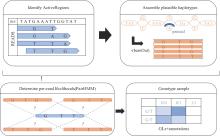
图1
GATK HaplotypeCaller流程图[28]"
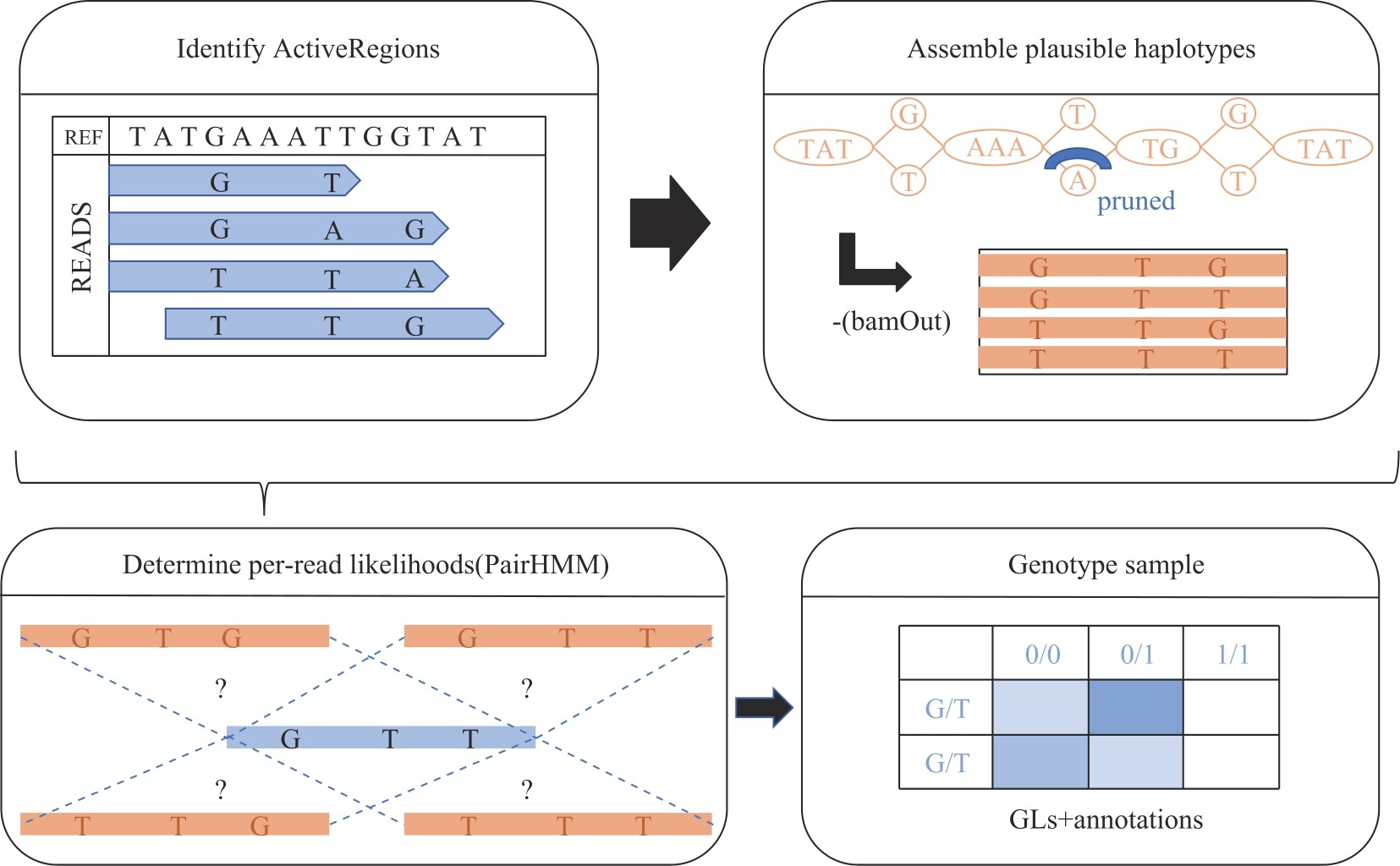
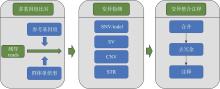
图2
DRAGEN变异检测流程图"
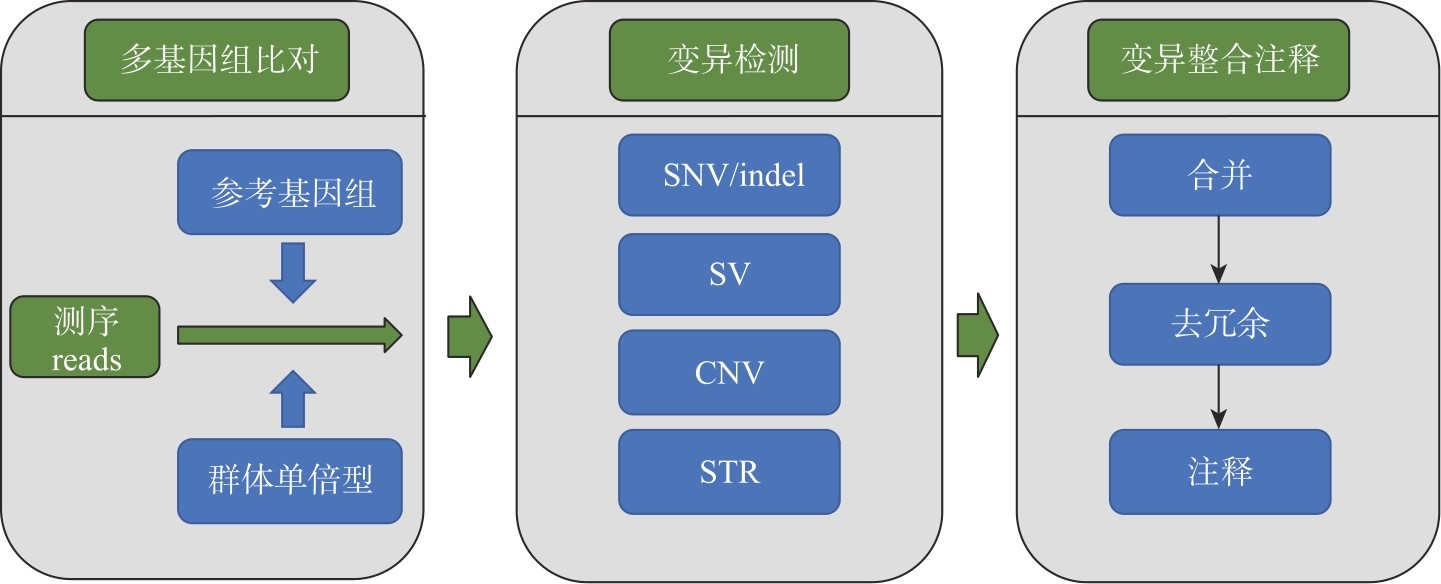
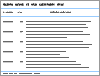
表1
DRAGEN准确性指标及优势"
| 变异类型 | 准确性指标(HG002样本) | 对比工具优势 |
|---|---|---|
| SNV | F1值99.85% | 错误数比DeepVariant+BWA减少58.7%,比GATK+BWA减少83% |
| indel(2-50 bp) | F1值99.80% | 在CMRG区域F1值98.64%,比Giraffe+DeepVariant高0.54% |
| 结构变异(插入) | F1值76.90% | 是Manta(34.90%)的2.2倍,Delly(4.70%)的16.4倍 |
| 结构变异(缺失≥50 bp) | F1值82.60% | 比Manta(70.80%)高11.8%,比Lumpy(66.80%)高15.8% |
| CNV(1-5 kb) | F1值92.60% | 是CNVnator(39.20%)的2.4倍 |
| STR(重叠区域) | F1值96.72% | 比GangSTR(69.86%)高26.86% |
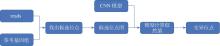
图3
DeepVariant流程图"
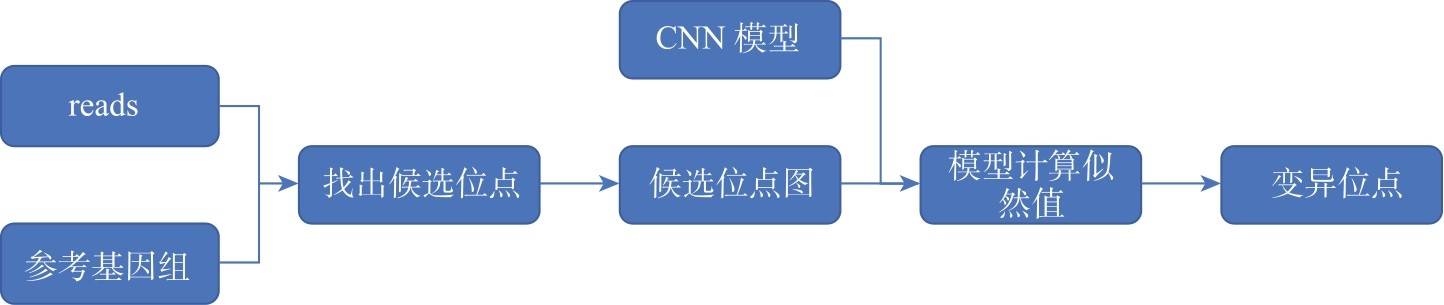
表2
深度学习方法的准确性和优势对比"
| 工具名称 | 测序平台 | 覆盖度 | 使用样本 | SNP(精度/召 回率/F1分数) | Indel(精度/召回率/F1分数) | 优势区域 | 参考 文献 |
|---|---|---|---|---|---|---|---|
| Clair3 | ONT | 50× | HG003样本 | 99.67%/ 99.60%/- | 90.86% /64.73%/- | 复杂区域,低覆盖、大规模检测 | [ |
| PEPPER-Margin-DeepVariant | ONT | 50× | HG003样本 | 99.61%/ 99.63%/- | 87.62%/ 57.42%/- | 首次实现ONT-SNP精度超Illumina短读段,特定复杂区域,单倍型定相 | [ |
| DeepVariant | Illumina | 35× | HG003样本 | 99.82%/ 99.38%/- | 99.74%/ 99.39%/ | Indel检测精度和召回率最优;碱基替换错误分布更随机,无明显偏向性 | [ [ |
| DeepVariant | Illumina | 30× | HG001样本 | 99.23%/ 96.89%/ 98.05% | 96.74%/ 92.11%/ 94.37% | Indel检测精度和召回率最优;碱基替换错误分布更随机,无明显偏向性 | [ [ |
| GATK 4.0 | Illumina | 30× | HG001样本 | 98.61%/ 97.04%/ 97.82% | 94.83%/ 86.02%/ 90.21% | SNP召回率略高于DeepVariant;群体规模分析中常用的变异质量归一化支持更成熟 | [ |
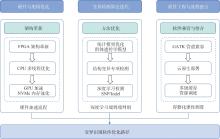
图4
变异识别软件的优化路径"
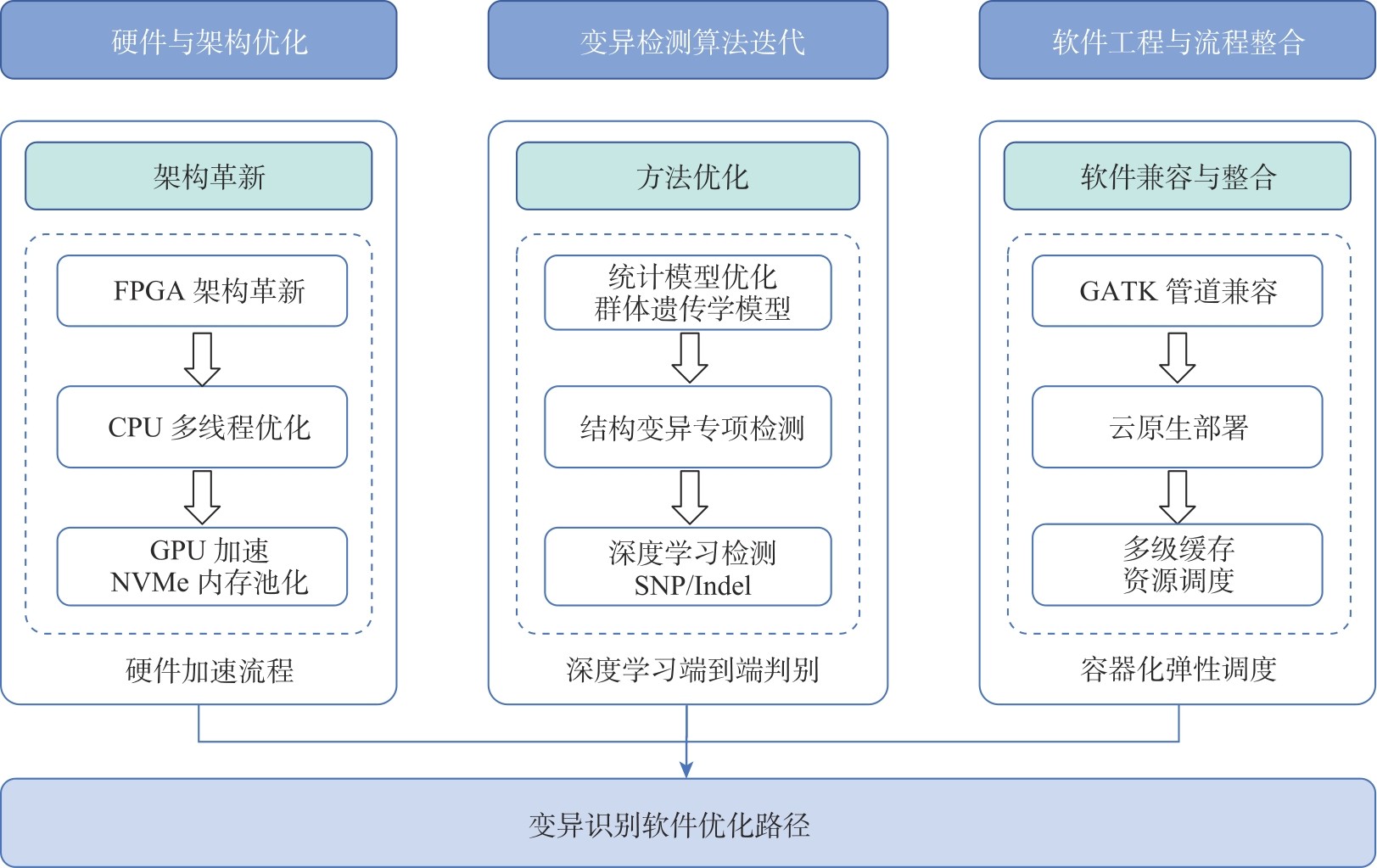
表3
变异识别优化方法对比表"
| 核心优化方案 | 适用场景 | 优点 | 缺点 | 对应文献 |
|---|---|---|---|---|
| PE环结构 | 中等长度序列变异分析、需灵活扩展的计算场景 | 灵活性和可扩展性好,便于适配不同数据规模,时间复杂度O(N*L2/P) | 对于极长序列,数据传输和存储开销较大 | [ |
| 波前计算模式 | GPU加速的并行计算场景、内存受限的分析任务 | 减少内核内存占用,实现高效并行计算,时间复杂度O(N*L/W) | 性能存在波动,对GPU内存带宽要求较高 | [ |
| 非合作结构 | 高计算密度的变异分析、可扩展性要求高的场景 | 提高计算效率,良好的可扩展性,时间复杂度为O(N*L2/P) | 对内存带宽需求较高 | [ |
| 动态内存交换方法 | GPU内存资源紧张的大规模数据处理场景 | 充分利用GPU内存资源,提高内存利用率,时间复杂度为O(N*L) | 实现复杂度高,内存交换带来额外开销 | [ |
| 深度学习端到 端判别 | 复杂区域变异检测、难例变异挖掘 | 可自动学习变异特征,对复杂测序信号处理能力强;能有效挖掘传统算法遗漏的难例变异,时间复杂度为O(N*C*k2) | 需大量标注数据训练模型;成本较高 | [ |
| 扩展Manta算法 | 染色体结构变异检测 | 结构变异检测灵敏度高;可精准识别传统方法难检测的染色体大片段变化,时间复杂度为O(R*L+K*M2) | 对短读长数据的复杂结构变异解析能力仍有局限 | [ |
| GATK最佳实践流程兼容与加速 | 现有基因组分析流程、标准化分析场景 | 兼容成熟流程,降低用户迁移成本;保留标准分析结果的可比性 | 受限于GATK原有框架,部分自定义优化难以实现;对非标准流程适配性差 | [ |
| 大规模队列联合调用可扩展性设计 | 生物银行级大规模样本分析、群体遗传学研究 | 支持高通量分析;大规模数据处理 速度快 | 任务调度复杂,易出现资源竞争;对硬件集群规模要求较高 | [ |
| [1] | ZHU Q L, LIU S, GAO P, et al. High-throughput sequencing technology and its application[J]. Journal of Northeast Agricultural University (English Edition), 2014, 21(3): 84-96. |
| [2] | 李庆岗, 陶立. 高通量测序技术及其在生命科学中的应用[J]. 畜牧与饲料科学, 2012, 33(2): 25. |
| [3] | MASTROROSA F K, MILLER D E, EICHLER E E. Applications of long-read sequencing to Mendelian genetics[J]. Genome Medicine, 2023, 15: 42. |
| [4] | GNERRE S, MACCALLUM I, PRZYBYLSKI D, et al. High-quality draft assemblies of mammalian genomes from massively parallel sequence data[J]. Proceedings of the National Academy of Sciences of the United States of America, 2011, 108(4): 1513-1518. |
| [5] | SIRÉN J, MONLONG J, CHANG P C, et al. Pangenomics enables genotyping of known structural variants in 5202 diverse genomes[J]. Science, 2021, 374: eabg8871. |
| [6] | JI Y, LI Y, LIANG Y, et al. Unveiling novel genetic variants in 370 challenging medically relevant genes using the long read sequencing data of 41 samples from 19 global populations[J]. Molecular Genetics and Genomics, 2024, 299: 65. |
| [7] | SHAFIN K, PESOUT T, LORIG-ROACH R, et al. Nanopore sequencing and assembly of a human genome with ultra-long reads[J]. Nature Biotechnology, 2022, 40(8): 1293-1300. |
| [8] | MCKENNA A, HANNA M, BANKS E, et al. The Genome Analysis Toolkit: a MapReduce framework for analyzing next-generation DNA sequencing data[J]. Genome Research, 2010, 20(9): 1297-1303. |
| [9] | BEHERA S, CATREUX S, ROSSI M, et al. Comprehensive and accurate genome analysis at scale using DRAGEN accelerated algorithms[EB/OL]. (2024-01-02)[2025-10-10]. BioRxiv. DOI: https://doi.org/10.1101/2024.01.02.573821. |
| [10] | EDGE P, BANSAL V. Longshot enables accurate variant calling in diploid genomes from single-molecule long read sequencing[J]. Nature Communications, 2019, 10: 4660. |
| [11] | POPLIN R, CHANG P C, ALEXANDER D, et al. A universal SNP and small-indel variant caller using deep neural networks[J]. Nature Biotechnology, 2018, 36: 983-987. |
| [12] | PARK J, COOK D E, CHANG P C, et al. Accurate somatic small variant discovery for multiple sequencing technologies with DeepSomatic[J]. Nature Biotechnology, 2025. |
| [13] | GUILLE A, HADJADJ D, BLANC J F, et al. A benchmarking study of individual somatic variant callers and voting-based ensembles for whole-exome sequencing[J]. Briefings in Bioinformatics, 2024, 26(1): bbae697. |
| [14] | DAVIS J, GOADRICH M. The relationship between Precision-Recall and ROC curves[C]//Proceedings of the 23rd International Conference on Machine Learning. New York: ACM, 2006: 233-240. |
| [15] | CHENG H, CONCEPCION G T, FENG X, et al. Haplotype-resolved de novo assembly using phased assembly graphs with hifiasm[J]. Nature Methods, 2021, 18: 170-175. |
| [16] | 连帅彬, 郭东亮, 戴宪华. 基因结构变异检测方法综述[J]. 现代生物医学进展, 2012, 12(18): 3577-3580. |
| [17] | GAO Y, LIU Y, MA Y, et al. GraphAligner: rapid and versatile sequence-to-graph alignment[J]. Genome Biology, 2019, 20: 207. |
| [18] | ABYZOV A, URBAN A E, SNYDER M, et al. CNVnator: an approach to discover, genotype, and characterize typical and atypical CNVs from family and population genome sequencing[J]. Genome Research, 2011, 21(6): 974-984. |
| [19] | JIANG T, LIU Y Z, JIANG Y, et al. Long-read-based human genomic structural variation detection with cuteSV[J]. Genome Biology, 2020, 21(1): 189. |
| [20] | LAYER R M, CHIANG C, QUINLAN A R, et al. LUMPY: a probabilistic framework for structural variant discovery[J]. Genome Biology, 2014, 15: R84. |
| [21] | CHEN X, SCHULZ-TRIEGLAFF O, SHAW R, et al. Manta: rapid detection of structural variants and indels for germline and cancer sequencing applications[J]. Bioinformatics, 2016, 32(8): 1220-1222. |
| [22] | RAUSCH T, ZICHNER T, SCHLATTL A, et al. DELLY: structural variant discovery by integrated paired-end and split-read analysis[J]. Bioinformatics, 2012, 28(18): i333-i339. |
| [23] | ZOOK J, CHAPMAN B, WANG J, et al. Integrating human sequence data sets provides a resource of benchmark SNP and indel genotype calls[J]. Nature Biotechnology, 2014, 32: 246-251 |
| [24] | LIU Z, XIE Z, LI M. Comprehensive and deep evaluation of structural variation detection pipelines with third-generation sequencing data[J]. Genome Biology, 2024, 25: 188. |
| [25] | RAJABY R, SUNG W K. SurVIndel2: improving copy number variant calling from next-generation sequencing using hidden split reads[J]. Nature Communications, 2024, 15: 10473. |
| [26] | NARDONE G G, CORTESE A, BRESADOLA L, et al. A hitchhiker guide to structural variant calling: a comprehensive benchmark through different sequencing technologies[J]. Biomedicines, 2025, 13(8): 1949. |
| [27] | VAN DER AUWERA G A, CARNEIRO M O, HARTL C, et al. From FastQ data to high-confidence variant calls: the Genome Analysis Toolkit best practices pipeline[J]. Current Protocols in Bioinformatics, 2013, 43: 11.10. 1-11.10.33. |
| [28] | HUANG S, MANIKANDAN G J, RAMACHANDRAN A, et al. Hardware acceleration of the pair-HMM algorithm for DNA variant calling[C]//Proceedings of the 2017 ACM/SIGDA International Symposium on Field-Programmable Gate Arrays. ACM, 2017: 275-284. |
| [29] | PEVZNER P A, TANG H, WATERMAN M S. An Eulerian path approach to DNA fragment assembly[J]. Proceedings of the National Academy of Sciences of the United States of America, 2001, 98(17): 9748-9753. |
| [30] | DURBIN R, EDDY S, KROGH A, et al. Biological Sequence Analysis: Probabilistic Models of Proteins and Nucleic Acids[M]. Cambridge: Cambridge University Press, 1998. |
| [31] | KIM S, SCHEFFLER K, HALPERN A L, et al. Strelka2: fast and accurate calling of somatic and germline variants[J]. Nature Methods, 2018, 15(9): 761-763. |
| [32] | CIBULSKIS K, LAWRENCE M S, CARTER S L, et al. Sensitive detection of somatic point mutations in impure and heterogeneous cancer samples[J]. Nature Biotechnology, 2013, 31(3): 213-219. |
| [33] | BENJAMIN D, SATO T, CIBULSKIS K, et al. Calling Somatic SNVs and Indels with Mutect2[EB/OL]. (2019-12-02)[2025-10-10]. BioRxiv. DOI: https://doi.org/10.1101/861054. |
| [34] | NARZISI G, CORVELO A, ARORA K, et al. Genome-wide somatic variant calling using localized colored de Bruijn graphs[J]. Communications Biology, 2018, 1(1): 20. |
| [35] | LIN M F, RODEH O, PENN J, et al. GLnexus: joint variant calling for large cohort sequencing[EB/OL]. (2018-06-11)[2025-10-01]. BioRxiv. DOI: https://doi.org/10.1101/343970. |
| [36] | SMITH T F, WATERMAN M S. Identification of common molecular subsequences[J]. Journal of Molecular Biology, 1981, 147(1): 195-197. |
| [37] | MASOOD D, REN L, NGUYEN C, et al. Evaluation of somatic copy number variation detection by NGS technologies and bioinformatics tools on a hyper-diploid cancer genome[J]. Genome Biology, 2024, 25(1): 163. |
| [38] | ZOOK J, CATOE D, MCDANIEL J, et al. Extensive sequencing of seven human genomes to characterize benchmark reference materials[J]. Scientific Data, 2016, 3: 160025. |
| [39] | ZHENG Z, LI S, SU J, et al. Symphonizing pileup and full-alignment for deep learning-based long-read variant calling[J]. Nature Computational Science, 2022, 2(12): 797-803. |
| [40] | FUKUSHIMA K. Neocognitron: a self-organizing neural network model for a mechanism of pattern recognition unaffected by shift in position[J]. Biological Cybernetics, 1980, 36(4): 193-202. |
| [41] | SHAFIN K, PESOUT T, CHANG P C, et al. Haplotype-aware variant calling with PEPPER-Margin-De-epVariant enables high accuracy in nanopore long-reads[J]. Nature Methods, 2021, 18: 1322-1332. |
| [42] | ASRI M, CHANG P C, MIER J C, et al. Pangenome-aware DeepVariant[EB/OL]. (2025-6-5)[2025-9-20].BioRxiv. DOI:https://doi.org/10.1101/2025.06.05.65-7102. |
| [43] | HE K, ZHANG X, REN S, et al. Deep residual learning for image recognition[C]//Proc. IEEE CVPR. 2016:770-778. |
| [44] | SUPERNAT A, VIDARSSON O V, STEEN V M, et al. Comparison of three variant callers for human whole genome sequencing[J]. Scientific Reports, 2018, 8(1): 17851. |
| [45] | CHEN N C, KOLESNIKOV A, GOEL S, et al. Improving variant calling using population data and deep learning[J]. BMC Bioinformatics 2023, 24(197). |
| [46] | ZHU T, VATS P, ONKEN S, et al. Parabricks: GPU Accelerated Universal Pan-Instrument Genomics An-alysis Software Suite[EB/OL]. (2025-08-04) [2025-10-27]. BioRxiv. DOI: https://doi.org/10.1101/2025.07.23.666378. |
| [47] | FARJOUN Y, GAUTHIER L, FRIEDMAN S F, et al. A comprehensive review of deep learning-based variant calling methods[J]. Briefings in Functional Genomics, 2024. |
| [48] | MUTLU O, ALSER M, SINGH G, et al. Accelerating genome analysis: a primer on an ongoing journey[J]. IEEE Micro, 2020, 40(5): 65-75. |
| [49] | SCHMIDT B, KALLENBORN F, WICHMANN A, et al. gpuPairHMM: High-speed Pair-HMM Forward Algorithm for DNA Variant Calling on GPUs[J]. ArXiv preprint ArXiv:2411.11547v1, 2024. |
| [50] | O’CONNELL K A, YOSUFZAI Z B, CAMPBELL R A, et al. Accelerating genomic workflows using NVIDIA Parabricks[J]. BMC Bioinformatics 2023, 24(1): 221. |
| [51] | REN S, BERTELS K, AL-ARS Z. GPU-Accelerated GATK HaplotypeCaller with Load-Balanced Multi-Process Optimization[C]//2017 IEEE 17th International Conference on Bioinformatics and Bioengineering. IEEE, 2017: 497-502. |
| [52] | University of Toronto. Lecture 8:State-Space Models-Forward Algorithm (HMM)[EB/OL]. (2022-01-01)[2025-10-27]. DOI: https://www.cs.toronto.edu/-duvenaud/courses/csc412/lectures/08-hmm.pdf. |
| [53] | FREED D, ALDANA R, WEBER J A, et al. The sentieon genomics tools-a fast and accurate solution to variant calling from next-generation sequence data[EB/OL]. BioRxiv, (2017-3-10)[2025-12-08]. DOI:10.1101/115717. |
| [54] | REN S, BERTELS K, AL-ARS Z. Efficient acceleration of the Pair-HMMs Forward Algorithm for GA-TK HaplotypeCaller on graphics processing units[J]. Evolutionary Bioinformatics, 2018, 14: 117693431-8760543. |
| [55] | WANG P, LEI Y, DOU Y. Pair-HMM accelerator based on non-cooperative structure[J]. IEICE Electronics Express, 2019, 16(15): 20190402. |
| [56] | BRANCHINI B, ZENI A, SANTAMBROGIO M D. A methodology for Accelerating Variant Calling on GPU[C]//SC21: The International Conference for High Performance Computing, Networking, Storage and Analysis. IEEE, 2021. |
| [1] | 伍清林, 徐瑾昊, 孙兴亮, 郭学军, 冯敏. 基于地形感知混合注意力网络的数字高程模型超分辨率重建[J]. 数据与计算发展前沿, 2026, 8(5): 122-133. |
| [2] | 王博, 徐玉灿, 高继涵, 佘伟光, 梁存霞, 靳冰, 王鑫春, 周艳聪, 孙宝. 基于边缘检测的气管插管内窥镜图像气道边界提取[J]. 数据与计算发展前沿, 2026, 8(5): 34-47. |
| [3] | 靳润锋, 梁文昊, 马英晋, 任鹏举, JAMES P Lewis, 金钟. 分子动力学模拟软件FIREBALL的异构加速优化[J]. 数据与计算发展前沿, 2026, 8(4): 123-135. |
| [4] | 张梓豪, 张小瑞, 孙伟, 周石煜. 一种用于面部视频抑郁水平评估的多尺度时间差分网络[J]. 数据与计算发展前沿, 2026, 8(4): 149-161. |
| [5] | 林予松, 梁振羽, 赵哲. PMDeUNet:一个用于高效分割腹部医学图像的轻量级网络模型[J]. 数据与计算发展前沿, 2026, 8(4): 162-178. |
| [6] | 张思扬, 胡林. 融合标签语义的农业科学数据层次多标签分类方法研究[J]. 数据与计算发展前沿, 2026, 8(4): 246-256. |
| [7] | 周玉明, 张一鸣, 刘圆圆, 黄山. 遥感卫星图像船舶检测样本数据集研究综述[J]. 数据与计算发展前沿, 2026, 8(2): 215-226. |
| [8] | 王兆滨, 王睿, 吕永科, 张耀南. 基于自适应语义连接和感知注意力的沙漠分割方法[J]. 数据与计算发展前沿, 2026, 8(2): 25-39. |
| [9] | 韩立钦, 李龙园, 王钰康, 张耀南, 常盟盟, 潘清元. 基于频域引导特征的泥石流灾后遥感影像语义分割网络构建研究[J]. 数据与计算发展前沿, 2026, 8(2): 54-65. |
| [10] | 潘语泉,袁得嵛,贾源,王安然. 基于融合特征的VGAT-VGAN跨社交网络身份关联算法[J]. 数据与计算发展前沿, 2026, 8(1): 103-118. |
| [11] | 蔡毅,王晓宾,陈蕊丽,韩珣. 基于笔迹的书写者性别与年龄检测研究综述[J]. 数据与计算发展前沿, 2026, 8(1): 129-147. |
| [12] | 万萌, 何洪林, 任小丽, 聂宁明, 曹荣强, 王宗国, 李凯, 王晓光, 王彦棡, 王珏, 高超. 基于工作流的陆地生态系统碳循环实时同化预测系统[J]. 数据与计算发展前沿, 2026, 8(1): 168-182. |
| [13] | 邓绎如,何洪波,王英,王闰强. 一种基于情感分析的网络舆论倾向性检测方法[J]. 数据与计算发展前沿, 2026, 8(1): 91-102. |
| [14] | 杨沁蒙, 聂宁明, 周纯葆, 王彦棡. 基于深度学习的Taylor杆碰撞数值模拟算法[J]. 数据与计算发展前沿, 2025, 7(6): 101-110. |
| [15] | 杜振鹏, 徐建良, 张先轶, 黄强. 基于GPU的FFT高性能算法库的实现和优化[J]. 数据与计算发展前沿, 2025, 7(6): 124-135. |
| 阅读次数 | ||||||
|
全文 |
|
|||||
|
摘要 |
|
|||||

