Frontiers of Data and Computing ›› 2026, Vol. 8 ›› Issue (2): 40-53.
CSTR: 32002.14.jfdc.CN10-1649/TP.2026.02.004
doi: 10.11871/jfdc.issn.2096-742X.2026.02.004
• Special Issue: Key Technologies and Applications of Cryospheric Big Data Mining and Analysis • Previous Articles Next Articles
LIU Jingqi1,2,3( ),ZHANG Yaonan1,2,*(),KANG Jianfang1,2,3,LIU Jie4,5,YANG Zhiwei4,5,ZHANG Zhixing6,WANG Baode7,8
Received:2025-10-10
Online:2026-04-20
Published:2026-04-23
LIU Jingqi, ZHANG Yaonan, KANG Jianfang, LIU Jie, YANG Zhiwei, ZHANG Zhixing, WANG Baode. Multi-Agent Collaborative Data-Engineering-Based Early Warning for Road Icing in High-Altitude Cold Mountainous Regions[J]. Frontiers of Data and Computing, 2026, 8(2): 40-53, https://cstr.cn/32002.14.jfdc.CN10-1649/TP.2026.02.004.
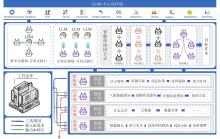
Fig.1
The road icing warning mode of “Intelligent Agent+Data Engineering”"
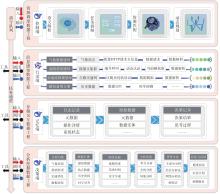
Fig.2
Multi-agent collaboration-based road icing data engineering early warning construction"
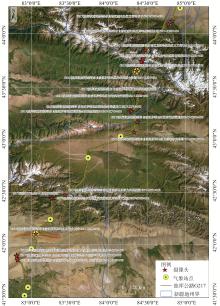
Fig.3
Distribution of cameras and meteorological stations on G217 Duku Highway"
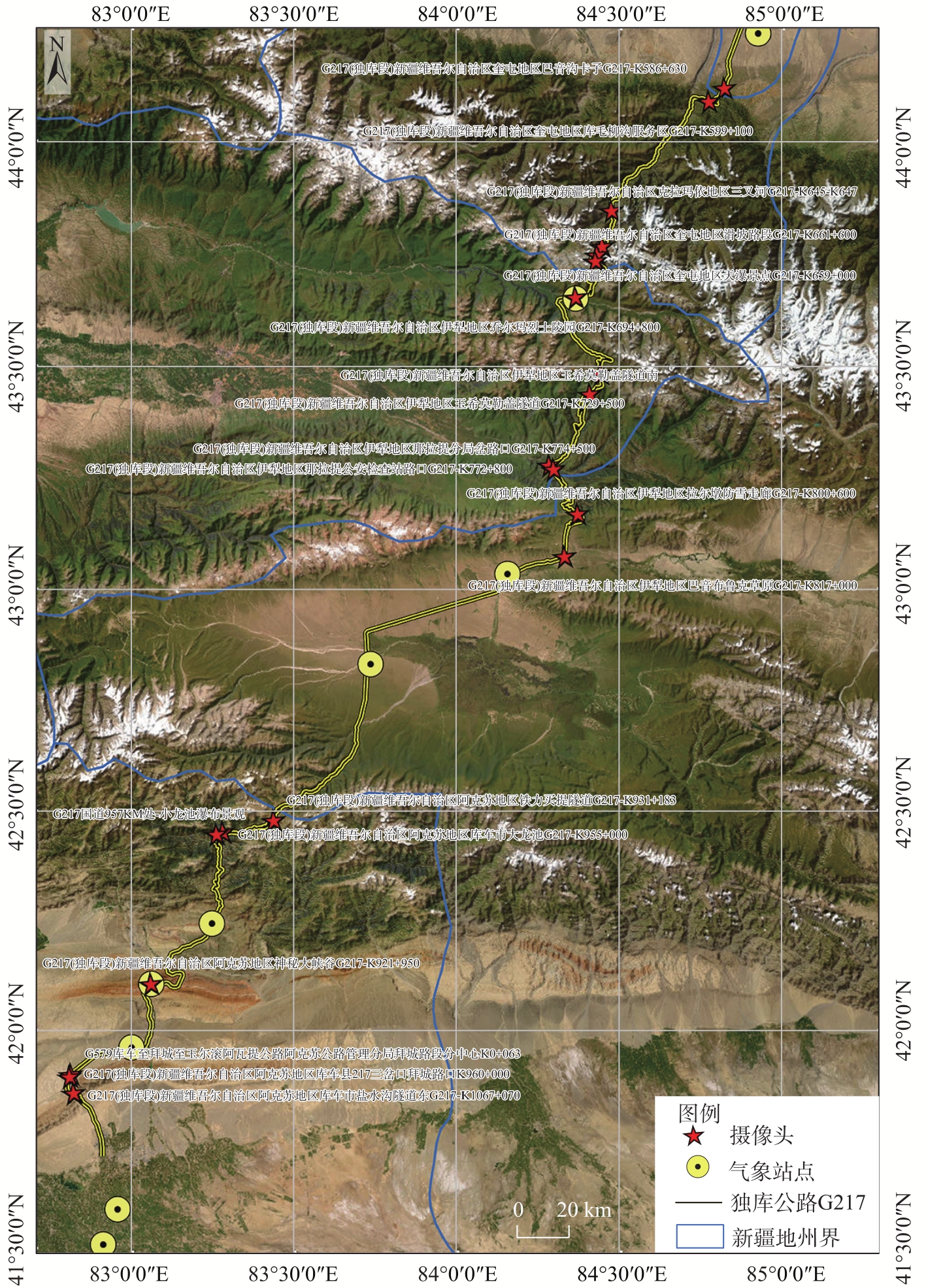
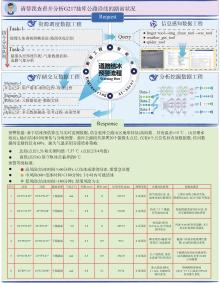
Fig.4
Demonstration of road icing warning scenario"
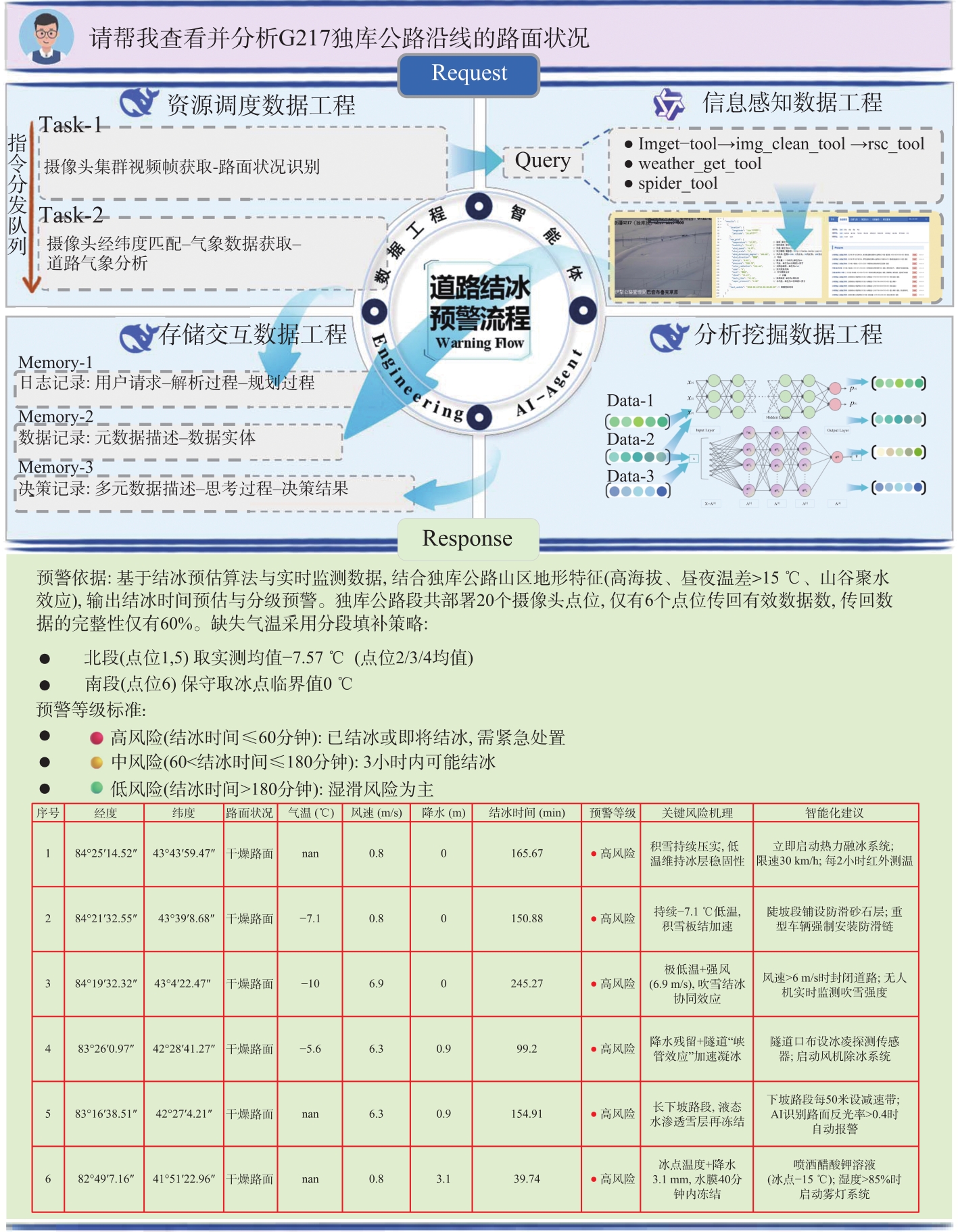
Table 1
Log records"
| 序号 | 摄像头 | 经度 | 纬度 | 摄像头当前帧 | 路面状况 | 气温(℃) | 风速(m/s) | 降水(m) |
|---|---|---|---|---|---|---|---|---|
| 1 | G217奎屯地区哈希勒根防雪走廊G217-K668+966 | 84°25′14.52″ | 43°43′59.47″ | 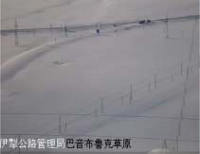 | 积雪路面 | nan | 0.8 | 0 |
| 2 | G217伊犁地区乔尔玛烈士陵园G217-K694+800 | 84°21′32.55″ | 43°39′8.68″ | 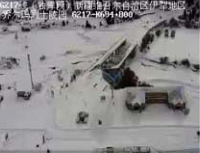 | 积雪路面 | -7.1 | 0.8 | 0 |
| 3 | G217伊犁地区巴音布鲁克草原G217-K817+000 | 84°19′32.32″ | 43°4′22.47″ | 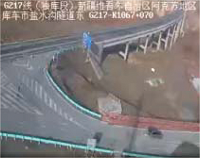 | 积雪路面 | -10 | 6.9 | 0 |
| 4 | G217阿克苏地区铁力买提隧道G217-K931+183 | 83°26′0.97″ | 42°28′41.27″ | 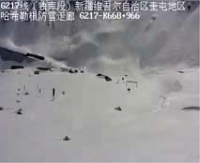 | 积雪路面 | -5.6 | 6.3 | 0.9 |
| 5 | G217阿克苏地区库车市大龙池G217-K955+000 | 83°16′38.51″ | 42°27′4.21″ | 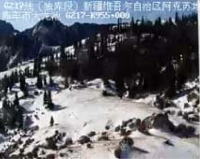 | 积雪路面 | nan | 6.3 | 0.9 |
| 6 | G217阿克苏地区库车市盐水沟隧道东G217-K1067+070 | 82°49′7.16″ | 41°51′22.96″ | 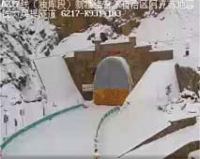 | 干燥路面 | nan | 0.8 | 3.1 |
| [1] | 张耀南. 数据工程学建设思考与实践[J]. 数据与计算发展前沿, 2022, 4(1): 5-19. |
| [2] | 陈占龙, 陶留锋, 孙政权, 等. 数据工程视角下的军事地质数据体系研究[J]. 测绘与空间地理信息, 2022(11): 1-4. |
| [3] | 张耀南, 田琛琛, 任彦润, 等. 自然灾害应急响应科学数据工程体系建设[J]. 数据与计算发展前沿, 2024, 6(1): 46-56. |
| [4] |
JIN A A, YE Y, LEE B, et al. Decoagent: Large language model empowered decentralized autonomous collaboration agents based on smart contracts[J]. IEEE Access, 2024, 12: 155234-155245.
doi: 10.1109/ACCESS.2024.3481641 |
| [5] | HONG S, ZHUGE M, CHEN J, et al. MetaGPT: Meta Programming for Multi-Agent Collaborative Framework[C]. The 12th International Conference on Learning Representations, Vienna, Austria, 2024. |
| [6] | WANG J Y, XU H Y, JIA H T, et al. Mobile-agent-v2: Mobile device operation assistant with effective navigation via multi-agent collaboration[J]. Advances in Neural Information Processing Systems, 2024, 37: 2686-2710. |
| [7] | 王宁. 道路路面缺陷检测算法与养护策略研究[D]. 山东交通学院, 2024. |
| [8] | 杨二贺. 面向组合式图像检索的多模态特征对齐与融合方法研究[D]. 东华大学, 2025. |
| [9] | 贾兴利, 曲远海, 朱浩然, 等. 交通预测中的时空图神经网络研究综述: 从模型解构到发展路径[J/OL]. 交通运输工程学报, 1-35[2025-10-25]. https://doi.org/10.19818/j.cnki.1671-1637.2026.01.003. |
| [10] | SHAO J. Fuzzy categorization of weather conditions for thermal mapping[J]. Journal of Applied Meteorology and Climatology, 2000, 39(10): 1784-1790. |
| [11] |
VARGAS J, ALSWEISS S, TOKER O, et al. An overview of autonomous vehicles sensors and their vulnerability to weather conditions[J]. Sensors, 2021, 21(16): 5397.
doi: 10.3390/s21165397 |
| [12] | FLATSCHER M, NEUMAYER M, BRETTERLIEBER T, et al. Measurement of complex dielectric material properties of ice using electrical impedance spectroscopy[C]. IEEE Sensors, Orlando, USA, 2016: 1-3. |
| [13] |
TROIANO A, NADDEO F, SOSSO E, et al. Assessment of force and fatigue in isometric contractions of the upper trapezius muscle by surface EMG signal and perceived exertion scale[J]. Gait & Posture, 2008, 28(2): 179-186.
doi: 10.1016/j.gaitpost.2008.04.002 |
| [14] |
AMOIROPOULOS K, KIOSELAKI G, KOURKOUMELIS N, et al. Shaping beam profiles using plastic optical fiber tapers with application to ice sensors[J]. Sensors, 2020, 20: 2503.
doi: 10.3390/s20092503 |
| [15] | SIEGL A, NEUMAYER M, BRETTERLIEBER T. Fibre optical ice sensing: Sensor model and icing experiments for different ice types[C]. IEEE International Instrumentation and Measurement Technology Conference, Dubrovnik, Croatia, 2020: 1-6. |
| [16] |
LI X, SHIIH W Y, VARTULI J, et al. Detection of water-ice transition using a lead zirconate titanate/brass transducer[J]. Journal of Applied Physics, 2002, 92: 106-111.
doi: 10.1063/1.1481191 |
| [17] | GU H, LI B, ZHANG X, et al. Detection of road surface water and ice based on polarization measurement[J]. Electronic Measurement Technology, 2011, 34: 99-102. |
| [18] | HORITA Y, SHIBATA K, MAEDA K, et al. Omni-directional polarization image sensor based on an omni-directional camera and a polarization filter[C]. IEEE International Conference on Advanced Video and Signal Based Surveillance, Genova, Italy, 2009: 280-285. |
| [19] |
CASSELGREN J, SJÖDAHL M. Polarization resolved classification of winter road condition in the near-infrared region[J]. Applied Optics, 2012, 51: 3036-3045.
doi: 10.1364/AO.51.003036 |
| [20] |
SUN Z, ZHANG J, ZHAO Y. Laboratory studies of polarized light reflection from sea ice and lake ice in visible and near infrared[J]. IEEE Geoscience and Remote Sensing Letters, 2012, 10: 170-173.
doi: 10.1109/LGRS.2012.2196753 |
| [21] | JONSSON P, CASSELGREN J, THÖRNBERG B. Road surface status classification using spectral analysis of NIR camera images[J]. Sensors, 2014, 15: 1641-1656. |
| [22] | JONSSON P. Remote sensor for winter road surface status detection[C]. IEEE Sensors, Limerick, Ireland, 2011: 1285-1288. |
| [23] |
LIU J Q, ZHANG Y N, LIU J, et al. Automated Recognition of Snow-Covered and Icy Road Surfaces Based on T-Net of Mount Tianshan[J]. Remote Sensing, 2024, 16: 3727.
doi: 10.3390/rs16193727 |
| [24] |
LEE S, JEON J, LE T H M. Feasibility of automated black ice segmentation in various climate conditions using deep learning[J]. Buildings, 2023, 13(3): 767.
doi: 10.3390/buildings13030767 |
| [25] |
YUAN Y C, ISLAM M S, YUAN Y L, et al. EcRD: Edge-cloud computing framework for smart road damage detection and warning[J]. IEEE Internet of Things Journal, 2020, 8(16): 12734-12747.
doi: 10.1109/JIOT.2020.3024885 |
| [26] | 郭晓澎. 主动式路面积雪凝冰监测预警及处置系统研究[J]. 现代信息科技, 2024, 8(21): 175-180. |
| [27] |
SARABANDI K, LI E S, NASHASHIBI A. Modeling and measurements of scattering from road surfaces at millimeter-wave frequencies[J]. IEEE Transactions on Antennas and Propagation, 2002, 45(11): 1679-1688.
doi: 10.1109/8.650080 |
| [28] |
CARSON J, MANNEERING F. The effect of ice warning signs on ice-accident frequencies and severities[J]. Accident Analysis & Prevention, 2001, 33(1): 99-109.
doi: 10.1016/S0001-4575(00)00020-8 |
| [29] |
KIRCHER K, THORSLUND B. Effects of road surface appearance and low friction warning systems on driver behaviour and confidence in the warning system[J]. Ergonomics, 2009, 52(2): 165-176.
doi: 10.1080/00140130802277547 pmid: 18937091 |
| [30] |
ZHOU Z, HUANG M H, HE J P, et al. Ice structure monitoring with an optical fiber sensing system[J]. Cold Regions Science and Technology, 2010, 61(1): 1-5.
doi: 10.1016/j.coldregions.2009.12.004 |
| [31] | TAN B. Road surface temperature monitor system realization based on Rich Internet Application model and GPRS technology[C]. The 2nd International Workshop on Intelligent Systems and Applications, Wuhan, China, 2010: 1-4. |
| [32] | PAPADIMITRATOS P, BUTTYAN L, HOLCZER T, et al. Secure vehicular communication systems: design and architecture[J]. IEEE Communications Magazine, 2008, 46(11): 100-109. |
| [33] | TANG J. Winter Road Weather Monitoring and Warning Service System[C]. The 11th International Conference of Chinese Transportation Professionals, Nanjing, China, 2011: 2080-2085. |
| [34] | CHENG Y C, He K. A New Monitoring and Early-Warning System on Large Range Road Using IPv6 Network[J]. Applied Mechanics and Materials, 2013, 253: 1135-1138. |
| [35] | LIU T, PAN Q, SANCHEZ J, et al. Prototype decision support system for black ice detection and road closure control[J]. IEEE Intelligent Transportation Systems Magazine, 2017, 9(2): 91-102. |
| [36] |
DILORENZO T, YU X. Use of ice detection sensors for improving winter road safety[J]. Accident Analysis & Prevention, 2023, 191: 107197.
doi: 10.1016/j.aap.2023.107197 |
| [37] |
LIU W J, CHEN Y Q, HOU F J, et al. Fixed spray type anti-ice deicing control system design[J]. Journal of Physics: Conference Series, 2019, 1423(1): 012001.
doi: 10.1088/1742-6596/1423/1/012001 |
| [38] | LIU W J, ZHANG Z P, LI D Z, et al. Design and Implementation of Intelligent Road Ice Early Warning System[C]. The 20th COTA International Conference of Transportation Professionals, 2020: 1955-1967. |
| [39] |
CHARLTON S G. Conspicuity, memorability, comprehension, and priming in road hazard warning signs[J]. Accident Analysis & Prevention, 2006, 38(3): 496-506.
doi: 10.1016/j.aap.2005.11.007 |
| [40] |
DING S, DONG X, ZHANG J, et al. Multi-Agent policy gradients with dynamic weighted value decomposition[J]. Pattern Recognition, 2025, 164: 111576.
doi: 10.1016/j.patcog.2025.111576 |
| [41] | ASGHARI S M, OUYANG Y, NAYYAR A. Regret bounds for decentralized learning in cooperative multi-agent dynamical systems[C]. Conference on Uncertainty in Artificial Intelligence, Toronto, Canada, 2020: 121-130. |
| [42] |
HAN Z H, WANG J X, YAN X L, et al. CoReaAgents: A Collaboration and Reasoning Framework Based on LLM-Powered Agents for Complex Reasoning Tasks[J]. Applied Sciences, 2025, 15(10): 5663.
doi: 10.3390/app15105663 |
| [43] | DING Z, HUANG T, LU Z. Learning individually inferred communication for multi-agent cooperation[J]. Advances in Neural Information Processing Systems, 2020, 33: 22069-22079. |
| [44] | ZHANG K, YANG Z, BAŞAR T. Multi-agent reinforcement learning: A selective overview of theories and algorithms[J]. Handbook of reinforcement learning and control, 2021: 321-384. |
| [45] | YUAN Y, WENG X S, OU Y L, et al. Agentformer: Agent-aware transformers for socio-temporal multi-agent forecasting[C]. IEEE/CVF International Conference on Computer Vision Workshops, Montreal, Canada, 2021: 1-7. |
| [46] | YANG W K, BI X H, LIN Y K, et al. Watch out for your agents! Investigating backdoor threats to LLM-based agents[C]. Advances in Neural Information Processing Systems, 2024, 37: 100938-100964. |
| [47] | KOUVAROS P. Towards Formal Verification of Neuro-symbolic Multi-agent Systems[C]. The 32nd International Joint Conference on Artificial Intelligence, Macao, China, 2023: 7014-7019. |
| [48] | XU X W, ZHANG D W, LIU Q, et al. Agentic RAG with Human-in-the-Retrieval[C]. IEEE 22nd International Conference on Software Architecture Companion, Odense, Denmark, 2025: 498-502. |
| [49] |
LUO Z R, LI D, WAN J F, et al. Multi-agent collaboration mechanisms based on distributed online meta-learning for mass personalization[J]. Journal of Industrial Information Integration, 2025, 46: 100852.
doi: 10.1016/j.jii.2025.100852 |
| [50] | TELNOV Y F, KAZAKOV V A, DANILOV A V. Designing a multi-agent system for a network enterprise[J]. Бизнес-информатика, 2024, 18(3): 70-86. |
| [51] | DAS A, CHEN S C, SHYU M L, et al. Enabling synergistic knowledge sharing and reasoning in large language models with collaborative multi-agents[C]. IEEE 9th International Conference on Collaboration and Internet Computing, Atlanta, GA, USA, 2023: 92-98. |
| [52] | GAO P Y, ZHAO J M, CHEN X Y, et al. An Efficient Context-Dependent Memory Framework for LLM-Centric Agents[C]. Proceedings of the 2025 Conference of the Nations of the Americas Chapter of the Association for Computational Linguistics, Albuquerque, New Mexico, 2025: 1055-1069. |
| [53] | HOU X Y, FORSYTH C, ANDREWS-TODD J, et al. An LLM-Enhanced Multi-agent Architecture for Conversation-Based Assessment[C]. International Conference on Artificial Intelligence in Education, Palermo, Italy, 2025: 119-134. |
| [54] | TOPSAKAL O, AKINCI T C. Creating large language model applications utilizing langchain: A primer on developing llm apps fast[C]. International Conference on Applied Engineering and Natural Sciences, Konya, Turkey, 2023, 1(1): 1050-1056. |
| [55] | WAN J B, ZHANG F, PAN J F. Promoting organized basic research: Strategic layout and strategic capacity in science and technology[J]. Bulletin of Chinese Academy of Sciences (Chinese Version), 2021, 36(12): 1404-1412. |
| [56] |
肖楚琬, 刘嘉, 唐小峰. 面向智能决策的军事数据工程建设[J]. 指挥控制与仿真, 2020(3): 97-101.
doi: 10.3969/j.issn.1673-3819.2020.03.018 |
| [57] | 畅婷婷. 匈塞铁路联锁数据工程化生成方法与实现[J]. 铁路通信信号工程技术, 2023(3): 91-96. |
| [58] | 李少芳, 张家成, 李伟. 装备试验中的数据流程重构研究[J]. 兵器装备工程学报, 2022, 43(12): 99-104. |
| [59] | 周欣欣, 涂积奇, 王常月, 等. 航天型号数据工程应用实践[J]. 中国质量与标准导报, 2023(3): 62-65. |
| [60] | CHUN D X, JUN C Y, ZHONG C Y, et al. Data Engineering in Information System Construction[C]. Proceedings of the International Symposium on Room Acoustics, Kuala Lumpur, Malaysia, 2012: 135-137. |
| [61] |
BAESENS B, HÖPPNER S, VERDONCK T. Data Engineering for Fraud Detection[J]. Decision Support Systems, 2021, 140: 113429.
doi: 10.1016/j.dss.2020.113429 |
| [62] | 马跃飞. 数据工程标准体系框架研究现状与建议[J]. 电子技术与软件工程, 2019(9): 183-184. |
| [1] | HE Bangyan, LI Qi, SUN Zhenan, WANG Rui. Exploring the Impact of 3D Transformation-Based Post-Processing on the Transferability of 3D Adversarial Point Clouds [J]. Frontiers of Data and Computing, 2026, 8(2): 123-140. |
| [2] | ZHAO Ruohan, YUAN Lingyun. Research on the Trusted Storage Model of EducationalData Based on Sensitivity Grading [J]. Frontiers of Data and Computing, 2026, 8(2): 227-240. |
| [3] | ZHANG Yaonan, LIU Jingqi, KANG Jianfang, NAN Zhuotong, TIAN Wenbiao, MIN Yufang, ZHAO Shuping, Wang Baode. Exploration of An Integrated “Big Data+AI+Modeling” Research Paradigm for Cryosphere Studies [J]. Frontiers of Data and Computing, 2026, 8(2): 3-14. |
| [4] | QIU Yubao, CUI Heng, JIN Zekai, LI Xiaoting, YU Shuwen. Research on Digital Environment Services for Arctic Sea Route [J]. Frontiers of Data and Computing, 2026, 8(2): 82-97. |
| [5] | YANG Bin,LYU Liang,LYU Xiaowen,QIAO Zhen. Multi-Format Scientific Data Retrieval Method Based on Abstract Assisted Cognitive Enhancement [J]. Frontiers of Data and Computing, 2026, 8(1): 207-218. |
| [6] | WU Zhihui,HUANG Shaohan,ZHANG Yifei,QI Jiaxing,XIAO Zhiwen,ZENG Chang,LUAN Zhongzhi. Retrieval-Enhanced Log Question Answering System [J]. Frontiers of Data and Computing, 2026, 8(1): 64-76. |
| [7] | ZHOU Faguo, LIU Fang, WANG Yangang, WANG Jue, YU Miao, LI Shunde, ZHOU Chunbao, WANG Jing, YANG Qinmeng. Porting and Adapting Deep Learning Framework Operators on Domestic Supercomputers [J]. Frontiers of Data and Computing, 2025, 7(6): 136-148. |
| [8] | RUAN Min, WANG Lin, ZHANG Aixia, WANG Wanglong. An Study on Integration of Lightweight Multimodal Distillation and Trusted Traceability for Ingredient Recognition in Smart Supply Chain [J]. Frontiers of Data and Computing, 2025, 7(6): 179-190. |
| [9] | LIANG Fei, ZHANG Shixing, CHENG Zirui. A Blockchain Anomaly Transaction Detection Model Based on Threat Environment Perception and Large Language Model Feature Enhancement [J]. Frontiers of Data and Computing, 2025, 7(6): 23-34. |
| [10] | XIN Yuhang,WANG Qiyi,SUN Jing,ZHAO Chunyan,LIU Yujia,LIANG Xue,CHEN Jie. Application of Radar Echo Extrapolation Based Model TrajCast on Domestic Accelerators for Short-Term and Imminent Precipitation Forecasting [J]. Frontiers of Data and Computing, 2025, 7(5): 113-122. |
| [11] | CAO Kai,TANG Xiao,CHEN Huansheng,MA Jingang,WU Qizhong,WANG Wending,CHEN Xueshun,LI Jinxi,WANG Zifa. Porting and Parallel Optimization of the Gas-Phase Chemistry Module of the Air Quality Model EPICC-Model on China’s Domestic Accelerators [J]. Frontiers of Data and Computing, 2025, 7(5): 123-137. |
| [12] | ZENG Yan,WU Baofu,YI Guangzheng,HUANG Chengchuang,QIU Yang,CHEN Yue,WAN Jian,HU Fan,JIN Sicong,LIANG Jiajun,LI Xin. FlowAware: A Feature-Aware Automated Model Parallelization Method for AI-for-Science Tasks [J]. Frontiers of Data and Computing, 2025, 7(5): 65-87. |
| [13] | LIU Dianyu,LIU Qingkai,XIAO Yuyang,WANG Jie. CAE-Bench:An Evaluation of Large Language Models in Structural Mechanics Simulation [J]. Frontiers of Data and Computing, 2025, 7(4): 155-168. |
| [14] | SHI Yiheng,WANG Qiyi,SUN Jing,ZHAO Chunyan,DENG Shuai,WU Peng,YAO Wang. Computation Resource Assessment Methodology for Large Meteorological AI Models [J]. Frontiers of Data and Computing, 2025, 7(4): 182-195. |
| [15] | LAI Chang, LIU Shengyu. Automatic Detection and Parameter Extraction of Medium-Scale Traveling Ionospheric Disturbances [J]. Frontiers of Data and Computing, 2025, 7(4): 33-41. |
| Viewed | ||||||
|
Full text |
|
|||||
|
Abstract |
|
|||||

