Frontiers of Data and Computing ›› 2026, Vol. 8 ›› Issue (2): 123-140.
CSTR: 32002.14.jfdc.CN10-1649/TP.2026.02.010
doi: 10.11871/jfdc.issn.2096-742X.2026.02.010
• Technology and Application • Previous Articles Next Articles
HE Bangyan1,2( ),LI Qi3,SUN Zhenan3,WANG Rui1,2,*()
Received:2025-03-31
Online:2026-04-20
Published:2026-04-23
HE Bangyan, LI Qi, SUN Zhenan, WANG Rui. Exploring the Impact of 3D Transformation-Based Post-Processing on the Transferability of 3D Adversarial Point Clouds[J]. Frontiers of Data and Computing, 2026, 8(2): 123-140, https://cstr.cn/32002.14.jfdc.CN10-1649/TP.2026.02.010.
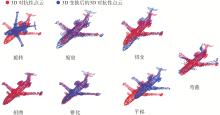
Fig.1
Commonly used 3D transformations"
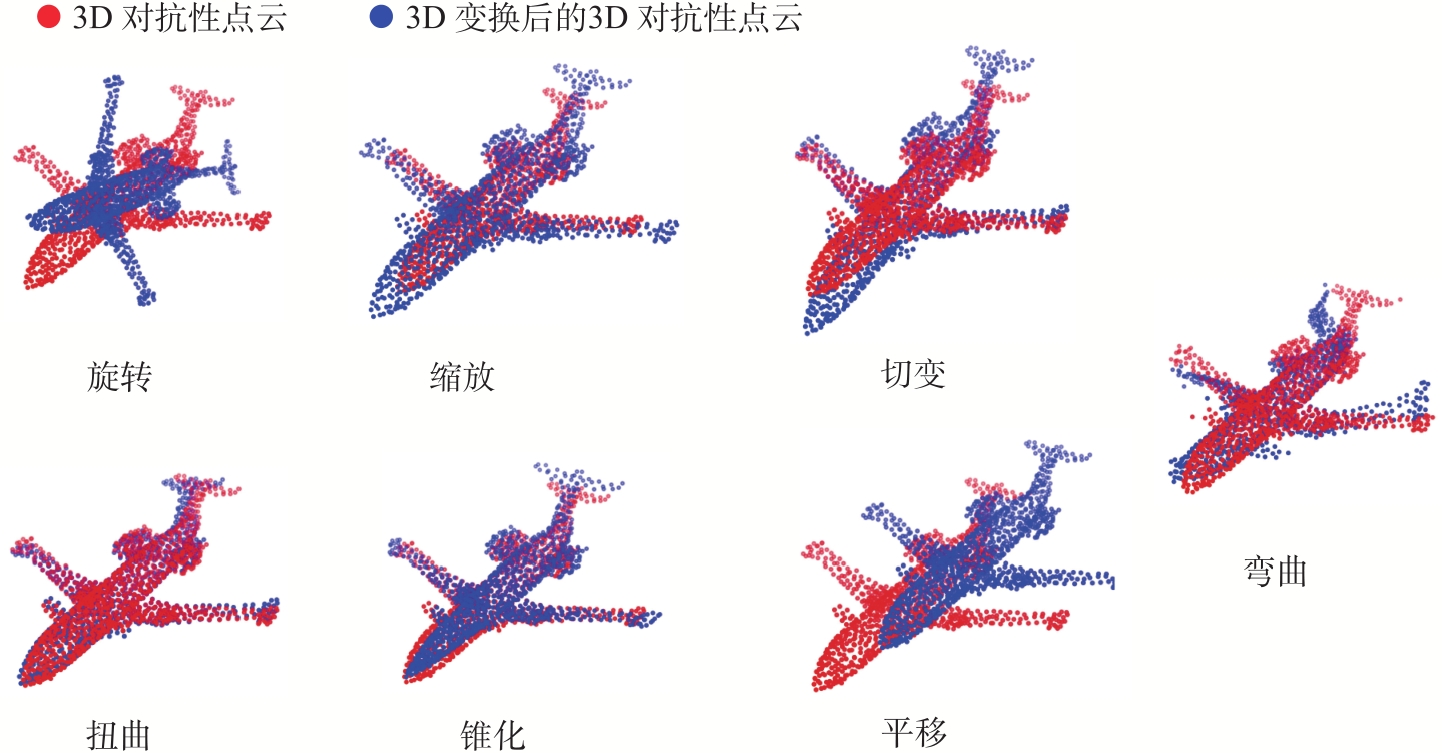

Table 1
The transformation matrix of 3D transformation and the influence mechanism of 3D transformation"
| 3D变换 | 转换矩阵 | 影响机制 |
|---|---|---|
| 旋转 | 改变点云的全局空间方向。 | |
| 缩放 | 均匀缩放点云尺寸,保持几何结构但改变空间密度。 | |
| 切变 | 对点云施加线性错切,影响局部邻域关系。 | |
| 扭曲 | 非线性变形点云,影响全局和局部结构。 | |
| 锥化 | 非均匀缩放点云,导致局部变形。 | |
| 弯曲 | 对各点的空间坐标进行调整,改变点云在空间中的分布。 | |
| 平移 | 整体移动点云位置,不改变结构。 |
"
| 算法一: | 3D对抗性点云的生成及3D变换的嵌入方式 |
|---|---|
| 输入: | 良性点云Pben,源模型 |
| 输出: | 3D变换后的3D对抗性点云 |
| 1: | |
| 2: | fori=1 to N do |
| 3: | |
| 4: | |
| 5: | |
| 6: | end for |
| 7: |
Table 2
Transfer attacks conducted on ModelNet40 dataset, and the source model is PointNet"
| 最大扰动幅度 (→) | 0.18 | 0.45 | ||||||||
|---|---|---|---|---|---|---|---|---|---|---|
| 目标模型 (→) | PointNet | PointNet++ | PointConv | DGCNN | PointNet | PointNet++ | PointConv | DGCNN | ||
| 攻击 (↓) | 3D变换 (↓) | |||||||||
| 3D-Adv[ | 无 | 97.50 | 5.24 | 1.39 | 4.70 | 97.46 | 4.91 | 2.41 | 4.70 | |
| 旋转 | 90.79 | 86.48 | 89.22 | 85.04 | 90.83 | 86.34 | 89.33 | 84.95 | ||
| 切变 | 50.61 | 26.32 | 23.81 | 10.84 | 50.61 | 26.58 | 24.24 | 10.80 | ||
| 缩放 | 57.83 | 7.80 | 3.93 | 5.73 | 57.83 | 8.24 | 3.45 | 5.78 | ||
| 扭曲 | 52.97 | 19.95 | 15.20 | 11.56 | 52.97 | 18.77 | 14.97 | 11.60 | ||
| 锥化 | 62.82 | 20.86 | 16.72 | 11.20 | 62.82 | 20.02 | 16.16 | 11.34 | ||
| 弯曲 | 57.63 | 9.57 | 7.27 | 7.12 | 58.17 | 9.36 | 7.42 | 6.99 | ||
| 平移 | 73.04 | 5.40 | 2.32 | 19.22 | 72.99 | 5.61 | 2.62 | 19.27 | ||
| KNN[ | 无 | 100.00 | 11.64 | 2.60 | 9.77 | 100.00 | 10.13 | 3.39 | 9.54 | |
| 旋转 | 91.97 | 88.35 | 89.67 | 87.37 | 92.15 | 88.21 | 89.42 | 87.90 | ||
| 切变 | 85.52 | 35.46 | 27.50 | 18.46 | 86.02 | 33.99 | 26.74 | 18.64 | ||
| 缩放 | 94.83 | 14.22 | 5.36 | 11.25 | 94.96 | 13.65 | 4.92 | 11.25 | ||
| 扭曲 | 89.47 | 27.44 | 16.27 | 18.32 | 89.56 | 27.79 | 17.37 | 17.92 | ||
| 锥化 | 94.14 | 28.03 | 18.76 | 17.74 | 94.37 | 27.97 | 17.86 | 17.52 | ||
| 弯曲 | 96.05 | 17.00 | 9.23 | 12.54 | 96.10 | 16.53 | 9.25 | 12.23 | ||
| 平移 | 80.16 | 12.72 | 3.21 | 28.81 | 80.30 | 11.35 | 3.60 | 28.18 | ||
| AdvPC[ | 无 | 100.00 | 31.76 | 12.21 | 14.92 | 100.00 | 31.79 | 13.32 | 14.92 | |
| 旋转 | 92.19 | 91.03 | 92.29 | 90.05 | 92.28 | 91.46 | 91.87 | 90.10 | ||
| 切变 | 80.48 | 55.00 | 37.69 | 23.92 | 80.62 | 55.44 | 38.39 | 24.15 | ||
| 缩放 | 88.61 | 36.16 | 16.05 | 15.37 | 88.61 | 35.63 | 15.76 | 15.41 | ||
| 扭曲 | 83.48 | 49.09 | 27.94 | 23.39 | 83.48 | 49.42 | 27.08 | 23.34 | ||
| 锥化 | 89.01 | 47.46 | 32.15 | 23.16 | 89.01 | 47.50 | 32.23 | 22.85 | ||
| 弯曲 | 92.78 | 37.99 | 18.73 | 17.78 | 92.87 | 37.34 | 18.45 | 17.69 | ||
| 平移 | 79.44 | 32.77 | 13.00 | 36.29 | 79.57 | 32.72 | 12.84 | 36.38 | ||
| AOF[ | 无 | 100.00 | 56.95 | 35.05 | 28.94 | 100.00 | 58.17 | 35.43 | 30.33 | |
| 旋转 | 93.46 | 93.40 | 94.08 | 92.34 | 93.69 | 93.42 | 94.09 | 92.29 | ||
| 切变 | 91.42 | 72.21 | 56.83 | 40.41 | 91.97 | 71.99 | 55.85 | 41.13 | ||
| 缩放 | 93.55 | 59.38 | 37.46 | 29.30 | 93.65 | 59.80 | 38.45 | 30.73 | ||
| 扭曲 | 91.33 | 67.83 | 49.84 | 39.65 | 91.24 | 68.54 | 50.20 | 40.91 | ||
| 锥化 | 94.01 | 67.16 | 54.11 | 38.66 | 94.24 | 68.50 | 53.41 | 39.61 | ||
| 弯曲 | 95.91 | 62.10 | 41.72 | 34.12 | 95.91 | 62.43 | 40.51 | 35.83 | ||
| 平移 | 85.79 | 57.63 | 35.89 | 51.48 | 86.56 | 58.95 | 35.10 | 52.55 | ||
Table 3
Transfer attacks conducted on ModelNet40 dataset, and the source model is DGCNN"
| 最大扰动幅度 (→) | 0.18 | 0.45 | ||||||||
|---|---|---|---|---|---|---|---|---|---|---|
| 目标模型 (→) | PointNet | PointNet++ | PointConv | DGCNN | PointNet | PointNet++ | PointConv | DGCNN | ||
| 攻击 (↓) | 3D变换 (↓) | |||||||||
| 3D-Adv[ | 无 | 0.95 | 6.34 | 5.30 | 88.98 | 0.95 | 6.19 | 4.91 | 88.98 | |
| 旋转 | 91.47 | 87.37 | 90.67 | 86.92 | 92.37 | 88.55 | 90.96 | 89.11 | ||
| 切变 | 16.61 | 32.47 | 28.44 | 36.60 | 15.52 | 33.12 | 28.99 | 37.86 | ||
| 缩放 | 6.31 | 13.34 | 7.70 | 71.59 | 6.22 | 13.53 | 8.26 | 71.68 | ||
| 扭曲 | 9.71 | 23.32 | 19.20 | 40.19 | 10.12 | 23.28 | 18.33 | 40.14 | ||
| 锥化 | 19.02 | 24.66 | 21.90 | 39.96 | 18.97 | 25.03 | 22.89 | 40.77 | ||
| 弯曲 | 4.04 | 11.72 | 9.51 | 45.59 | 4.04 | 11.72 | 9.51 | 45.59 | ||
| 平移 | 67.77 | 7.75 | 5.29 | 56.99 | 68.63 | 7.57 | 4.90 | 57.57 | ||
| KNN[ | 无 | 5.22 | 30.98 | 20.14 | 100.00 | 5.17 | 32.05 | 21.39 | 100.00 | |
| 旋转 | 91.47 | 90.21 | 92.09 | 91.40 | 91.92 | 90.08 | 92.58 | 91.58 | ||
| 切变 | 22.51 | 54.46 | 43.75 | 98.70 | 22.61 | 54.86 | 44.51 | 98.34 | ||
| 缩放 | 11.26 | 36.48 | 23.23 | 100.00 | 11.48 | 37.96 | 23.63 | 100.00 | ||
| 扭曲 | 12.89 | 46.96 | 36.84 | 97.58 | 13.39 | 48.75 | 38.40 | 97.80 | ||
| 锥化 | 24.19 | 45.98 | 35.95 | 98.07 | 24.06 | 47.10 | 36.58 | 98.57 | ||
| 弯曲 | 8.03 | 37.34 | 27.78 | 99.96 | 8.35 | 38.73 | 28.85 | 99.96 | ||
| 平移 | 72.13 | 33.08 | 20.84 | 99.51 | 72.13 | 33.62 | 20.70 | 99.64 | ||
| AdvPC[ | 无 | 6.67 | 60.00 | 41.84 | 93.91 | 7.17 | 60.18 | 41.89 | 93.82 | |
| 旋转 | 92.96 | 92.70 | 93.96 | 92.65 | 92.83 | 92.66 | 93.91 | 92.34 | ||
| 切变 | 24.88 | 74.62 | 58.44 | 82.80 | 25.37 | 74.75 | 58.48 | 82.71 | ||
| 缩放 | 14.39 | 61.86 | 44.23 | 92.43 | 14.80 | 62.18 | 44.45 | 92.47 | ||
| 扭曲 | 18.93 | 70.55 | 54.16 | 83.74 | 19.84 | 70.69 | 53.99 | 83.78 | ||
| 锥化 | 31.32 | 70.91 | 58.89 | 84.32 | 31.73 | 71.18 | 58.89 | 84.54 | ||
| 弯曲 | 11.35 | 64.93 | 46.81 | 88.04 | 12.39 | 65.20 | 46.76 | 88.13 | ||
| 平移 | 71.86 | 61.67 | 41.98 | 87.77 | 71.95 | 61.75 | 41.98 | 87.77 | ||
| AOF[ | 无 | 12.35 | 63.35 | 53.74 | 98.25 | 14.98 | 62.77 | 52.50 | 98.25 | |
| 旋转 | 92.65 | 94.08 | 94.84 | 92.88 | 92.60 | 94.35 | 94.62 | 93.46 | ||
| 切变 | 27.78 | 76.90 | 68.93 | 84.54 | 30.05 | 76.09 | 68.26 | 84.95 | ||
| 缩放 | 18.57 | 65.00 | 56.76 | 95.56 | 21.83 | 64.82 | 55.10 | 94.85 | ||
| 扭曲 | 24.56 | 73.86 | 64.01 | 86.69 | 27.24 | 73.24 | 65.12 | 86.34 | ||
| 锥化 | 36.50 | 74.31 | 67.55 | 87.63 | 38.77 | 72.56 | 66.56 | 85.71 | ||
| 弯曲 | 16.80 | 68.58 | 58.11 | 89.25 | 19.79 | 67.47 | 57.79 | 88.58 | ||
| 平移 | 72.63 | 63.98 | 54.24 | 88.49 | 73.31 | 63.36 | 53.40 | 87.81 | ||
Table 4
Transfer attacks conducted on ModelNet40C dataset, and the source model is PointNet"
| 最大扰动幅度 (→) | 0.18 | 0.45 | ||||||||
|---|---|---|---|---|---|---|---|---|---|---|
| 目标模型 (→) | PointNet | PointNet++ | PointConv | DGCNN | PointNet | PointNet++ | PointConv | DGCNN | ||
| 攻击 (↓) | 3D变换 (↓) | |||||||||
| 3D-Adv[ | 无 | 85.39 | 10.34 | 6.28 | 6.26 | 85.39 | 10.37 | 6.28 | 6.26 | |
| 旋转 | 92.81 | 87.91 | 90.38 | 88.21 | 92.81 | 87.91 | 90.34 | 88.09 | ||
| 切变 | 54.47 | 34.70 | 32.08 | 18.45 | 54.47 | 34.72 | 32.11 | 18.45 | ||
| 缩放 | 56.24 | 14.07 | 10.39 | 10.00 | 56.27 | 14.14 | 10.49 | 10.01 | ||
| 扭曲 | 53.96 | 26.74 | 21.72 | 17.56 | 53.90 | 26.74 | 21.69 | 17.44 | ||
| 锥化 | 60.03 | 26.71 | 24.53 | 17.93 | 59.98 | 26.76 | 24.51 | 17.92 | ||
| 弯曲 | 56.00 | 16.76 | 13.42 | 12.88 | 56.00 | 16.72 | 13.41 | 12.86 | ||
| 平移 | 76.63 | 10.75 | 6.85 | 28.08 | 76.72 | 10.81 | 6.78 | 27.94 | ||
| KNN[ | 无 | 85.62 | 18.23 | 9.09 | 18.26 | 85.62 | 17.75 | 9.02 | 18.22 | |
| 旋转 | 93.60 | 89.33 | 90.06 | 89.77 | 93.59 | 89.42 | 90.25 | 89.93 | ||
| 切变 | 79.51 | 43.87 | 36.17 | 27.18 | 79.47 | 43.75 | 35.78 | 26.63 | ||
| 缩放 | 83.25 | 23.87 | 13.35 | 19.62 | 83.25 | 23.58 | 13.05 | 19.98 | ||
| 扭曲 | 81.96 | 35.39 | 25.17 | 26.03 | 81.95 | 34.79 | 25.05 | 26.07 | ||
| 锥化 | 85.05 | 35.68 | 26.69 | 26.17 | 85.16 | 35.58 | 26.29 | 25.96 | ||
| 弯曲 | 84.44 | 25.52 | 16.46 | 21.50 | 84.39 | 25.45 | 16.37 | 21.11 | ||
| 平移 | 82.45 | 18.38 | 10.16 | 38.56 | 82.51 | 17.96 | 9.84 | 38.33 | ||
| AOF[ | 无 | 85.62 | 47.63 | 35.42 | 31.46 | 85.62 | 48.09 | 35.86 | 32.04 | |
| 旋转 | 94.30 | 91.92 | 93.26 | 91.73 | 94.44 | 92.22 | 93.28 | 91.77 | ||
| 切变 | 80.32 | 68.10 | 58.20 | 43.72 | 80.41 | 68.29 | 58.29 | 44.21 | ||
| 缩放 | 82.23 | 52.73 | 39.41 | 32.19 | 82.21 | 53.00 | 39.13 | 33.29 | ||
| 扭曲 | 82.77 | 61.61 | 50.50 | 41.75 | 82.81 | 62.14 | 50.59 | 42.41 | ||
| 锥化 | 84.65 | 62.01 | 51.53 | 40.56 | 84.66 | 62.72 | 51.64 | 40.85 | ||
| 弯曲 | 83.84 | 54.78 | 42.20 | 34.35 | 83.84 | 55.54 | 42.28 | 35.19 | ||
| 平移 | 85.21 | 50.17 | 36.18 | 52.39 | 85.55 | 50.39 | 36.14 | 52.46 | ||
Table 5
Transfer attacks conducted on ModelNet40 dataset, and the target models are adversarially trained (PointCAT)"
| 最大扰动幅度 (→) | 0.18 | 0.45 | ||||||||
|---|---|---|---|---|---|---|---|---|---|---|
| 目标模型 (→) | PointNet | PointNet++ | CurveNet | DGCNN | PointNet | PointNet++ | CurveNet | DGCNN | ||
| 攻击 (↓) | 3D变换 (↓) | |||||||||
| 3D-Adv[ | 无 | 0.64 | 0.98 | 0.71 | 0.84 | 0.64 | 1.02 | 0.71 | 0.84 | |
| 旋转 | 89.22 | 87.24 | 85.55 | 87.69 | 89.54 | 89.19 | 86.93 | 88.76 | ||
| 切变 | 13.54 | 13.99 | 8.83 | 11.20 | 12.90 | 14.51 | 8.70 | 10.67 | ||
| 缩放 | 1.47 | 1.73 | 1.03 | 1.29 | 2.03 | 1.86 | 1.07 | 1.07 | ||
| 扭曲 | 2.26 | 9.53 | 6.29 | 8.58 | 2.30 | 10.04 | 6.60 | 9.38 | ||
| 锥化 | 4.33 | 8.70 | 7.09 | 10.13 | 3.45 | 8.87 | 6.87 | 9.69 | ||
| 平移 | 22.29 | 1.20 | 2.81 | 4.93 | 21.74 | 0.89 | 2.94 | 4.89 | ||
| KNN[ | 无 | 2.49 | 2.04 | 2.63 | 2.18 | 2.44 | 1.73 | 2.68 | 2.27 | |
| 旋转 | 89.64 | 87.99 | 85.50 | 88.09 | 89.45 | 89.19 | 87.47 | 89.16 | ||
| 切变 | 15.29 | 15.14 | 10.35 | 12.27 | 14.65 | 15.58 | 9.95 | 12.58 | ||
| 缩放 | 3.04 | 2.35 | 2.81 | 2.18 | 3.55 | 2.61 | 2.63 | 2.18 | ||
| 扭曲 | 3.59 | 10.68 | 7.85 | 10.18 | 3.78 | 10.27 | 7.58 | 10.36 | ||
| 锥化 | 5.34 | 9.67 | 8.30 | 11.20 | 4.93 | 10.24 | 8.88 | 10.62 | ||
| 平移 | 24.83 | 2.17 | 4.46 | 6.49 | 24.74 | 1.68 | 4.46 | 6.67 | ||
| AdvPC[ | 无 | 2.26 | 2.26 | 2.63 | 2.09 | 2.26 | 2.12 | 2.63 | 2.09 | |
| 旋转 | 90.05 | 88.88 | 85.95 | 88.67 | 90.14 | 90.34 | 88.00 | 89.82 | ||
| 切变 | 15.29 | 15.94 | 10.88 | 12.71 | 15.85 | 15.36 | 10.57 | 12.76 | ||
| 缩放 | 3.09 | 2.62 | 2.81 | 2.44 | 2.95 | 2.53 | 2.59 | 2.31 | ||
| 扭曲 | 3.32 | 10.37 | 8.16 | 10.31 | 3.87 | 10.71 | 8.07 | 10.76 | ||
| 锥化 | 5.39 | 9.89 | 8.70 | 11.60 | 4.88 | 9.93 | 9.01 | 11.29 | ||
| 平移 | 23.45 | 2.48 | 4.24 | 6.71 | 22.85 | 2.35 | 4.06 | 6.44 | ||
| AOF[ | 无 | 4.97 | 3.24 | 3.75 | 3.78 | 6.77 | 3.59 | 4.01 | 3.64 | |
| 旋转 | 91.85 | 90.92 | 88.49 | 90.58 | 92.12 | 91.98 | 89.65 | 91.29 | ||
| 切变 | 19.53 | 18.83 | 13.29 | 17.07 | 22.20 | 18.51 | 13.69 | 16.58 | ||
| 缩放 | 5.76 | 4.35 | 4.24 | 4.09 | 7.46 | 4.34 | 4.01 | 4.22 | ||
| 扭曲 | 5.62 | 12.54 | 8.88 | 12.09 | 8.15 | 13.05 | 10.08 | 12.62 | ||
| 锥化 | 9.81 | 13.31 | 11.46 | 14.00 | 11.01 | 13.39 | 13.16 | 14.00 | ||
| 平移 | 26.62 | 3.59 | 5.22 | 8.67 | 27.22 | 3.59 | 5.84 | 8.00 | ||
Table 6
White-box attacks conducted on ModelNet40 dataset, and the models are adversarially trained (PointCAT)"
| 模型 (↓) | 3D变换 (↓) | ASR (目标攻击) (%) | ASR (非目标攻击) (%) | |||||||
|---|---|---|---|---|---|---|---|---|---|---|
| IFGM[ | MIFGM[ | PGD[ | C&W[ | IFGM[ | MIFGM[ | PGD[ | C&W[ | |||
| PointNet[ | 无 | 22.65 | 22.69 | 22.97 | 36.71 | 65.80 | 65.88 | 67.79 | 86.18 | |
| 旋转 | 2.31 | 2.92 | 2.59 | 2.71 | 89.42 | 91.94 | 90.28 | 89.59 | ||
| 缩放 | 7.50 | 13.13 | 8.87 | 7.41 | 42.34 | 58.59 | 43.88 | 28.12 | ||
| 切变 | 2.23 | 6.20 | 2.84 | 1.94 | 34.20 | 54.50 | 35.90 | 26.50 | ||
| 锥化 | 6.52 | 10.82 | 8.02 | 7.94 | 42.22 | 56.85 | 44.33 | 31.20 | ||
| 平移 | 0.97 | 2.07 | 1.18 | 1.34 | 32.29 | 42.42 | 32.13 | 30.43 | ||
| 扭曲 | 4.29 | 9.44 | 6.16 | 5.23 | 32.13 | 53.24 | 35.53 | 21.39 | ||
| DGCNN[ | 无 | 40.56 | 21.56 | 47.97 | 70.83 | 48.82 | 48.62 | 51.74 | 97.08 | |
| 旋转 | 2.51 | 2.39 | 2.35 | 1.99 | 88.94 | 90.07 | 88.09 | 89.55 | ||
| 缩放 | 21.47 | 19.12 | 23.87 | 32.01 | 40.32 | 46.96 | 42.71 | 51.74 | ||
| 切变 | 3.36 | 8.06 | 3.48 | 5.63 | 31.77 | 46.39 | 33.97 | 33.39 | ||
| 锥化 | 5.79 | 9.16 | 5.75 | 6.93 | 31.00 | 45.38 | 33.71 | 33.59 | ||
| 平移 | 5.19 | 10.05 | 8.35 | 9.00 | 29.17 | 42.87 | 30.67 | 32.94 | ||
| 扭曲 | 6.32 | 10.45 | 6.24 | 7.82 | 31.73 | 43.11 | 33.10 | 29.70 | ||
Table 7
White-box attacks conducted on ShapeNetPart dataset"
| 模型 (↓) | 3D变换 (↓) | ASR (目标攻击) (%) | ASR (非目标攻击) (%) | |||||||
|---|---|---|---|---|---|---|---|---|---|---|
| IFGM[ | MIFGM[ | PGD[ | C&W[ | IFGM[ | MIFGM[ | PGD[ | C&W[ | |||
| PointNet[ | 无 | 7.90 | 8.56 | 10.16 | 17.43 | 17.75 | 18.27 | 18.41 | 24.70 | |
| 旋转 | 5.32 | 6.12 | 5.85 | 5.85 | 80.79 | 80.06 | 79.68 | 79.47 | ||
| 缩放 | 4.63 | 7.13 | 4.73 | 6.16 | 12.67 | 16.67 | 12.91 | 8.39 | ||
| 切变 | 1.67 | 4.70 | 2.51 | 1.77 | 8.00 | 14.20 | 8.46 | 3.24 | ||
| 锥化 | 3.86 | 5.88 | 4.70 | 4.59 | 11.59 | 15.90 | 12.73 | 7.20 | ||
| 平移 | 1.57 | 2.51 | 1.01 | 1.32 | 15.31 | 17.47 | 14.68 | 15.03 | ||
| 扭曲 | 3.65 | 5.22 | 4.31 | 4.18 | 10.26 | 15.27 | 11.62 | 6.09 | ||
| DGCNN[ | 无 | 27.91 | 14.89 | 33.89 | 54.18 | 27.11 | 27.56 | 31.87 | 66.63 | |
| 旋转 | 5.98 | 6.30 | 6.19 | 5.88 | 84.10 | 84.17 | 82.99 | 84.79 | ||
| 缩放 | 18.20 | 14.09 | 21.57 | 32.08 | 23.07 | 27.66 | 27.17 | 42.21 | ||
| 切变 | 5.53 | 9.74 | 7.20 | 7.45 | 18.37 | 26.86 | 22.37 | 18.58 | ||
| 锥化 | 7.76 | 9.95 | 8.80 | 10.89 | 20.18 | 27.04 | 23.49 | 25.09 | ||
| 平移 | 8.87 | 10.33 | 10.75 | 12.04 | 21.57 | 30.62 | 25.09 | 29.54 | ||
| 扭曲 | 7.97 | 10.06 | 8.63 | 10.72 | 20.15 | 27.28 | 24.04 | 21.89 | ||
Table 8
Transfer attacks conducted on ModelNet40 dataset, and the target models are adversarially trained (TRADES and MART)"
| 最大扰动幅度 (→) | 0.18 | 0.45 | ||||||||||
|---|---|---|---|---|---|---|---|---|---|---|---|---|
| 对抗训练方式 (→) | TRADES[ | MART[ | TRADES[ | MART[ | ||||||||
| 目标模型 (→) | PointNet | DGCNN | PointNet | DGCNN | PointNet | DGCNN | PointNet | DGCNN | ||||
| 攻击 (↓) | 3D变换 (↓) | |||||||||||
| 3D-Adv[ | 无 | 6.34 | 2.04 | 4.85 | 1.85 | 6.34 | 2.04 | 4.85 | 1.80 | |||
| 旋转 | 92.21 | 89.86 | 92.23 | 89.96 | 92.21 | 89.86 | 92.23 | 90.05 | ||||
| 切变 | 24.61 | 14.66 | 19.89 | 12.31 | 24.57 | 14.66 | 19.94 | 12.40 | ||||
| 缩放 | 6.47 | 2.44 | 6.83 | 2.82 | 6.47 | 2.44 | 6.83 | 2.87 | ||||
| 扭曲 | 17.18 | 12.89 | 13.26 | 11.34 | 17.18 | 12.89 | 13.31 | 11.34 | ||||
| 锥化 | 20.01 | 10.76 | 14.25 | 8.70 | 19.96 | 10.76 | 14.35 | 8.75 | ||||
| 平移 | 14.90 | 5.36 | 17.62 | 9.72 | 14.86 | 5.36 | 17.71 | 9.72 | ||||
| KNN[ | 无 | 11.62 | 5.89 | 7.87 | 5.04 | 11.53 | 5.76 | 8.11 | 4.86 | |||
| 旋转 | 93.12 | 91.01 | 92.53 | 90.70 | 93.16 | 91.19 | 92.73 | 90.61 | ||||
| 切变 | 29.49 | 18.78 | 24.59 | 15.83 | 29.95 | 18.56 | 24.79 | 15.55 | ||||
| 缩放 | 11.67 | 6.20 | 9.90 | 5.69 | 11.67 | 6.20 | 9.95 | 5.65 | ||||
| 扭曲 | 21.19 | 17.76 | 16.28 | 15.22 | 21.29 | 17.63 | 16.53 | 15.22 | ||||
| 锥化 | 26.21 | 14.08 | 18.60 | 11.89 | 26.12 | 14.17 | 18.56 | 11.99 | ||||
| 平移 | 19.01 | 9.30 | 22.76 | 13.74 | 19.23 | 9.26 | 23.06 | 13.74 | ||||
| AdvPC[ | 无 | 8.07 | 9.03 | 6.88 | 7.54 | 8.25 | 9.17 | 6.88 | 7.59 | |||
| 旋转 | 93.57 | 92.87 | 92.53 | 92.18 | 93.57 | 92.87 | 92.53 | 92.18 | ||||
| 切变 | 29.35 | 23.21 | 24.44 | 20.68 | 29.49 | 23.25 | 24.49 | 20.59 | ||||
| 缩放 | 8.57 | 9.70 | 9.10 | 8.56 | 8.66 | 9.79 | 9.15 | 8.65 | ||||
| 扭曲 | 22.29 | 21.97 | 17.91 | 18.37 | 22.33 | 22.01 | 17.91 | 18.46 | ||||
| 锥化 | 25.52 | 18.73 | 17.76 | 16.80 | 25.62 | 18.73 | 17.76 | 16.98 | ||||
| 平移 | 16.23 | 13.91 | 21.08 | 17.35 | 16.27 | 13.99 | 21.18 | 17.35 | ||||
| AOF[ | 无 | 17.59 | 21.52 | 15.88 | 19.30 | 20.46 | 23.21 | 18.70 | 20.41 | |||
| 旋转 | 94.67 | 94.11 | 92.92 | 93.89 | 94.94 | 94.38 | 93.37 | 94.12 | ||||
| 切变 | 37.47 | 36.85 | 33.00 | 33.04 | 38.83 | 38.40 | 35.43 | 34.71 | ||||
| 缩放 | 17.87 | 22.32 | 17.17 | 19.90 | 20.78 | 24.00 | 20.53 | 21.19 | ||||
| 扭曲 | 31.72 | 35.96 | 26.08 | 31.47 | 34.18 | 37.29 | 29.00 | 32.48 | ||||
| 锥化 | 35.41 | 32.37 | 27.02 | 30.17 | 36.96 | 33.66 | 29.39 | 30.96 | ||||
| 平移 | 23.25 | 26.48 | 29.05 | 30.59 | 26.53 | 28.03 | 31.17 | 31.65 | ||||
Table 9
Transfer attacks conducted on ModelNet40 dataset, with the source models being PointNet"
| 最大扰动幅度 (→) | 0.18 | 0.45 | ||||||||
|---|---|---|---|---|---|---|---|---|---|---|
| 目标模型 (→) | PointNet | PointNet++ | PointConv | DGCNN | PointNet | PointNet++ | PointConv | DGCNN | ||
| 攻击 (↓) | 3D变换 (↓) | |||||||||
| 3D-Adv[ | 无 | 97.50 | 5.24 | 1.39 | 4.70 | 97.46 | 4.91 | 2.41 | 4.70 | |
| 旋转 | 90.79 | 86.48 | 89.22 | 85.04 | 90.83 | 86.34 | 89.33 | 84.95 | ||
| 组合优化 | 92.01 | 88.36 | 89.89 | 86.79 | 92.06 | 88.84 | 89.75 | 86.74 | ||
| KNN[ | 无 | 100.00 | 11.64 | 2.60 | 9.77 | 100.00 | 10.13 | 3.39 | 9.54 | |
| 旋转 | 91.97 | 88.35 | 89.67 | 87.37 | 92.15 | 88.21 | 89.42 | 87.90 | ||
| 组合优化 | 92.51 | 90.10 | 90.73 | 88.76 | 92.56 | 90.22 | 90.78 | 88.71 | ||
| AdvPC[ | 无 | 100.00 | 31.76 | 12.21 | 14.92 | 100.00 | 31.79 | 13.32 | 14.92 | |
| 旋转 | 92.19 | 91.03 | 92.29 | 90.05 | 92.28 | 91.46 | 91.87 | 90.10 | ||
| 组合优化 | 92.69 | 92.64 | 92.69 | 91.36 | 92.74 | 92.59 | 92.83 | 91.40 | ||
| AOF[ | 无 | 100.00 | 56.95 | 35.05 | 28.94 | 100.00 | 58.17 | 35.43 | 30.33 | |
| 旋转 | 93.46 | 93.40 | 94.08 | 92.34 | 93.69 | 93.42 | 94.09 | 92.29 | ||
| 组合优化 | 93.55 | 94.38 | 94.08 | 92.39 | 93.42 | 94.15 | 94.34 | 92.43 | ||
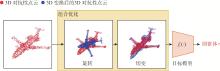
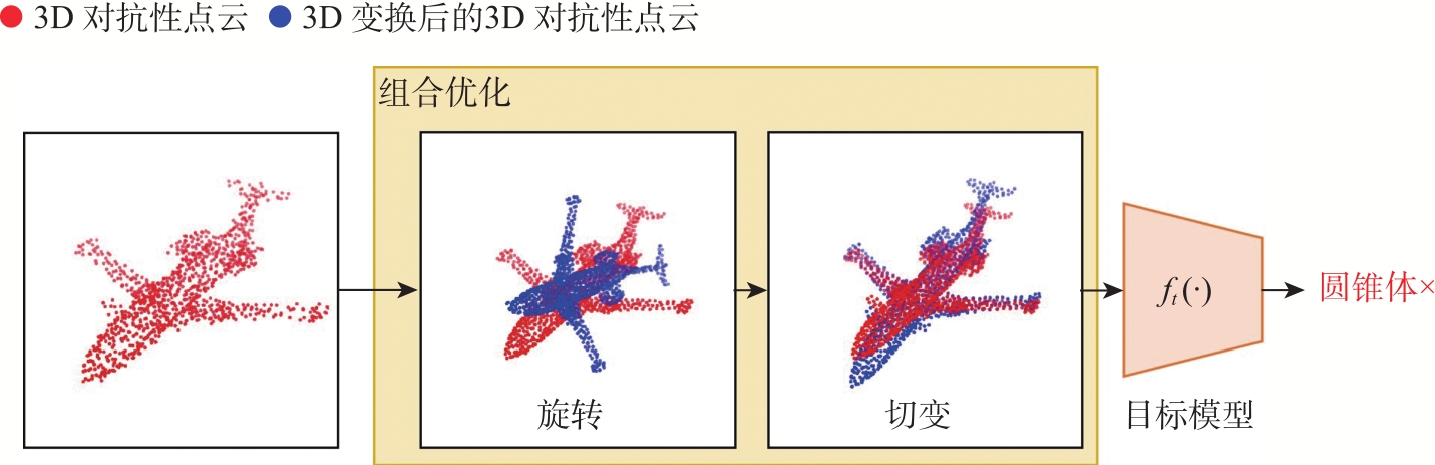
Fig.2
The combinatorial optimization strategy proposed in this paper"
| [1] | HU Q, LIU D, HU W. Density-insensitive unsupervised domain adaption on 3d object detection[C]// Proceedings of the IEEE/CVF Conference on Computer Vision and Pattern Recognition, 2023: 17556-17566. |
| [2] | SINKO M, KAMENCAY P, HUDEC R, et al. 3D registration of the point cloud data using ICP algorithm in medical image analysis[C]// 2018 ELEKTRO, IEEE, 2018: 1-6. |
| [3] | XIANG C, QI C R, LI B. Generating 3d adversarial point clouds[C]// Proceedings of the IEEE/CVF conference on computer vision and pattern recognition, 2019: 9136-9144. |
| [4] | LOU T, JIA X, GU J, et al. Hide in thicket: Generating imperceptible and rational adversarial perturbations on 3d point clouds[C]// Proceedings of the IEEE/CVF Conference on Computer Vision and Pattern Recognition, 2024: 24326-24335. |
| [5] | TANG K, KE W, PENG W, et al. Imperceptible Adversarial Attacks on Point Clouds Guided by Point-to-Surface Field[C]// ICASSP 2025-2025 IEEE International Conference on Acoustics, Speech and Signal Processing (ICASSP), IEEE, 2025: 1-5. |
| [6] | HAMDI A, ROJAS S, THABET A, et al. Advpc: Transferable adversarial perturbations on 3d point clouds[C]// Computer Vision-ECCV 2020: 16th European Conference, Glasgow, UK, August 23-28, 2020, Proceedings, Part XII 16. Springer International Publishing, 2020: 241-257. |
| [7] | CAI X, TAO Y, LIU D, et al. Frequency-Aware GAN for Imperceptible Transfer Attack on 3D Point Clouds[C]// Proceedings of the 32nd ACM International Conference on Multimedia, 2024: 6162-6171. |
| [8] |
ZHANG J, DONG Y, ZHU J, et al. Improving transferability of 3D adversarial attacks with scale and shear transformations[J]. Information Sciences, 2024, 662: 120245.
doi: 10.1016/j.ins.2024.120245 |
| [9] | QIAN F, ZOU Y, XU M, et al. A comprehensive understanding of the impact of data augmentation on the transferability of 3D adversarial examples[J]. ACM Transactions on Knowledge Discovery from Data, 2025, 19(2): 1-41. |
| [10] | WANG X, LI M, LIU W, et al. Unlearnable 3D point clouds: Class-wise transformation is all you need[J]. Advances in Neural Information Processing Systems, 2024, 37: 99404-99432. |
| [11] | CHU W, LI L, LI B. Tpc: Transformation-specific smoothing for point cloud models[C]// International conference on machine learning, PMLR, 2022: 4035-4056. |
| [12] | HU S, LIU W, LI M, et al. Pointcrt: Detecting backdoor in 3d point cloud via corruption robustness[C]// Proceedings of the 31st ACM International Conference on Multimedia, 2023: 666-675. |
| [13] | WANG X, LI M, XU P, et al. PointAPA: Towards availability poisoning attacks in 3D point clouds[C]// European Symposium on Research in Computer Security. Cham: Springer Nature Switzerland, 2024: 125-145. |
| [14] | WU Z, SONG S, KHOSLA A, et al. 3d shapenets: A deep representation for volumetric shapes[C]// Proceedings of the IEEE conference on computer vision and pattern recognition, 2015: 1912-1920. |
| [15] | REN J, PAN L, LIU Z. Benchmarking and analyzing point cloud classification under corruptions[C]// International Conference on Machine Learning, PMLR, 2022: 18559-18575. |
| [16] | YI L, KIM V G, CEYLAN D, et al. A scalable active framework for region annotation in 3d shape collections[J]. ACM Transactions on Graphics (ToG), 2016, 35(6): 1-12. |
| [17] | QI C R, SU H, MO K, et al. Pointnet: Deep learning on point sets for 3d classification and segmentation[C]// Proceedings of the IEEE conference on computer vision and pattern recognition, 2017: 652-660. |
| [18] | QI C R, YI L, SU H, et al. Pointnet++: Deep hierarchical feature learning on point sets in a metric space[J]. Advances in neural information processing systems, 2017, 30: 5099-5108. |
| [19] | WU W, QI Z, FUXIN L. Pointconv: Deep convolutional networks on 3d point clouds[C]// Proceedings of the IEEE/CVF Conference on computer vision and pattern recognition, 2019: 9621-9630. |
| [20] | XIANG T, ZHANG C, SONG Y, et al. Walk in the cloud: Learning curves for point clouds shape analysis[C]// Proceedings of the IEEE/CVF international conference on computer vision, 2021: 915-924. |
| [21] | WANG Y, SUN Y, LIU Z, et al. Dynamic graph cnn for learning on point clouds[J]. ACM Transactions on Graphics (tog), 2019, 38(5): 1-12. |
| [22] |
HUANG Q, DOND X, CHEN D, et al. PointCAT: Contrastive adversarial training for robust point cloud recognition[J]. IEEE Transactions on Image Processing, 2024, 33: 2183-2196.
doi: 10.1109/TIP.2024.3372456 pmid: 38451765 |
| [23] | ZHANG H, YU Y, JIAO J, et al. Theoretically principled trade-off between robustness and accuracy[C]// International conference on machine learning, PMLR, 2019: 7472-7482. |
| [24] | WANG Y, ZOU D, YI J, et al. Improving adversarial robustness requires revisiting misclassified examples[C]// International conference on learning representations, 2020: 8909-8922. |
| [25] | TSAI T, YANG K, HO T Y, et al. Robust adversarial objects against deep learning models[C]// Proceedings of the AAAI Conference on Artificial Intelligence, 2020, 34(1): 954-962. |
| [26] |
LIU B, ZHANG J, ZHU J. Boosting 3D adversarial attacks with attacking on frequency[J]. IEEE Access, 2022, 10: 50974-50984.
doi: 10.1109/ACCESS.2022.3171659 |
| [27] | HE B, LIU J, LI Y, et al. Generating transferable 3d adversarial point cloud via random perturbation factorization[C]// Proceedings of the AAAI Conference on Artificial Intelligence 2023, 37(1): 764-772. |
| [28] | ZHOU H, CHEN K, ZHANG W, et al. Dup-net: Denoiser and upsampler network for 3d adversarial point clouds defense[C]// Proceedings of the IEEE/CVF international conference on computer vision, 2019: 1961-1970. |
| [29] | WU Z, DUAN Y, WANG H, et al. IF-Defense:3D Adversarial Point Cloud Defense via Implicit Function based Restoration[J/OL]. 2020, arXiv:2010.05272[2020-10-11]. https://arxiv.org/abs/2010.05272. |
| [30] | SUN J, NIE W, YU Z, et al. PointDP:Diffusion-driven Purification against Adversarial Attacks on 3D Point Cloud Recognition[J/OL]. 2022, arXiv:2208.09801[2022-8-21]. https://arxiv.org/abs/2208.09801. |
| [31] |
CROITORU F A, HONDRU V, IONESCU R T, et al. Diffusion models in vision: A survey[J]. IEEE Transactions on Pattern Analysis and Machine Intelligence, 2023, 45(9): 10850-10869.
doi: 10.1109/TPAMI.2023.3261988 |
| [32] | LIU D, YU R, SU H. Extending adversarial attacks and defenses to deep 3d point cloud classifiers[C]// 2019 IEEE International Conference on Image Processing (ICIP), IEEE, 2019: 2279-2283. |
| [33] | GOODFELLOW I J, SHLENS J, SZEGEDY C. Explaining and Harnessing Adversarial Examples[J/OL]. 2014, arXiv:1412.6572[2014-12-11]. https://arxiv.org/abs/1412.6572. |
| [34] | DONG X, CHEN D, ZHOU H, et al. Self-robust 3d point recognition via gather-vector guidance[C]// 2020 IEEE/CVF conference on computer vision and pattern recognition (cvpr), IEEE, 2020: 11513-11521. |
| [35] | LI K, ZHANG Z, ZHONG C, et al. Robust structured declarative classifiers for 3d point clouds: Defending adversarial attacks with implicit gradients[C]// Proceedings of the IEEE/CVF Conference on Computer Vision and Pattern Recognition, 2022: 15294-15304. |
| [36] |
ZHANG J, CHEN L, OUYANG B, et al. Pointcutmix: Regularization strategy for point cloud classification[J]. Neurocomputing, 2022, 505: 58-67.
doi: 10.1016/j.neucom.2022.07.049 |
| [37] | JI Q, WANG L, SHI C, et al. Benchmarking and analyzing robust point cloud recognition: Bag of tricks for defending adversarial examples[C]// Proceedings of the IEEE/CVF International Conference on Computer Vision, 2023: 4295-4304. |
| [38] |
SUN N, JIN B, GUO J, et al. 3D point cloud adversarial sample classification algorithm based on self-supervised learning and information gain[J]. IEEE Access, 2023, 11: 119544-119552.
doi: 10.1109/ACCESS.2023.3326990 |
| [39] | LIN J, YANG X, LI T, et al. Improving Adversarial Robustness for 3D Point Cloud Recognition at Test-Time through Purified Self-Training[J/OL]. 2024, arXiv:2409. 14940[2024-9-23]. https://arxiv.org/abs/2409.14940. |
| [40] | HUANG Y, ZHANG M, DING D, et al. Causalpc: Improving the robustness of point cloud classification by causal effect identification[C]// Proceedings of the IEEE/CVF Conference on Computer Vision and Pattern Recognition, 2024: 19779-19789. |
| [41] | WU L, ZHUANG J, CHEN H. Voco: A simple-yet-effective volume contrastive learning framework for 3d medical image analysis[C]// Proceedings of the IEEE/CVF Conference on Computer Vision and Pattern Recognition, 2024: 22873-22882. |
| [42] |
CUI J, ZHONG Z, TIAN Z, et al. Generalized parametric contrastive learning[J]. IEEE Transactions on Pattern Analysis and Machine Intelligence, 2024, 46(12): 7463-7474.
doi: 10.1109/TPAMI.2023.3278694 |
| [43] | WEN X, ZHAO B, ZHENG A, et al. Self-supervised visual representation learning with semantic grouping[J]. Advances in neural information processing systems, 2022, 35: 16423-16438. |
| [44] | CARLINI N, WAGNER D. Towards evaluating the robustness of neural networks[C]// 2017 ieee symposium on security and privacy (sp), Ieee, 2017: 39-57. |
| [45] | GU S, RIGAZIO L. Towards Deep Neural Network Architectures Robust to Adversarial Examples[J/OL]., 2014, arXiv:1412.5068 [2014-12-11]. https://arxiv.org/abs/1412.5068. |
| [46] | DONG Y, LIAO F, PANG T, et al. Boosting adversarial attacks with momentum[C]// Proceedings of the IEEE conference on computer vision and pattern recognition, 2018: 9185-9193. |
| [47] | MADRY A, MAKELOV A, SCHMIDT L, et al. Towards deep learning models resistant to adversarial attacks[J]. arXiv preprint arXiv:1706.06083, 2017. |
| [48] |
HAO L, HAO K, WEI B, et al. Boosting the transferability of adversarial examples via stochastic serial attack[J]. Neural Networks, 2022, 150: 58-67.
doi: 10.1016/j.neunet.2022.02.025 pmid: 35305532 |
| [49] |
ZHANG J, LIU T, TAO D, et al. Going Deeper, Generalizing Better: An Information-Theoretic View for Deep Learning[J]. IEEE Transactions on Neural Networks and Learning Systems, 2024, 35(11): 16683-16695.
doi: 10.1109/TNNLS.2023.3297113 |
| [1] | WANG Wenbin,GAO Siyuan,GAO Manda,LIANG Ling,YANG Guangjun,HE Bangyan,LIU Yaozu. Improving Adversarial Transferability on Vision-Language Pre-Training Models via Block Shuffle and Rotation [J]. Frontiers of Data and Computing, 2025, 7(2): 130-140. |
| Viewed | ||||||
|
Full text |
|
|||||
|
Abstract |
|
|||||

