Frontiers of Data and Computing ›› 2026, Vol. 8 ›› Issue (5): 165-176.
CSTR: 32002.14.jfdc.CN10-1649/TP.2026.05.013
doi: 10.11871/jfdc.issn.2096-742X.2026.05.013
• Technology and Application • Previous Articles Next Articles
SHEN Shuyi( ),WANG Yifan,BU Fanliang*()
Received:2026-03-16
Online:2026-10-20
Published:2026-10-20
SHEN Shuyi, WANG Yifan, BU Fanliang. A Survey on Temporal Knowledge Graph Representation Learning Methods[J]. Frontiers of Data and Computing, 2026, 8(5): 165-176, https://cstr.cn/32002.14.jfdc.CN10-1649/TP.2026.05.013.
Fig.1
Classification of temporal modeling methods for temporal knowledge graphs"
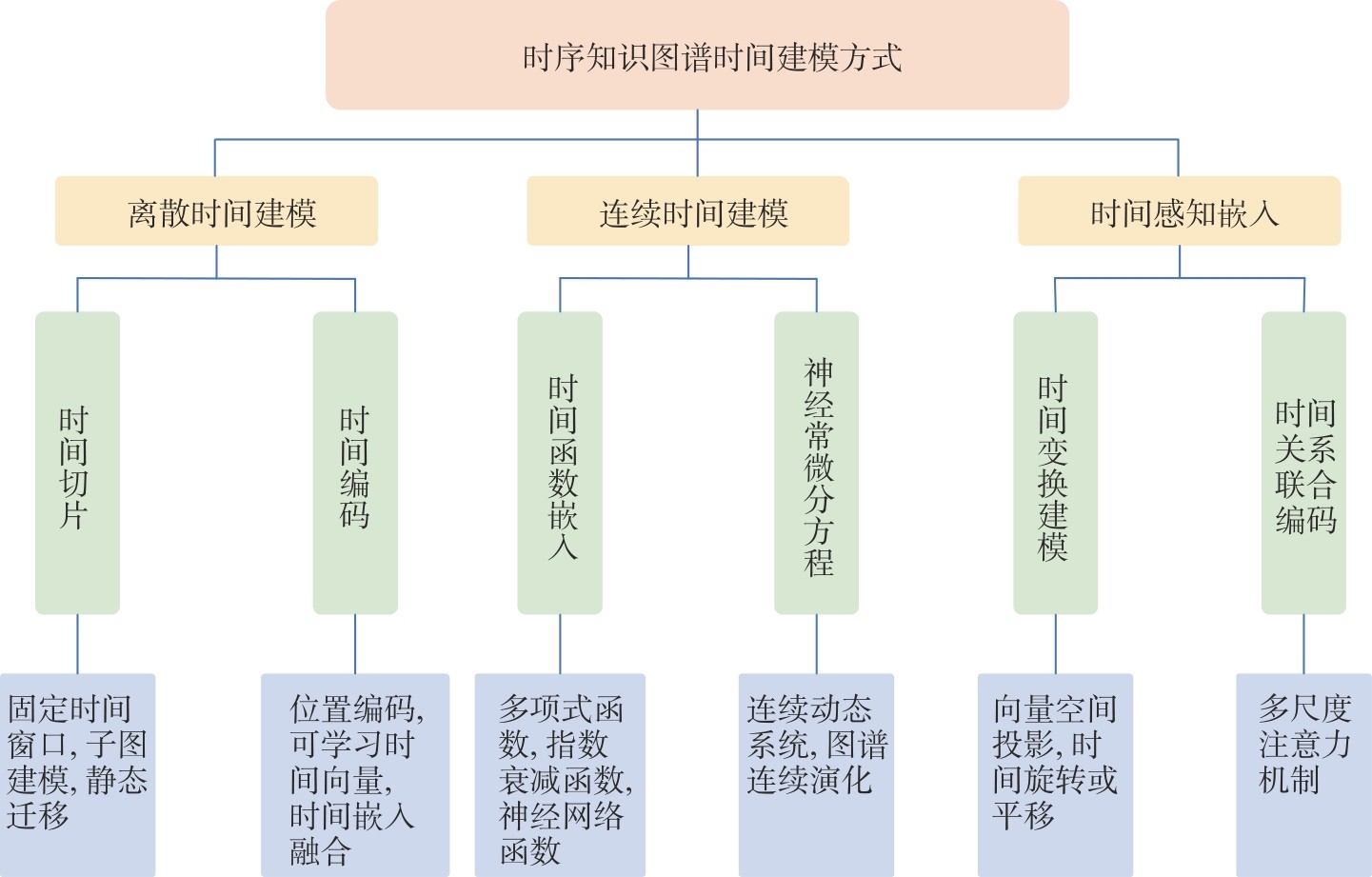
Fig.2
Classification of temporal knowledge graph reasoning tasks"
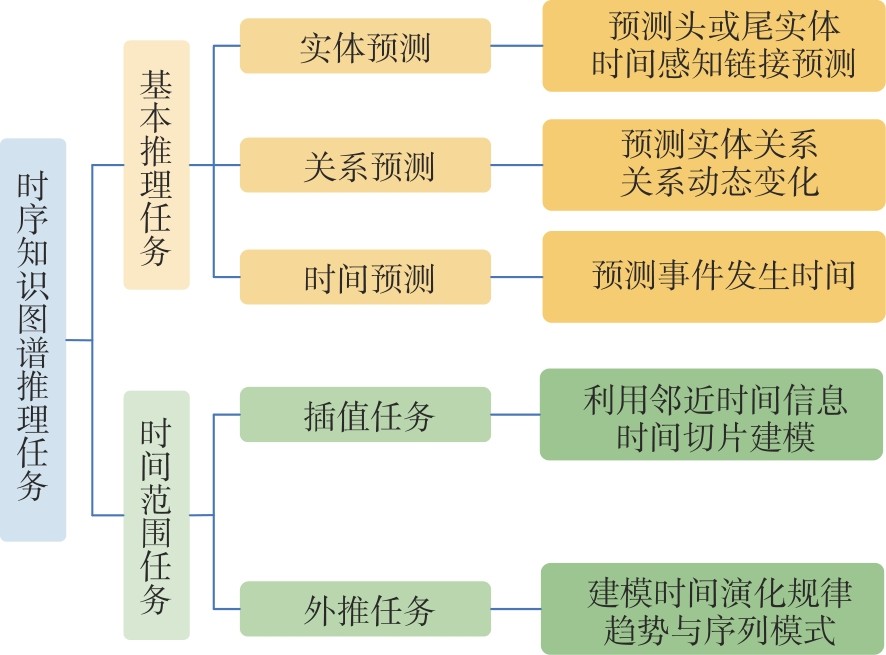
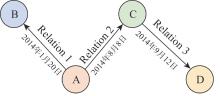
Fig.3
Example of facts in a temporal knowledge graph"
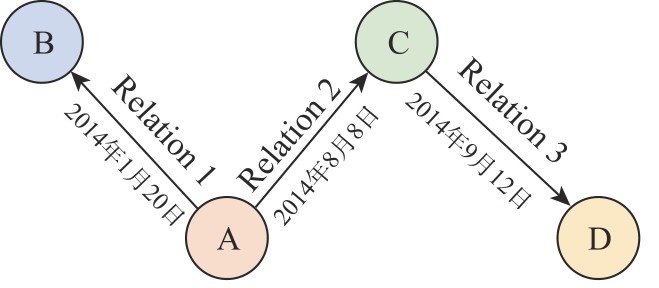
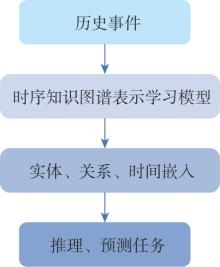
Fig.4
Reasoning process flowchart for temporal knowledge graphs"
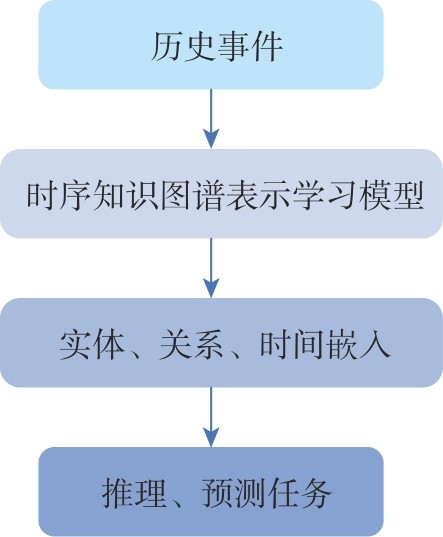
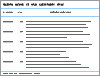
Table 1
Dynamic evolution modeling framework based on historical event sequences"
| 基于历史事件序列的动态演化建模框架 | |
|---|---|
| 输入: | 历史事件序列 |
| 输出: | 未来事件预测或事实补全结果 |
| 1: | 初始化实体、关系和时间嵌入 |
| 2: | 根据时间戳构建按时间排序的事件序列 |
| 3: | 对每个时间步编码事件并更新隐藏状态 |
| 4: | 计算下一事件概率 |
| 5: | 输出预测结果 |
Table 2
Comparison of temporal knowledge graph representation learning methods"
| 方法 | 代表模型 | 时间建模能力 | 结构依赖 建模 | 历史信息 利用 | 计算复 杂度 | 适用场景 | 局限 |
|---|---|---|---|---|---|---|---|
| 时间增强嵌入方法 | TTransE[ HyTE[ | 离散时间建模,显式时间向量 | 基于三元组,较弱 | 无显式历史建模 | 低 | 大规模知识图谱补全 | 表达能力有限,难建模复杂关系和长期依赖 |
| 张量分解 方法 | T-SimplE[ T-ComplEx[ | 时间与关系联合建模 | 隐式多关系建模,适中 | 以静态建模为主 | 较高 | 复杂关系模式建模 | 计算复杂度高,对稀疏数据较敏感 |
| 图神经网络 方法 | RE-GCN[ TiRGN[ | 离散或连续时间建模(结合RNN、时间编码) | 显式图结构建模,较强 | 部分历史融合 | 高 | 能利用图结构信息,表达能力强 | 计算开销大,大规模动态图训练困难 |
| 基于历史序列的动态演化方法 | Know-Evolve[ RE-NET[ CyGNet[ | 连续时间,事件驱动建模 | 部分结合图结构,适中 | 显式历史依赖建模 | 较高 | 事件预测与时间推理 | 历史序列长时计算开销大,易信息衰减 |
Table 3
Dataset statistics"
| 数据集 | 实体数 | 关系数 | 训练集 | 验证集 | 测试集 | 时间戳 | 时间间隔 |
|---|---|---|---|---|---|---|---|
| ICEWS14 | 7,128 | 230 | 72,826 | 8,941 | 8,963 | 365 | 24hours |
| ICEWS05-15 | 10,488 | 251 | 386,962 | 46,275 | 46,092 | 4,017 | 24hours |
| ICEWS18 | 23,033 | 256 | 373,018 | 45,995 | 49,545 | 365 | 24hours |
| GDELT | 7,691 | 240 | 1,734,399 | 238,765 | 305,241 | 2,975 | 15mins |
| YAGO | 10,623 | 10 | 1,615,40 | 19,523 | 20,026 | 189 | 1year |
| WIKI | 12,554 | 24 | 539,286 | 67,538 | 63,110 | 232 | 1year |
Table 4
Performance comparison of typical temporal knowledge graph embedding models"
| Model | ICEWS14 | ICEWS05-15 | ICEWS18 | |||||||||||
|---|---|---|---|---|---|---|---|---|---|---|---|---|---|---|
| MRR | Hits@1 | Hits@3 | Hits@10 | MRR | Hits@1 | Hits@3 | Hits@10 | MRR | Hits@1 | Hits@3 | Hits@10 | |||
| TTransE[ | 25.5 | 7.4 | - | 60.1 | 27.1 | 8.4 | - | 61.6 | - | - | - | - | ||
| TA-TransE[ | 27.5 | 9.5 | - | 62.5 | 29.9 | 9.6 | - | 66.8 | - | - | - | - | ||
| HyTE[ | 29.7 | 10.8 | 41.6 | 65.5 | 31.6 | 11.6 | 44.5 | 68.1 | - | - | - | - | ||
| ATiSE[ | 55.0 | 43.6 | 62.9 | 75.0 | 51.9 | 37.8 | 60.6 | 79.4 | - | - | - | - | ||
| DistMult[ | 43.9 | 32.3 | - | 67.2 | 45.6 | 33.7 | - | 69.1 | - | - | - | - | ||
| ComplEx[ | 46.7 | 34.7 | 52.7 | 71.6 | 48.1 | 36.2 | 53.5 | 72.9 | - | - | - | - | ||
| T-ComplEx[ | 61.9 | 54.2 | 66.1 | 76.7 | 66.5 | 58.3 | 71.6 | 81.1 | - | - | - | - | ||
| RE-GCN[ | 40.4 | 30.7 | 45.0 | 59.2 | 48.0 | 37.3 | 53.9 | 68.3 | 30.6 | 21.0 | 34.3 | 48.8 | ||
| CENET[ | 39.0 | 29.6 | 43.2 | 57.5 | 42.0 | 32.2 | 47.0 | 60.4 | 27.9 | 18.2 | 31.6 | 47.0 | ||
| TiRGN[ | 44.0 | 33.8 | 49.0 | 63.8 | 50.0 | 39.3 | 56.1 | 70.7 | 33.7 | 23.2 | 37.1 | 54.2 | ||
| RPHF-GNN[ | 42.7 | 31.8 | 45.0 | 63.8 | 46.9 | 35.3 | 53.4 | 68.6 | 31.3 | 20.6 | 35.6 | 52.2 | ||
| RE-NET[ | 38.3 | 28.7 | 41.4 | 54.5 | 43.3 | 33.4 | 47.8 | 63.1 | 28.8 | 19.1 | 32.4 | 47.5 | ||
| CyGNet[ | 35.0 | 25.7 | 39.0 | 53.6 | 36.8 | 26.6 | 41.6 | 56.2 | 24.9 | 15.9 | 28.3 | 42.6 | ||
| CognTKE[ | 46.1 | 36.5 | 51.1 | 64.5 | 53.1 | 42.6 | 59.4 | 72.7 | 35.2 | 25.2 | 39.9 | 54.7 | ||
| [1] | 何巍. 社交网络舆情多模态知识图谱构建框架研究[J]. 情报杂志, 2024, 43(1): 160-166. |
| [2] | 段卓廷, 纪成坤, 张迪, 等. 人工智能驱动的情报实践变革: 知识结构、循证过程与组织形态[J/OL]. 情报杂志, 1-9[2025-12-27]. https://link.cnki.net/urlid/61.1167.G3.20251117.0942.008. |
| [3] | 徐增林, 盛泳潘, 贺丽荣, 等. 知识图谱技术综述[J]. 电子科技大学学报, 2016, 45(4): 589-606. |
| [4] | 刘峤, 李杨, 段宏, 等. 知识图谱构建技术综述[J]. 计算机研究与发展, 2016, 53(3): 582-600. |
| [5] | LEBLAY J, CHEKOL M W. Deriving validity time in knowledge graph[C]// Companion proceedings of the the web conference 2018. 2018: 1771-1776. |
| [6] | SIDIROPOULOS N D, DE LATHAUWER L, FU X, et al. Tensor decomposition for signal processing and machine learning[J]. IEEE Transactions on signal processing, 2017, 65(13): 3551-3582. |
| [7] | HITCHCOCK F L. The expression of a tensor or a polyadic as a sum of products[J]. Journal of Mathematics and Physics, 1927, 6(1-4): 164-189. |
| [8] | HAN Z, DING Z, MA Y, et al. Learning neural ordinary equations for forecasting future links on temporal knowledge graphs[C]// Proceedings of the 2021 conference on empirical methods in natural language processing. 2021: 8352-8364. |
| [9] | DASGUPTA S S, RAY S N, TALUKDAR P. Hyte: Hyperplane-based temporally aware knowledge graph embedding[C]// Proceedings of the 2018 conference on empirical methods in natural language processing. 2018: 2001-2011. |
| [10] | GARCÍA-DURÁN A, DUMANČIĆ S, NIEPERT M. Learning sequence encoders for temporal knowledge graph completion[C]// Proceedings of the 2018 conference on empirical methods in natural language processing. 2018: 4816-4821. |
| [11] | GONG X, QIN J, CHAI H, et al. Temporal-relational matching network for few-shot temporal knowledge graph completion[C]//International conference on database systems for advanced applications. Cham: Springer Nature Switzerland, 2023: 768-783. |
| [12] | 王俞涵, 陈子阳, 赵翔, 等. 时序知识图谱表示与推理的研究进展与趋势[J]. 软件学报, 2024, 35(8): 3923-3951. |
| [13] | LIANG K, MENG L, LIU M, et al. A survey of knowledge graph reasoning on graph types: Static, dynamic, and multi-modal[J]. IEEE Transactions on Pattern Analysis and Machine Intelligence, 2024, 46(12): 9456-9478. |
| [14] | 沈英汉, 江旭晖, 王元卓, 等. 时态知识图谱的推理研究综述[J]. 计算机学报, 2023, 46(6): 1272-1301. |
| [15] | WANG J, WANG B, QIU M, et al. A survey on temporal knowledge graph completion: Taxonomy, progress, and prospects[J]. arXiv preprint arXiv:2308. 02457, 2023. |
| [16] | XU C, NAYYERI M, ALKHOURY F, et al. Temporal knowledge graph embedding model based on additive time series decomposition[J]. arXiv preprint arXiv:1911.07893, 2019. |
| [17] | XU C, NAYYERI M, ALKHOURY F, et al. TeRo: A time-aware knowledge graph embedding via temporal rotation[C]// Proceedings of the 28th International Conference on Computational Linguistics. 2020: 1583- 1593. |
| [18] | SADEGHIAN A, ARMANDPOUR M, COLAS A, et al. Chronor: Rotation based temporal knowledge graph embedding[C]// Proceedings of the AAAI conference on artificial intelligence. 2021, 35(7): 6471-6479. |
| [19] | NICKEL M, TRESP V, KRIEGEL H P. A three-way model for collective learning on multi-relational data[C]// Icml. 2011, 11(10.5555): 3104482-3104584. |
| [20] | YANG B, YIH W, HE X, et al. Embedding entities and relations for learning and inference in knowledge bases[J]. arXiv preprint arXiv:1412.6575, 2014. |
| [21] | TROUILLON T, WELBL J, RIEDEL S, et al. Complex embeddings for simple link prediction[C]// International conference on machine learning. PMLR, 2016: 2071-2080. |
| [22] | KAZEMI S M, POOLE D. Simple embedding for link prediction in knowledge graphs[J]. Advances in Neural Information Processing Systems, 2018, 31. |
| [23] | LIN L, SHE K. Tensor decomposition-based temporal knowledge graph embedding[C]// 2020 IEEE 32nd International conference on tools with artificial intelligence (ICTAI). IEEE, 2020: 969-975. |
| [24] | LACROIX T, OBOZINSKI G, USUNIER N. Tensor decompositions for temporal knowledge base completion[J]. arXiv preprint arXiv:2004.04926, 2020. |
| [25] | SHAO P, ZHANG D, YANG G, et al. Tucker decomposition-based temporal knowledge graph completion[J]. Knowledge-Based Systems, 2022, 238: 107841. |
| [26] | BALAŽEVIĆ I, ALLEN C, HOSPEDALES T. Tucker: Tensor factorization for knowledge graph completion[C]// Proceedings of the 2019 conference on empirical methods in natural language processing and the 9th international joint conference on natural language processing (EMNLP-IJCNLP). 2019: 5185-5194. |
| [27] | CAI B, XIANG Y, GAO L, et al. Temporal knowledge graph completion: A survey[J]. arXiv preprint arXiv:2201.08236, 2022. |
| [28] | LI Z, JIN X, LI W, et al. Temporal knowledge graph reasoning based on evolutional representation learning[C]// Proceedings of the 44th international ACM SIGIR conference on research and development in information retrieval. 2021: 408-417. |
| [29] | XU Y, OU J, XU H, et al. Temporal knowledge graph reasoning with historical contrastive learning[C]// Proceedings of the AAAI conference on artificial intelligence. 2023, 37(4): 4765-4773. |
| [30] | LI Y, SUN S, ZHAO J. Tirgn: Time-guided recurrent graph network with local-global historical patterns for temporal knowledge graph reasoning[C]// IJCAI. 2022: 2152-2158. |
| [31] | MINGCONG S, ZHU C, ZHANG D, et al. Multi-granularity history and entity similarity learning for temporal knowledge graph reasoning[C]// Proceedings of the 2024 Conference on Empirical Methods in Natural Language Processing. 2024: 5232-5243. |
| [32] | DENG S, RANGWALA H, NING Y. Dynamic knowledge graph based multi-event forecasting[C]// Proceedings of the 26th ACM SIGKDD international conference on knowledge discovery & data mining. 2020: 1585-1595. |
| [33] | XU C, SU F, LEHMANN J. Time-aware graph neural network for entity alignment between temporal knowledge graphs[C]// Proceedings of the 2021 conference on empirical methods in natural language processing. 2021: 8999-9010. |
| [34] | FENG S, YE Z, LIU Q, et al. RPHF-GNN: Recurrent perception of history-future graph neural networks for temporal knowledge graph reasoning[J]. IEEE Access, 2025. |
| [35] | CHO K, VAN MERRIËNBOER B, GULÇEHRE Ç, et al. Learning phrase representations using RNN encoder-decoder for statistical machine translation[C]// Proceedings of the 2014 conference on empirical methods in natural language processing (EMNLP). 2014: 1724-1734. |
| [36] | TRIVEDI R, DAI H, WANG Y, et al. Know-evolve: Deep temporal reasoning for dynamic knowledge graphs[C]// international conference on machine learning. PMLR, 2017: 3462-3471. |
| [37] | JIN W, QU M, JIN X, et al. Recurrent event network: Autoregressive structure inferenceover temporal knowledge graphs[C]// Proceedings of the 2020 conference on empirical methods in natural language processing (EMNLP). 2020: 6669-6683. |
| [38] | ZHANG M, XIA Y, LIU Q, et al. Learning long-and short-term representations for temporal knowledge graph reasoning[C]// Proceedings of the ACM web conference 2023. 2023: 2412-2422. |
| [39] | ZHU C, CHEN M, FAN C, et al. Learning from history: Modeling temporal knowledge graphs with sequential copy-generation networks[C]// Proceedings of the AAAI conference on artificial intelligence. 2021, 35(5): 4732-4740. |
| [40] | LI Z, GUAN S, JIN X, et al. Complex evolutional pattern learning for temporal knowledge graph reasoning[C]//Proceedings of the 60th annual meeting of the association for computational linguistics (volume 2: short papers). 2022: 290-296. |
| [41] | LI Z, JIN X, GUAN S, et al. Search from history and reason for future: Two-stage reasoning on temporal knowledge graphs[C]//Proceedings of the 59th annual meeting of the association for computational linguistics and the 11th international joint conference on natural language processing (volume 1: long papers). 2021: 4732-4743. |
| [42] | SUN H, ZHONG J, MA Y, et al. Timetraveler: Reinforcement learning for temporal knowledge graph forecasting[C]// Proceedings of the 2021 conference on empirical methods in natural language processing. 2021: 8306-8319. |
| [43] | HAN Z, CHEN P, MA Y, et al. Explainable subgraph reasoning for forecasting on temporal knowledge graphs[C]// International conference on learning representations. 2020. |
| [44] | CHEN W, WU Y, WU S, et al. Cogntke: A cognitive temporal knowledge extrapolation framework[C]// Proceedings of the AAAI Conference on Artificial Intelligence. 2025, 39(14): 14815-14823. |
| [45] | JÄGER K. The limits of studying networks via event data: Evidence from the ICEWS dataset[J]. Journal of Global Security Studies, 2018, 3(4): 498-511. |
| [46] | LEETARU K, SCHRODT P A. Gdelt: Global data on events, location, and tone, 1979-2012[C]// ISA annual convention. 2013, 2(4): 1-49. |
| [47] | SUCHANEK F M, KASNECI G, WEIKUM G. Yago: a core of semantic knowledge[C]// Proceedings of the 16th international conference on World Wide Web. 2007: 697-706. |
| [48] | VRANDEČIĆ D, KRÖTZSCH M. Wikidata: a free collaborative knowledgebase[J]. Communications of the ACM, 2014, 57(10): 78-85. |
| [49] | JI S, PAN S, CAMBRIA E, et al. A survey on knowledge graphs: Representation, acquisition, and applications[J]. IEEE Transactions on Neural Networks and Learning Systems, 2021, 33(2): 494-514. |
| [50] | GOEL R, KAZEMI S M, BRUBAKER M, et al. Diachronic embedding for temporal knowledge graph completion[C]// Proceedings of the AAAI conference on artificial intelligence. 2020, 34(04): 3988-3995. |
| [51] | MAVROMATIS C, SUBRAMANYAM P L, IOANNIDIS V N, et al. Tempoqr: temporal question reasoning over knowledge graphs[C]// Proceedings of the AAAI conference on artificial intelligence. 2022, 36(5): 5825-5833. |
| [52] | FENG S, CHEN B, LIU Q, et al. A contrastive learning framework with dual gates and noise awareness for temporal knowledge graph reasoning[J]. Scientific Reports, 2025, 15(1): 18474. |
| [53] | ZHANG Y, KONG X, YE K, et al. Tackling sparse facts for temporal knowledge graph completion[C]// Proceedings of the ACM on Web Conference 2025. 2025: 3561-3570. |
| [1] | JU Zizheng, CHEN Peng, SUI Jinguang, ZHU Longsheng. A Police Incident Prediction Model Based on Multi-Scale Spatio-Temporal Graph Fusion [J]. Frontiers of Data and Computing, 2026, 8(2): 154-170. |
| [2] | ZHANG Boyao, CAO Rongqiang, WAN Meng, SUN Jingqi, WANG Yangang, WANG Jue, ZHAO Yonghua. Design and Implementation of a Platform for Domain Knowledge Graph Construction and Applications [J]. Frontiers of Data and Computing, 2023, 5(3): 111-122. |
| Viewed | ||||||
|
Full text |
|
|||||
|
Abstract |
|
|||||

