Frontiers of Data and Computing ›› 2025, Vol. 7 ›› Issue (6): 55-67.
CSTR: 32002.14.jfdc.CN10-1649/TP.2025.06.006
doi: 10.11871/jfdc.issn.2096-742X.2025.06.006
• Special Issue: Call for Papers for the 40th National Conference on Computer Security • Previous Articles Next Articles
YUAN Zimeng1,2( ),LONG Chun1,2,*(),LI Jing2,YANG Fan2,FU Yuhao2,WEI Jinxia1,2,WAN Wei1,2
Received:2025-08-01
Online:2025-12-20
Published:2025-12-17
YUAN Zimeng, LONG Chun, LI Jing, YANG Fan, FU Yuhao, WEI Jinxia, WAN Wei. Survey of Verification Methods for Delegated Quantum Computation[J]. Frontiers of Data and Computing, 2025, 7(6): 55-67, https://cstr.cn/32002.14.jfdc.CN10-1649/TP.2025.06.006.
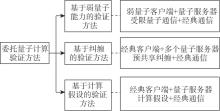
Fig.1
Classification of verification methods for delegated quantum computation"
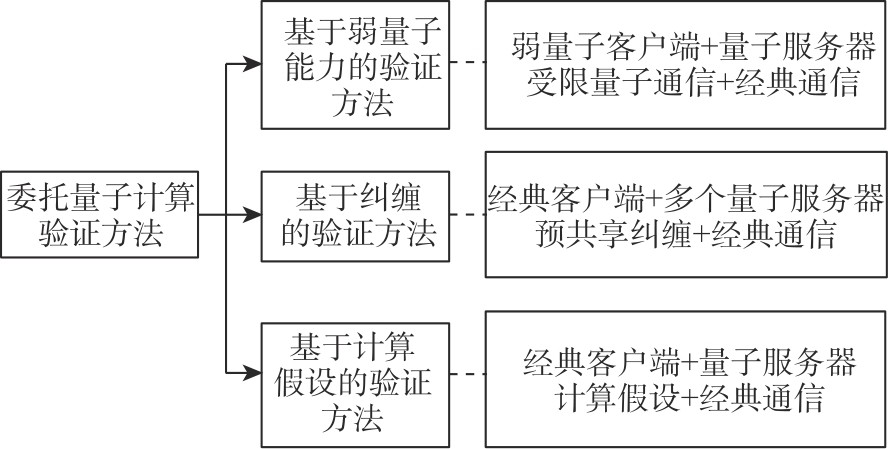
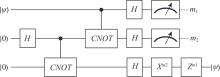
Fig.2
The quantum circuit model"

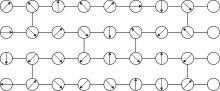
Fig.3
The measurement-based model"
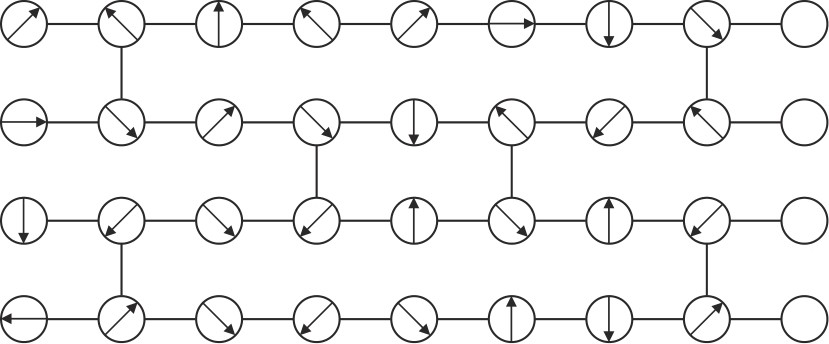
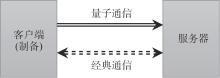
Fig.4
Verifiable delegated quantum computation in the “prepare-and-send” mode"
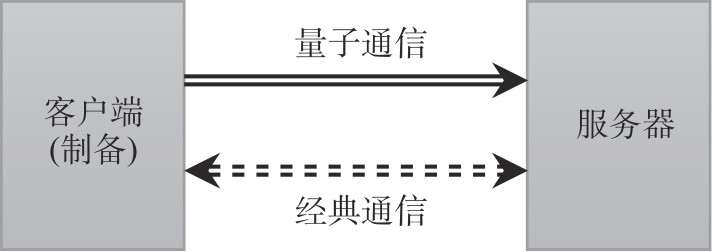
Table 1
Comparison of verification protocols for delegated quantum computation based on traps"
| 验证方案 | 特点 | 容错性 | 资源开销 |
|---|---|---|---|
| Fitzsimons与Kashefi[ | 利用RHG方案[ | 有 | |
| Kashefi与Wallden[ | 利用“三倍点缀”方法插入陷阱 | 无 | 线性级别 |
| Ferracin等人[ | 将资源态的某些量子比特替换为陷阱 | 无 | 线性级别 |
| Leichtle等人[ | 在Ferracin等人方案的基础上引入多数投票机制 | 有 | 线性级别 |
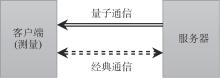
Fig.5
Verifiable delegated quantum computation in the “receive-and-measure” mode"
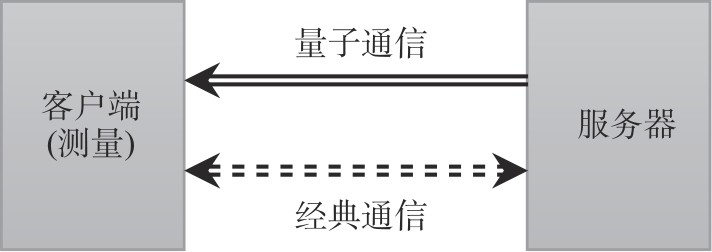
Table 2
Comparison of verification protocols for delegated quantum computation based on stabilizer tests"
| 验证方案 | 验证的资源态类型 | 资源开销 |
|---|---|---|
| Morimae[ | RHG态[ | 指数级别 |
| Hayashi与Morimae[ | 一般图态 | 指数级别 |
| Miller与Miyake[ | Union Jack态(超图态) | 指数级别 |
| Morimae等人[ | 超边度数为2或3的超图态 | |
| Takeuchi与Morimae[ | 一般超图态 | |
| Takeuchi等人[ | 一般超图态 | |
| Zhu与Hayashi[ | 一般超图态 | |
| Zhu与Hayashi[ | 一般量子态 | |
| Tao等人[ | m-染色超图态 | |
| Li等人[ | 一般图态 |

Fig.6
Verifiable delegated quantum computation based on entanglement"
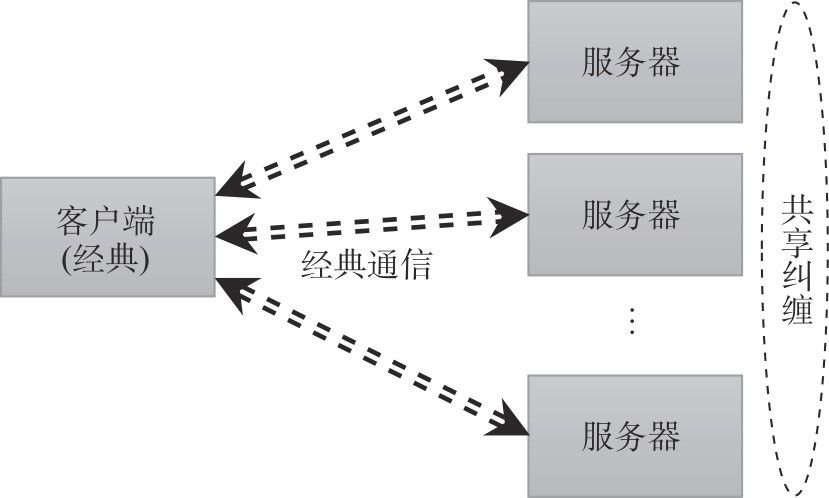
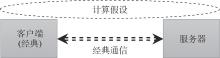
Fig.7
Verifiable delegated quantum computation based on computational assumptions"
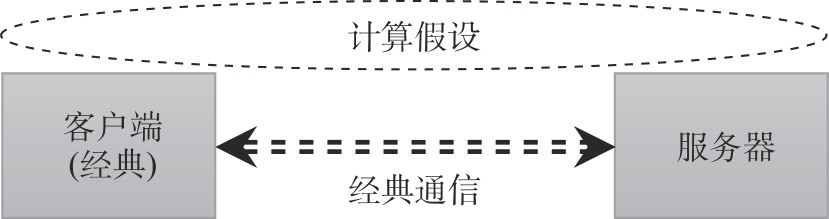
Table 3
Comparison of three types of verification methods for delegated quantum computation"
| 验证方法 | 通信需求 | 客户端能力需求 | 服务器数目 | 计算假设需求 | 安全性 | 效率 | 实现难度 |
|---|---|---|---|---|---|---|---|
| 基于弱量子能力 | 受限量子通信、经典通信 | 弱量子客户端 | 无 | 强 | 高 | 适中 | |
| 基于纠缠 | 经典通信 | 经典客户端 | 无 | 强 | 低 | 困难 | |
| 基于计算假设 | 经典通信 | 经典客户端 | 量子计算难题 | 适中 | 中 | 简单 |
| [1] | SHOR P W. Algorithms for quantum computation: discrete logarithms and factoring[C]// Proceedings of the 35th annual symposium on foundations of computer science, 1994: 124-134. |
| [2] | GROVER L K. A fast quantum mechanical algorithm for database search[C]// Proceedings of the twenty-eighth annual ACM symposium on Theory of computing, 1996: 212-219. |
| [3] |
HARROW A W, HASSIDIM A, LLOYD S. Quantum algorithm for linear systems of equations[J]. Physical Review Letters, 2009, 103(15): 150502.
doi: 10.1103/PhysRevLett.103.150502 |
| [4] | AKTER M S, RODRIGUEZ-CARDENAS J, SHAHRIAR H, et al. Quantum cryptography for enhanced network security: A comprehensive survey of research, developments, and future directions[C]// 2023 IEEE International Conference on Big Data (BigData), 2023: 5408-5417. |
| [5] |
HDAIB M, RAJASEGARAR S, PAN L. Quantum deep learning-based anomaly detection for enhanced network security[J]. Quantum Machine Intelligence, 2024, 6(1): 26.
doi: 10.1007/s42484-024-00163-2 |
| [6] | SILVER D, PATEL T, RANJAN A, et al. SLIQ: quantum image similarity networks on noisy quantum computers[C]// Proceedings of the AAAI Conference on Artificial Intelligence, 2023: 9846-9854. |
| [7] | FAN Z, ZHANG J, ZHANG P, et al. Quantum-inspired neural network with runge-kutta method[C]// Proceedings of the AAAI Conference on Artificial Intelligence, 2024: 17977-17984. |
| [8] |
QU Z, ZHANG Z, ZHENG M. A quantum blockchain-enabled framework for secure private electronic medical records in Internet of Medical Things[J]. Information Sciences, 2022, 612: 942-958.
doi: 10.1016/j.ins.2022.09.028 |
| [9] | SARAIVA A A, DA SILVA J P O, SOUSA J V M, et al. Incorporating an Intelligent System Based on a Quantum Algorithm into Predictive Analysis for Screening COVID-19 Patients[C]// Proceedings of the 17th International Joint Conference on Biomedical Engineering Systems and Technologies - BIODEVICES, 2024: 111-116. |
| [10] | BIESNER D, GERLACH T, BAUCKHAGE C, et al. Solving subset sum problems using quantum inspired optimization algorithms with applications in auditing and financial data analysis[C]// 2022 21st IEEE International Conference on Machine Learning and Applications (ICMLA), 2022: 903-908. |
| [11] | CHOU Y H, LAI Y T, TONG Y F, et al. A Quantum-Inspired Multi-objective Portfolio Strategy Based on Trend Ratio Model in Global Financial Network[C]// 2024 IEEE Congress on Evolutionary Computation (CEC), 2024: 1-8. |
| [12] |
CHILDS A M. Secure assisted quantum computation[J]. Quantum Information and Computation, 2005, 5(6): 456-466.
doi: 10.26421/QIC |
| [13] |
GHEORGHIU A, KAPOURNIOTIS T, KASHEFI E. Verification of quantum computation: An overview of existing approaches[J]. Theory of computing systems, 2019, 63: 715-808.
doi: 10.1007/s00224-018-9872-3 |
| [14] | NIELSEN M A, CHUANG I L. Quantum computation and quantum information[M]// Cambridge, UK: Cambridge university press, 2010: 80-96. |
| [15] |
RAUSSENDORF R, BROWNE D E, BRIEGEL H J. Measurement-based quantum computation on cluster states[J]. Physical Review A, 2003, 68(2): 022312.
doi: 10.1103/PhysRevA.68.022312 |
| [16] | BRUZEWICZ C D, CHIAVERINI J, MCCONNELL R, et al. Trapped-ion quantum computing: Progress and challenges[J]. Applied physics reviews, 2019, 6(2), 021314. |
| [17] |
GAO D, FAN D, ZHA C, et al. Establishing a new benchmark in quantum computational advantage with 105-qubit Zuchongzhi 3.0 processor[J]. Physical Review Letters, 2025, 134(9): 090601.
doi: 10.1103/PhysRevLett.134.090601 |
| [18] | BRIEGEL H J, BROWNE D E, DÜR W, et al. Measurement-based quantum computation[J]. Nature Phy-sics, 2009, 5(1): 19-26. |
| [19] | AGHAEE Rad H, AINSWORTH T, ALEXANDER R N, et al. Scaling and networking a modular photonic quantum computer[J]. Nature, 2025, 638(8052): 1-8. |
| [20] | BARNUM H, CRÉPEAU C, GOTTESMAN D, et al. Authentication of quantum messages[C]// Proceedin-gs of the 43rd Annual IEEE Symposium on Foundations of Computer Science, 2002: 449-458. |
| [21] | AHARONOV D, BEN-OR M, EBAN E. Interactive Proofs for Quantum Computations[J]. arXiv preprint arXiv:0810.5375, 2008. |
| [22] | AHARONOV D, BEN-OR M, EBAN E, et al. Interactive proofs for quantum computations[J]. arXiv preprint arXiv:1704.04487, 2017. |
| [23] |
FITZSIMONS J F, KASHEFI E. Unconditionally verifiable blind quantum computation[J]. Physical Review A, 2017, 96(1): 012303.
doi: 10.1103/PhysRevA.96.012303 |
| [24] | RAUSSENDORF R, HARRINGTON J, GOYAL K. A fault-tolerant one-way quantum computer[J]. Ann-als of physics, 2006, 321(9): 2242-2270. |
| [25] |
KASHEFI E, WALLDEN P. Optimised resource construction for verifiable quantum computation[J]. Journal of Physics A: Mathematical and Theoretical, 2017, 50(14): 145306.
doi: 10.1088/1751-8121/aa5dac |
| [26] |
FERRACIN S, KAPOURNIOTIS T, DATTA A. Reducing resources for verification of quantum computations[J]. Physical Review A, 2018, 98(2): 022323.
doi: 10.1103/PhysRevA.98.022323 |
| [27] |
LEICHTLE D, MUSIC L, KASHEFI E, et al. Verifying BQP computations on noisy devices with minimal overhead[J]. PRX Quantum, 2021, 2(4): 040302.
doi: 10.1103/PRXQuantum.2.040302 |
| [28] | BROADBENT A. How to Verify a Quantum Computation[J]. Theory of Computing, 2018, 14(1): 1-37. |
| [29] |
ROSSI M, HUBER M, BRUΒ D, et al. Quantum hypergraph states[J]. New Journal of Physics, 2013, 15(11): 113022.
doi: 10.1088/1367-2630/15/11/113022 |
| [30] | GACHECHILADZE M. Quantum hypergraph states and the theory of multiparticle entanglement[D]. Siegen, Germany: Siegen University, 2019. |
| [31] |
MORIMAE T. Verification for measurement-only bli-nd quantum computing[J]. Physical Review A, 2014, 89(6): 060302.
doi: 10.1103/PhysRevA.89.060302 |
| [32] |
HAYASHI M, MORIMAE T. Verifiable measurement-only blind quantum computing with stabilizer testing[J]. Physical Review Letters, 2015, 115(22): 220502.
doi: 10.1103/PhysRevLett.115.220502 |
| [33] | MILLER J, MIYAKE A. Hierarchy of universal entanglement in 2D measurement-based quantum computation[J]. npj Quantum Information, 2016, 2(1): 1-6. |
| [34] |
MORIMAE T, TAKEUCHI Y, HAYASHI M. Verification of hypergraph states[J]. Physical Review A, 2017, 96(6): 062321.
doi: 10.1103/PhysRevA.96.062321 |
| [35] | TAKEUCHI Y, MORIMAE T. Verification of many-qubit states[J]. Physical Review X, 2018, 8(2): 021-060. |
| [36] |
TAKEUCHI Y, MANTRI A, MORIMAE T, et al. Resource-efficient verification of quantum computing using Serfling’s bound[J]. npj Quantum Information, 2019, 5(1): 27.
doi: 10.1038/s41534-019-0142-2 |
| [37] |
ZHU H, HAYASHI M. Efficient verification of hypergraph states[J]. Physical Review Applied, 2019, 12(5): 054047.
doi: 10.1103/PhysRevApplied.12.054047 |
| [38] |
ZHU H, HAYASHI M. Efficient verification of pure quantum states in the adversarial scenario[J]. Physical Review Letters, 2019, 123(26): 260504.
doi: 10.1103/PhysRevLett.123.260504 |
| [39] | TAO H, ZHANG X, SHAO L, et al. Verification of colorable hypergraph states with stabilizer test[J]. Quantum Science and Technology, 2022, 8(1): 015-012. |
| [40] |
LI Z, ZHU H, HAYASHI M. Robust and efficient verification of graph states in blind measurement-based quantum computation[J]. npj Quantum Information, 2023, 9(1): 115.
doi: 10.1038/s41534-023-00783-9 |
| [41] |
DRMOTA P, NADLINGER D P, MAIN D, et al. Verifiable blind quantum computing with trapped ions and single photons[J]. Physical Review Letters, 2024, 132(15): 150604.
doi: 10.1103/PhysRevLett.132.150604 |
| [42] |
BELL J S. On the einstein podolsky rosen paradox[J]. Physics Physique Fizika, 1964, 1(3): 195-200.
doi: 10.1103/PhysicsPhysiqueFizika.1.195 |
| [43] |
CLAUSER J F, HORNE M A, Shimony A, et al. Proposed experiment to test local hidden-variable theories[J]. Physical Review Letters, 1969, 23(15): 880.
doi: 10.1103/PhysRevLett.23.880 |
| [44] |
GHIO M, MALPETTI D, ROSSI M, et al. Multipartite entanglement detection for hypergraph states[J]. Journal of Physics A: Mathematical and Theoretical, 2017, 51(4): 045302.
doi: 10.1088/1751-8121/aa99c9 |
| [45] | LIU N, DEMARIE T F, TAN S H, et al. Client-friendly continuous-variable blind and verifiable quantum computing[J]. Physical Review A, 2019, 100(6): 062-309. |
| [46] |
XU Q, TAN X, HUANG R, et al. Verification of blind quantum computation with entanglement witnesses[J]. Physical Review A, 2021, 104(4): 042412.
doi: 10.1103/PhysRevA.104.042412 |
| [47] | MORIMAE T, FITZSIMONS J F. Post hoc verification with a single prover[J]. arXiv preprint arXiv:1603.06046, 2016. |
| [48] |
HANGLEITER D, KLIESCH M, SCHWARZ M, et al. Direct certification of a class of quantum simulations[J]. Quantum Science and Technology, 2017, 2(1): 015004.
doi: 10.1088/2058-9565/2/1/015004 |
| [49] | FITZSIMONS J F, HAJDUŠEK M, MORIMAE T. Post hoc verification of quantum computation[J]. Ph-ysical Review Letters, 2018, 120(4): 040501. |
| [50] | MORIMAE T. Blind quantum computing can always be made verifiable[J]. arXiv preprint arXiv:1803.06624, 2018. |
| [51] |
REICHARDT B W, UNGER F, VAZIRANI U. Classical command of quantum systems[J]. Nature, 2013, 496(7446): 456-460.
doi: 10.1038/nature12035 |
| [52] |
GHEORGHIU A, KASHEFI E, WALLDEN P. Robustness and device independence of verifiable blind quantum computing[J]. New Journal of Physics, 2015, 17(8): 083040.
doi: 10.1088/1367-2630/17/8/083040 |
| [53] | HAJDUŠEK M, PÉREZ-DELGADO C A, FITZSIMONS J F. Device-independent verifiable blind qua-ntum computation[J]. arXiv preprint arXiv:1502.02563, 2015. |
| [54] | COLADANGELO A, GRILO A B, JEFFERY S, et al. Verifier-on-a-leash: new schemes for verifiable delegated quantum computation, with quasilinear resources[C]// Annual International Conference on the Theory and Applications of Cryptographic Techniques, 2019: 247-277. |
| [55] | MCKAGUE M. Interactive proofs for BQP via self-tested graph states[J]. Theory of Computing, 2016, 12(3): 1-42. |
| [56] | FITZSIMONS J, VIDICK T. A multiprover interactive proof system for the local Hamiltonian problem[C]// Proceedings of the 2015 Conference on Innovations in Theoretical Computer Science, 2015: 103-112. |
| [57] | NATARAJAN A, VIDICK T. Robust self-testing of many-qubit states[J]. arXiv preprint arXiv:1610.03574, 2016. |
| [58] | GRILO A B. A Simple Protocol for Verifiable Delegation of Quantum Computation in One Round[C]// 46th International Colloquium on Automata, Languages, and Programming (ICALP 2019), 2019: 28. |
| [59] |
BERNSTEIN D J, LANGE T. Post-quantum cryptography[J]. Nature, 2017, 549(7671): 188-194.
doi: 10.1038/nature23461 |
| [60] | BRAKERSKI Z, CHRISTIANO P, MAHADEV U, et al. A cryptographic test of quantumness and certifiable randomness from a single quantum device[J]. Journal of the ACM (JACM), 2021, 68(5): 1-47. |
| [61] | MAHADEV U. Classical verification of quantum computations[C]// 2018 IEEE 59th Annual Symposium on Foundations of Computer Science (FOCS), 2018: 259-267. |
| [62] | CHIA N H, CHUNG K M, YAMAKAWA T. Classical verification of quantum computations with efficient verifier[C]// Theory of Cryptography Conference, 2020: 181-206. |
| [63] | ALAGIC G, CHILDS A M, GRILO A B, et al. Non-interactive classical verification of quantum computation[C]// Theory of Cryptography Conference, 2020: 153-180. |
| [64] | BARTUSEK J, KALAI Y T, LOMBARDI A, et al. Succinct classical verification of quantum computation[C]// Annual International Cryptology Conferen-ce, 2022: 195-211. |
| [65] | CHUNG K M, LEE Y, LIN H H, et al. Constant-round blind classical verification of quantum sampling[C]// Annual International Conference on the Theory and Applications of Cryptographic Techni-ques, 2022: 707-736. |
| [66] |
XU Q, TAN X, BAO D, et al. Classical verification of quantum measurement for the computational basis and the XY-plane basis[J]. Physical Review A, 2023, 107(5): 052616.
doi: 10.1103/PhysRevA.107.052616 |
| [67] | STRICKER R, CARRASCO J, RINGBAUER M, et al. Towards experimental classical verification of qu-antum computation[J]. Quantum Science and Technology, 2024, 9(2): 02LT01. |
| [68] | GHEORGHIU A, VIDICK T. Computationally-sec-ure and composable remote state preparation[C]// 2019 IEEE 60th Annual Symposium on Foundations of Computer Science (FOCS), 2019: 1024-1033. |
| [69] | ZHANG J. Classical verification of quantum computations in linear time[C]// 2022 IEEE 63rd Annual Sy-mposium on Foundations of Computer Science (FOCS), 2022: 46-57. |
| [70] | BARTUSEK J. Secure quantum computation with classical communication[C]// Theory of Cryptography Conference, 2021: 1-30. |
| [71] |
SHAN R, CHEN X, XU G, et al. Verifiable Multi-Party Universal Blind Quantum Computing in Distributed Networks[J]. Chinese Journal of Electronics, 2021, 30(4): 712-718.
doi: 10.1049/cje2.v30.4 |
| [72] | LI Q, WANG C, ZHU J, et al. Verifiable Multiparty Delegated Quantum Computation[J]. International Journal of Intelligent Systems, 2023, 2023(1): 2662685. |
| [73] |
QUAN J, LI Q, LI L. Verifiable blind quantum computation with identity authentication for multi-type clients[J]. IEEE Transactions on Information Forensics and Security, 2023, 19: 1687-1698.
doi: 10.1109/TIFS.2023.3340859 |
| [74] | KAPOURNIOTIS T, KASHEFI E, LEICHTLE D, et al. Asymmetric quantum secure multi-party computation with weak clients against dishonest majority[J]. Quantum Science and Technology, 2025, 10(2): 025015. |
| No related articles found! |
| Viewed | ||||||
|
Full text |
|
|||||
|
Abstract |
|
|||||

